
 Soyeb Akhtar
Finding the right self study app can save you hundreds of hours of wasted study time. In this guide, we tested and ranked the 7 best self study apps for Indian students — covering free options, competitive exam tools, and smart organizers — so you can pick the one that actually matches your needs and your phone’s storage.

Why Every Indian Student Needs a Self Study App
Let me be straight with you. If you are still relying only on textbooks, coaching notes, and YouTube rabbit holes to prepare for your exams, you are leaving a significant advantage on the table. The right self study app does not just replace a tutor — it actually builds a study system around your weak areas, your schedule, and your specific exam.
Think about what a typical Indian student deals with: board exams, entrance tests, college assignments, limited time, limited money, and an internet connection that dies at 11 PM. A well-chosen self study app addresses all of this — providing structured content, progress tracking, offline access, and doubt-solving — at little to no cost.
According to a 2024 Statista report, over 70% of Indian students now use at least one educational app as part of their exam preparation. The demand is real. The question is: which self study app is actually worth your time?
That is exactly what this guide answers. We analysed competitor content, read through thousands of student reviews on the Play Store, and cross-checked the syllabus coverage of each app — so you do not have to guess.
What Makes a Good Self Study App?
Not every app that markets itself as a “learning platform” is actually built for independent study. Here is what a genuinely useful self study app should have:
- Syllabus alignment: Covers CBSE, ICSE, JEE, NEET, UPSC, or whichever exam you are targeting.
- Works on mid-range Android phones: The average Indian student is not using an iPhone 15. The app must run smoothly on a ₹8,000–₹15,000 Android device.
- Offline access: India’s internet reliability is uneven. Content that works without Wi-Fi is not a luxury — it is a necessity.
- Progress tracking: You should be able to see which chapters you have covered and where your weak spots are.
- Doubt resolution: Getting stuck on a concept at midnight is real. Good apps either have community Q&A or AI-powered doubt solving.
- Price point: Free or genuinely affordable. If the core features are locked behind a ₹5,000/month paywall, it is not a student-first product.
With those criteria in mind, here is our curated list of the 7 best self study apps for students in India right now.
Quick Comparison: All 7 Apps at a Glance
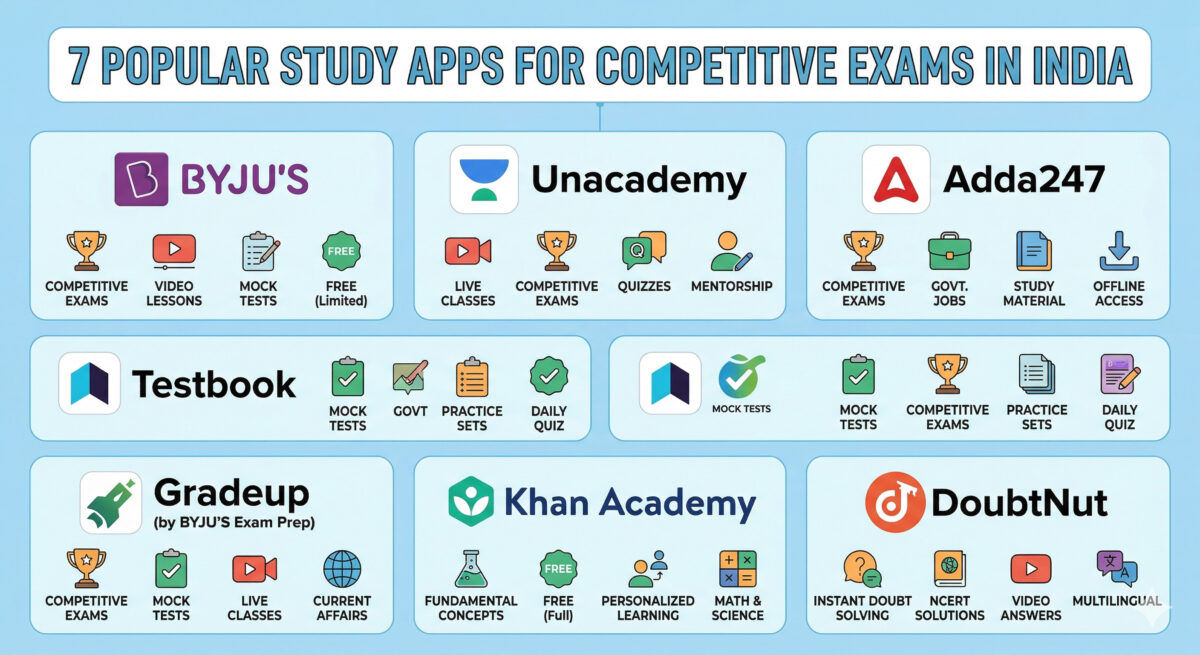
| App | Best For | Price | Offline | Competitive Exams | Our Rating |
|---|---|---|---|---|---|
| Physics Wallah | JEE, NEET, Boards | Mostly Free | ✅ Yes (paid) | ✅ Excellent | ★★★★★ |
| Unacademy | UPSC, JEE, NEET, SSC | Freemium | ✅ Yes (paid) | ✅ Excellent | ★★★★½ |
| Khan Academy | All subjects, self-paced | 100% Free | ⚠️ Limited | ⚠️ Partial | ★★★★★ |
| Doubtnut | Maths, Science doubts | Mostly Free | ❌ No | ✅ Good | ★★★★☆ |
| My Study Life | Planner, schedule | Free | ✅ Yes | ⚠️ Organizer only | ★★★★☆ |
| AnkiDroid | Memorization, revision | Free | ✅ Yes | ✅ Great for theory | ★★★★☆ |
| Notion | Notes, study system | Free (basic) | ✅ Yes | ⚠️ Organizer only | ★★★★☆ |
The 7 Best Self Study Apps for Students India (2026)
If there is one self study app every Indian student should have in 2026, it is Physics Wallah. Started by Alakh Pandey — a teacher who became famous for making JEE-level content available for ₹999 a year instead of ₹1.5 lakh at coaching — PW has since grown into a full-fledged learning platform.
The free version alone includes a massive library of video lectures for Class 6 to 12, JEE Main, JEE Advanced, NEET, and board exams. The explanations are in a mix of Hindi and English, making them significantly more accessible for students from smaller cities and towns where English-medium coaching is not always an option.
What sets PW apart from other self study apps is how it combines video lectures with practice sheets, DPPs (Daily Practice Problems), and mock tests — all structured exam-wise. You do not just watch a video; you actually practice in the same session.
✅ Pros
- Massive free library
- Bilingual (Hindi + English)
- Structured DPPs and mock tests
- Covers boards + competitive exams
- Affordable paid plans (₹999–₹3,000/year)
❌ Cons
- App can be heavy on low-RAM phones
- Offline downloads need paid plan
- Some subjects lack depth beyond Science/Maths
Unacademy built its reputation as India’s largest online learning platform, and for good reason. The app’s free tier alone has thousands of hours of content for UPSC, SSC, JEE, NEET, and state PSC exams — making it a legitimate self study app for aspirants who cannot afford regular coaching.
Where Unacademy really shines is in its UPSC preparation content. Roman Saini, a former IAS officer and co-founder, pioneered a style of teaching that breaks down the vast UPSC syllabus into digestible, structured sessions. For a student self-studying for UPSC — which is arguably the most overwhelming exam in India — this kind of syllabus mapping is genuinely valuable.
The paid Subscription (Unacademy Plus) unlocks live classes, doubt-solving sessions, and downloadable notes. But if you are disciplined, the free content alone can carry you a long way.
✅ Pros
- Excellent UPSC content depth
- Live classes with top educators
- Community & doubt-solving features
- Regular free mock tests
❌ Cons
- Many premium features are paywalled
- App quality varies by educator
- Occasional server issues during live sessions

Khan Academy is the gold standard for free education globally — and it is just as relevant for Indian students as it is for anyone else. The app covers Mathematics from Class 6 to advanced calculus, Science, Economics, History, and even coding — all completely free, forever.
The reason it works so well as a self study app is the way content is broken into bite-sized mastery units. You watch a short video, answer a few questions, and the app identifies whether you’ve understood the concept or whether you need more practice. It does not move you forward until you’ve actually grasped the topic — which is exactly how effective self-study should work.
In 2024, Khan Academy also expanded its India-specific content with CBSE-aligned chapters and Hindi-language content for several subjects, making it significantly more accessible for students in state board schools.
✅ Pros
- Completely free, no hidden charges
- Mastery-based learning system
- CBSE-aligned content available
- Works on low-end devices
❌ Cons
- Not tailored for JEE/NEET advanced level
- Limited offline access
- Competitive exam mock tests absent
Here is a scenario every student knows: it is 10 PM, you are stuck on a maths problem, and there is nobody to ask. Doubtnut was built specifically for this moment.
Open the app, photograph the question with your phone camera, and within seconds you get a step-by-step video solution. The app supports questions from NCERT textbooks, HC Verma, DC Pandey, RD Sharma, and other popular reference books. For JEE and NEET aspirants who are self-studying, this is genuinely a game-changer.
Beyond doubt-solving, Doubtnut has expanded into full courses and practice tests for Class 9–12, JEE, and NEET — most of which are free. The experience is not as polished as PW or Unacademy, but for on-demand, middle-of-the-night concept clarity, nothing else comes close.
✅ Pros
- Photo-based doubt solving is brilliant
- Huge question bank
- Free for most core features
- Great for Maths and Science
❌ Cons
- Weaker for Commerce and Humanities
- Ads can be disruptive
- No offline mode
Self-studying without a plan is just reading. My Study Life converts your syllabus into a structured, trackable schedule — and it does it better than any other free planner app available today.
You add your subjects, class schedule, assignment deadlines, and exam dates. The app builds a week-view calendar around all of it and sends you revision reminders as exams approach. It even accounts for rotating class timetables, which is common in Indian schools and coaching centres.
What makes this a particularly smart self study app is the revision scheduling feature. Based on your exam dates, it automatically suggests when you should revise each topic — taking the mental load of planning completely off your plate. This is especially useful during the chaotic pre-board months when you have 10 subjects competing for attention.
✅ Pros
- Smart revision scheduling
- Works offline
- Syncs across phone and laptop
- Free with no annoying ads
❌ Cons
- No content or video lessons
- Interface feels slightly outdated
AnkiDroid is the unsung hero of serious self-study — used by medical students worldwide to memorize thousands of anatomy terms and drug names, and equally powerful for Indian students preparing for theory-heavy papers in Biology, History, Economics, and Law.
The app is based on a technique called spaced repetition — which is the scientifically proven method of reviewing information at increasing intervals to move it from short-term to long-term memory. Instead of re-reading your notes ten times the night before an exam, AnkiDroid shows you a flashcard right when you are about to forget it — making every revision session far more efficient.
You create your own flashcard decks (or download pre-made NEET, UPSC, or JEE decks from the community), and the app handles the rest. It is not glamorous, but if retention is your problem, nothing else on this list comes close. And it is completely free — offline included.
✅ Pros
- Scientifically proven spaced repetition
- Completely free and offline
- Huge community deck library
- Works on the most basic Android phones
❌ Cons
- Steep initial learning curve
- Requires you to build or find good decks
- Old-fashioned interface
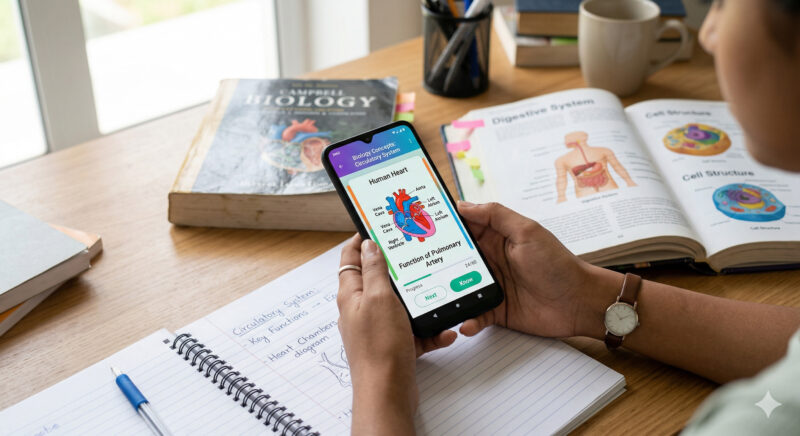
Notion is not a teaching app — and that is precisely what makes it different from everything else on this list. It is a workspace where you build your own self-study system: notes, weekly schedules, topic trackers, syllabus checklists, and resource libraries — all in one place.
Think of it this way: Physics Wallah gives you the lecture, My Study Life gives you the schedule, but Notion is the place where everything comes together. Students who are serious about self-study use Notion to create a “second brain” — a structured digital space where they organize their notes from every app, every textbook, every class.
Notion is free for individual students. The student plan (linked to your college email) is free with additional features. For students preparing for UPSC or CA exams — where the volume of study material is enormous — having everything in one searchable, organized workspace can genuinely change how you study.
You may also want to pair Notion with our guide on the best free note-taking apps for students for additional options.
✅ Pros
- Extremely flexible and customizable
- Free for students
- Syncs across all devices
- Great for UPSC and CA syllabus management
❌ Cons
- High learning curve initially
- Requires effort to set up properly
- Offline sync can be slow on poor connections
Best Self Study App Free Options (No Hidden Costs)
Worried about paying for apps? You do not have to. Here are the apps from our list that are genuinely, completely free — with no features locked behind subscriptions:
- Khan Academy — 100% free, forever. No subscription, no trial period.
- AnkiDroid — Free on Android (the iOS version, AnkiMobile, is paid, but AnkiDroid for Android is free).
- My Study Life — Free planner, no ads, no paywalled features.
- Doubtnut — Core doubt-solving is free. Full courses are freemium.
- Notion — Free plan is generous for individual students. Student plan is free with a college email.
Start with Khan Academy for content + My Study Life for planning + AnkiDroid for revision. This three-app combination costs ₹0 and covers most of what a serious self-studying student needs.
For a deeper breakdown of study tools that do not cost money, check out our guide on best time management tools for students — several of which are free and work beautifully alongside a self study app.
Best Self Study App for Competitive Exams India
Competitive exam preparation is a different beast. You need structured content, a timed practice environment, and peer comparison — not just video lectures. Here is how the apps stack up for India’s major competitive exams:
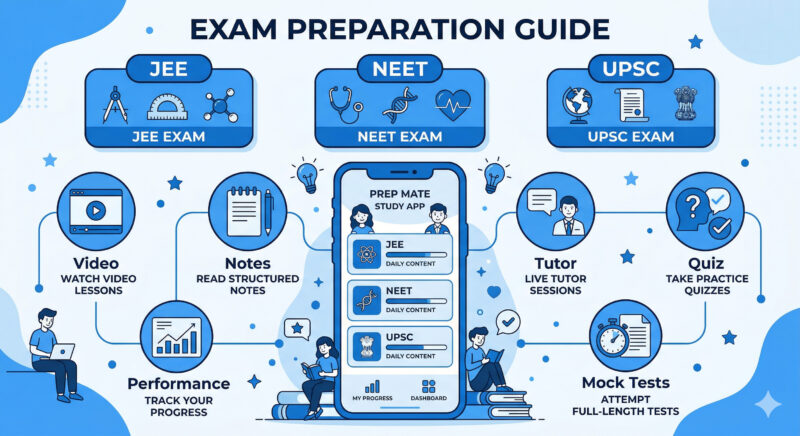
| Exam | Best Self Study App | Why It Works |
|---|---|---|
| JEE Main / Advanced | Physics Wallah | Structured DPPs, chapter-wise tests, Alakh Pandey’s Physics lectures |
| NEET | Physics Wallah + AnkiDroid | PW for lectures, AnkiDroid for Biology memorization |
| UPSC CSE | Unacademy + Notion | Unacademy for structured GS prep, Notion for notes organization |
| SSC CGL / CHSL | Unacademy | Dedicated SSC courses, live tests, tier-wise preparation |
| CBSE Boards (10, 12) | Khan Academy + Physics Wallah | Khan for concept clarity, PW for practice sets |
| CA Foundation | Notion + AnkiDroid | Notion for organizing vast syllabus, AnkiDroid for Accounts definitions |
If you want to go deeper on how to structure your competitive exam preparation, our post on time management skills for students walks through exactly how to build a daily schedule that actually works.
Expert Tips: How to Use a Self Study App Effectively
Downloading a self study app is the easy part. Most students install three or four, use them enthusiastically for a week, and then slowly drift back to scrolling Instagram during study hours. Here is how to actually make these tools work:
For a deeper framework on building a consistent study habit around these apps, read our guide on best time management tips for students.
Common Mistakes Students Make with Self Study Apps
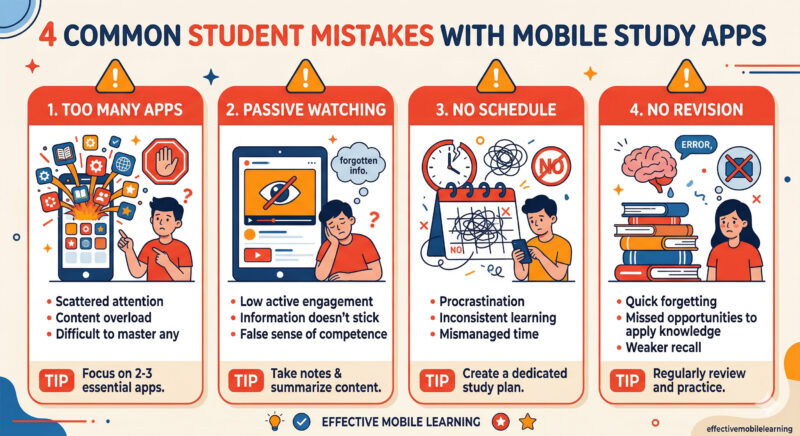
These are the most common patterns we see in students who use self study apps for months without any real improvement in their scores.
Mistake 1: Treating watching as learning. Passive video consumption gives you the feeling of studying without the actual outcome. If you cannot explain what you just watched without looking at your phone, you have not learned it. Pause every 10 minutes and summarize the concept in your own words.
Mistake 2: Downloading too many apps and using none well. App-hopping is just procrastination with a productive disguise. Having six study apps on your phone and rotating between them is not a system — it is a distraction. Pick two and commit for at least three weeks before switching.
Mistake 3: Never attempting the practice tests. Video content without practice is like reading a swimming manual without going near water. The tests inside Physics Wallah, Unacademy, and Khan Academy are where the real learning happens. Skipping them entirely is the single biggest mistake self-studying students make.
Mistake 4: No revision system. Watching a video once and moving on is the fastest path to forgetting everything. Use AnkiDroid or even a simple notebook to build a revision system. Without it, your study sessions stack up with no retention.
Also see our guide on best study apps for students 2026 — it covers additional tools and mistakes to avoid when building your study stack.
Frequently Asked Questions (FAQs)
Conclusion: The Right Self Study App Is the One You Actually Use
There is no single perfect self study app — the right choice depends entirely on which exam you are preparing for, how disciplined you are, and how much you can spend. But from everything we reviewed, here is the honest summary:
- If you are preparing for JEE or NEET, start with Physics Wallah. It covers more ground, for free, than most paid coaching apps.
- If you are a UPSC aspirant, Unacademy paired with Notion for notes is the strongest combination.
- If you want the best free self study app for school subjects, Khan Academy with My Study Life is a zero-cost powerhouse.
- If memorization is your biggest struggle, add AnkiDroid to whatever else you are using.
The biggest thing to remember: an app is a tool, not a teacher. It still requires you to show up consistently, do the practice problems, and build a real revision habit. With that discipline in place, the apps on this list will genuinely change how you study.
📚 Ready to Study Smarter?
Explore more guides from Learnox to build your complete student productivity system — all free, all built for Indian students.


I found this list really helpful! I’m excited to try out some of these apps for my study sessions. It’s great to see options tailored for Indian students. Thanks for sharing!
Great post! I found the insights on the self-study apps really helpful. I’m particularly interested in how the top recommendations cater to Indian students’ needs. Looking forward to trying them out!
Great list! I’m particularly interested in the app that focuses on interactive learning. It’s exciting to see how technology is evolving in education. Looking forward to trying these out!
Great list! I’m especially interested in how these apps can help with my exam preparation. Are there any features you recommend looking for in a self-study app?
This post is incredibly helpful! I never realized how many great self-study apps are available specifically for students in India. I’m particularly interested in checking out the app that incorporates gamification; it sounds like a fun way to learn. Thanks for sharing these recommendations!
Great list! I’m especially excited to try out the recommendations for interactive learning. It’s fascinating to see how technology is evolving to support self-study in India. Looking forward to seeing how these apps grow in 2026!
Great list! I especially love the recommendations for apps tailored to the Indian education system. It’s exciting to see how technology is evolving to support self-study. I’ll definitely be trying out a few of these in preparation for my exams!
Great insights! I’m always on the lookout for effective self-study apps, and your list for 2026 looks promising. I particularly like the emphasis on Indian students’ needs. Can’t wait to try some of these out and see how they improve my study routine!
Great list! I’m particularly interested in the app that helps with time management. It’s so essential for us students to stay organized while studying. Can’t wait to try some of these out!