
 Soyeb Akhtar
Effective tips for time management can change your entire academic life. Whether you are preparing for competitive exams, juggling college assignments, or trying to build side skills — this guide gives you 15 real, tested strategies that actually work for Indian students. No fluff, no generic advice.
Let’s be honest. Most students do not have a time management problem. They have a priority clarity problem. And the two are very different things.
You probably already know that tips for time management exist. You may have even read a few. But knowing is different from doing — and doing is different from doing it consistently under exam pressure, WhatsApp notifications, and the constant temptation of a four-hour YouTube rabbit hole.
This guide is not a motivational pep talk. It is a practical, step-by-step resource built around what actually helps Indian students manage their time without burning out. Every strategy here is something you can start today — not next semester, not after the holidays.
Why Time Management Matters for Students (More Than You Think)
According to the American Psychological Association, academic pressure and poor time management are among the top causes of student stress and burnout. In India, this is even more pronounced — students often juggle coaching classes, college attendance, self-study, and family expectations simultaneously.
The problem is rarely a lack of effort. Most students who struggle are working hard. They are just not working in a structured way. Without a system, time slips through the cracks between tasks. Suddenly it is 11 pm, the assignment is due tomorrow, and panic sets in.
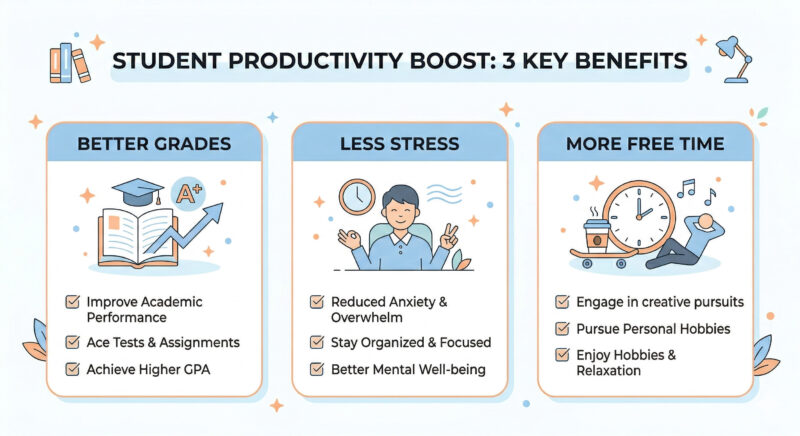
Good time management fixes this. It does not make you robotic. It actually creates more free time — because you stop wasting hours on indecision, rework, and anxiety.
The 15 Best Tips for Time Management for Students
1. Build a Weekly Study Plan Before the Week Begins
Every Sunday evening, sit down for 20–30 minutes and map out the entire coming week. Write down every deadline, exam date, class schedule, and personal commitment. Then assign study slots to fill the gaps.
This one habit alone can reduce your Sunday-night anxiety by at least half. When you already know what Monday looks like before it starts, you show up to your desk with a clear head instead of spending the first 40 minutes deciding what to do.
Think of it like a pilot filing a flight plan. The plane does not take off and then figure out the route. Neither should your study week.
2. Use the Pomodoro Technique to Study Smarter, Not Longer
The Pomodoro Technique involves studying in focused 25-minute sessions, followed by a 5-minute break. After four sessions, take a longer 20–30 minute break. This rhythm keeps your brain fresh and prevents the mental fatigue that comes from long, unbroken study marathons.
Francesco Cirillo developed this method in the late 1980s using a tomato-shaped kitchen timer — “pomodoro” is Italian for tomato. What started as a student’s personal hack has since become one of the most widely used productivity methods in the world.
The key is full commitment during each 25-minute session. Phone goes face-down. Notifications off. One task only. No multitasking.
3. Prioritise With the Eisenhower Matrix
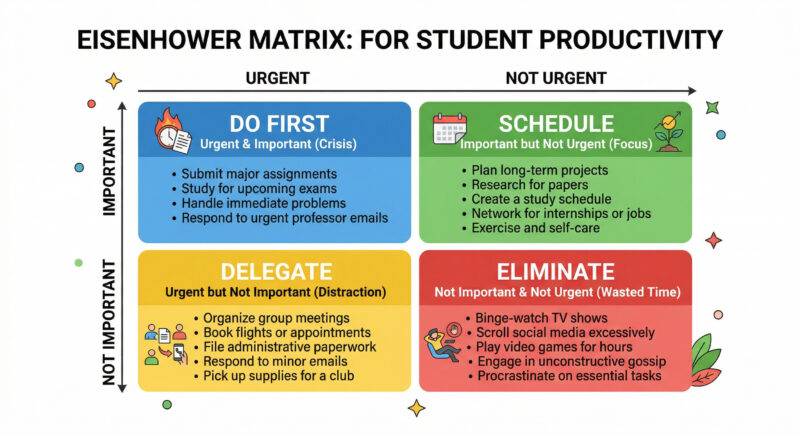
Not all tasks deserve equal attention. The Eisenhower Matrix helps you sort everything on your to-do list into four boxes: Urgent + Important (do first), Important + Not Urgent (schedule it), Urgent + Not Important (delegate or minimise), and Neither (eliminate).
Most students live entirely in the “Urgent + Important” box — always firefighting, never planning. The real productivity shift happens when you carve out regular time for the “Important but Not Urgent” box — things like revision, skill-building, and health — before they become emergencies.
A simple example: reviewing yesterday’s class notes is not urgent, but doing it consistently every evening is one of the most important habits a student can build. Wait until exam week to revisit three months of notes, and it becomes an urgent crisis.
4. Time Block Your Day Instead of Working From a To-Do List
A to-do list tells you what to do. A time-blocked calendar tells you when to do it. The difference is massive. With time blocking, you assign every task a specific slot in your day — and treat those slots like appointments you cannot cancel.
For example, instead of writing “study Physics” on your list (and pushing it to tomorrow every day), you block “4:00–5:30 PM — Physics: Electrostatics Chapter” in your calendar. The task now has a home. It will not drift.
Colour-code your blocks if that helps — blue for study, green for revision, orange for breaks, grey for classes. Google Calendar or even a ruled notebook works perfectly for this.
5. Set SMART Goals at the Start of Every Week
Vague goals produce vague results. Instead of “study more this week,” try “complete three past papers for Chemistry by Friday and review all wrong answers by Saturday morning.” That is Specific, Measurable, Achievable, Relevant, and Time-bound — a SMART goal.
SMART goals give your brain a clear finish line. Without one, you spend mental energy just figuring out whether you are making progress — energy that should be going into actual study.
6. Track Where Your Time Actually Goes for One Week
Before you can improve your time management, you need to know where your time is currently going. Spend one full week logging every activity in 30-minute blocks. The results will almost certainly surprise you.
Most students discover they spend significantly more time on passive scrolling than they estimated — often 3–4 hours daily, sometimes more. This is not a character flaw; it is how apps are designed. But seeing the data in black and white makes it hard to ignore.
Tools like Toggl Track (free) or the built-in Screen Time feature on Android and iOS can do this automatically. Check your weekly report at the end of the seven days and let it inform your plan going forward.
7. Cut Your Biggest Distractions Before You Sit Down to Study
Willpower is a limited resource. Relying on it to resist your phone during a study session is a losing battle. Instead, make distraction physically harder before you start — not during.
Put your phone in another room, use a website blocker like Freedom or Cold Turkey, and tell your family or roommates that you are unavailable for the next hour. The environment you create before a study session determines more of the outcome than the motivation you feel going in.
8. Apply the Two-Minute Rule for Small Tasks
Popularised by productivity expert David Allen in his book Getting Things Done, the two-minute rule is simple: if a task takes less than two minutes, do it immediately rather than adding it to your list. Replying to a professor’s email, updating your notes file, or checking tomorrow’s class venue — these things pile up and create mental clutter if deferred.
This rule keeps your to-do list clean and your mind clear. A cluttered task list is one of the quietest sources of student anxiety — dozens of tiny undone things nagging at the back of your brain all day.
9. Study During Your Peak Energy Hours
Every person has a natural rhythm of energy and focus throughout the day — what researchers call a chronotype. Some students do their sharpest thinking between 6–9 AM. Others hit their stride after 9 PM. Neither is wrong. What matters is that you schedule your hardest subjects during your sharpest hours, not your easiest ones.
If you are a morning person and you are saving Mathematics for the evening slot because it feels like a reward, you are working against your own biology. Flip it. Tackle the hardest subject when your focus is at its peak, and leave lighter tasks — reviewing flashcards, organising notes, watching recorded lectures — for the low-energy periods.
10. Build a Consistent Daily Routine (And Actually Stick to It)
Routine removes decision fatigue. When your study block happens at the same time every day, your brain stops arguing about whether to study — it just does it, the way it reaches for a toothbrush every morning without debate.
The first two weeks of a new routine are always the hardest. After that, consistency becomes self-reinforcing. The routine itself starts generating momentum.
11. Break Big Assignments Into Smaller, Dated Tasks
A 3,000-word assignment due in three weeks feels abstract and distant — until it is three days away and you have written nothing. Break every large project into micro-tasks, each with its own mini-deadline. “Pick topic by Tuesday. Find 5 sources by Thursday. Write introduction by Saturday.”
Smaller tasks are less intimidating, easier to start, and produce visible daily progress. Progress — even small progress — is the best motivator there is. Each completed micro-task tells your brain “this is working,” which makes it easier to continue.
12. Use the Right Apps and Digital Tools
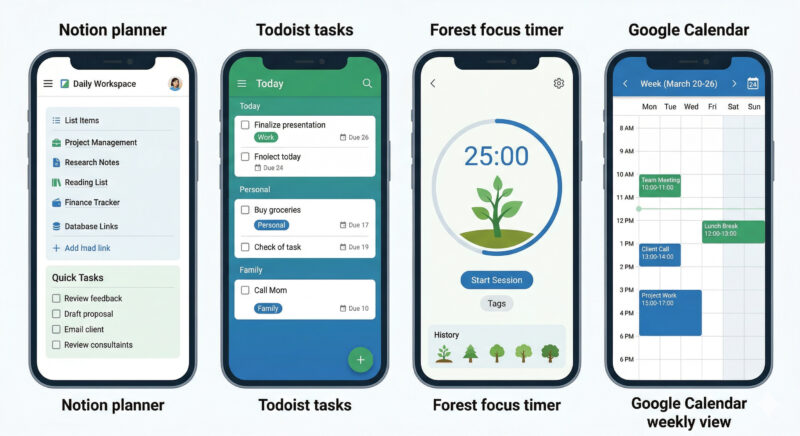
You do not need 15 apps to manage your time. You need two or three that you actually use. Here are the most practical ones for Indian students across different needs.
- Notion — All-in-one planner for notes, goals, and weekly review. Free for students.
- Google Calendar — The best free tool for time blocking. Colour-code your subjects.
- Todoist — Clean, simple task manager with priority flags and due dates.
- Forest App — Gamified focus timer that grows a virtual tree while you study. Kills the phone habit effectively.
- Learnox Study Planner — Our free study planner tool lets you plan your week in minutes, directly in the browser.
13. Learn to Say No — More Often Than Feels Comfortable
Every “yes” to something new is a “no” to something already planned. Students who struggle the most with time often struggle with boundaries — they join every group project, attend every social event, volunteer for every extra task, and then wonder why they have no time left to study.
This is not about becoming antisocial. It is about recognising that your time is finite, and that protecting your priorities is not selfish — it is necessary. Before agreeing to any new commitment, ask yourself honestly: do I have the time for this, and is this more important than what it will replace?
14. Do a Weekly Review Every Sunday Evening
The weekly review is perhaps the single most underused productivity practice among students. It takes 20 minutes and it completely changes how effective your time management becomes over time.
Each Sunday, ask yourself three questions: What did I accomplish this week? What did not get done, and why? What do I need to carry forward or reprioritise next week? Then use those answers to plan your Monday–Saturday schedule for the coming week.
Without reflection, you repeat the same inefficiencies every week without realising it. With it, you continuously improve your system based on real experience — your own experience, not someone else’s productivity advice.
15. Protect Your Sleep, Rest, and Breaks Like Non-Negotiables
Cutting sleep to study more is the academic equivalent of drawing from your retirement fund to pay daily groceries. It might seem to work in the short term. It does not.
Research consistently shows that students who sleep 7–8 hours retain information significantly better than those who sleep 5 hours or less. Memory consolidation happens during sleep — meaning the revision you did in the evening is actually “saved” into long-term memory overnight. Skip sleep, and the revision effort is largely wasted.
Breaks work the same way. The Pomodoro Technique builds them in deliberately. A 5-minute walk, a glass of water, or a brief stretch between sessions is not a waste of time — it is what makes the next session actually productive.

Common Time Management Mistakes Students Make
Knowing what to do is only half the battle. Knowing what to stop doing is equally important. Here are the most common traps that derail student productivity, even when intentions are good.
- Mistake 1: Studying for long hours without breaks. Six hours of continuous studying sounds impressive. In practice, focus collapses after 90 minutes without a real break — and the remaining four hours are mostly an illusion of productivity.
- Mistake 2: Treating all tasks as equally urgent. Not everything on your list deserves the same amount of attention. Checking your attendance portal for the fifth time today is not the same as completing that pending assignment.
- Mistake 3: Planning without execution. Some students spend 90 minutes building a beautiful Notion dashboard and then spend zero time studying. The plan is not the work. The plan enables the work.
- Mistake 4: Underestimating task duration. Most people underestimate how long things take. If you think an assignment will take one hour, block two. The extra time is almost always needed.
- Mistake 5: Starting each day without a plan. Opening your laptop without a clear intention for the day is how hours disappear into notifications and aimless browsing.
- Mistake 6: Ignoring physical health. Poor sleep, skipping meals, and sitting for 8 hours without movement directly reduce cognitive performance. The brain is a physical organ. Treat it like one.
Expert Tips from Top Students and Educators
We have distilled advice from high-achieving students, educators, and academic coaches into actionable principles that go beyond the standard advice.
🎯 “Plan for 70%, not 100%.” Leave 30% of your daily schedule as buffer time. Unexpected things always happen — a concept takes longer than expected, a friend needs help, your internet goes down. Buffers absorb these without derailing your entire day.
📓 “Write your top 3 priorities the night before.” Before bed, write three things that must happen tomorrow. Wake up and do those three before anything else. The rest of the day is bonus. This ensures you never finish a day with nothing meaningful accomplished.
🔁 “Review beats reading.” Spaced repetition — reviewing material at increasing intervals — is proven to be far more effective than reading notes twice. Use flashcard tools like Anki, or simply schedule a 15-minute review of each topic 24 hours, 3 days, and 1 week after first learning it.
📵 “Your phone is not the problem. Accessibility is.” Students who keep their phones in another room during study sessions report higher focus and longer unbroken work periods. The phone is not bad — it is just too easy to reach for. Make it slightly harder to access and your study quality improves immediately.

Do This, Not That — Quick Reference
✅ Do This
- Plan your week every Sunday
- Block study time with fixed slots
- Study your hardest subject first
- Take real breaks between sessions
- Track your actual time use
- Sleep 7–8 hours every night
- Review your week before planning next
❌ Not This
- Study for 6 hours without breaks
- Keep your phone on your desk while studying
- Leave the hardest subject for late evening
- Trust memory over a written plan
- Say yes to everything
- Pull all-nighters before exams
- Start your day without any plan
Frequently Asked Questions About Time Management for Students
How many hours should a student study per day?
Most education experts recommend 6–8 focused hours of study per day for students preparing for competitive exams. However, quality matters far more than quantity. Three hours of deep, distraction-free study often produce better outcomes than six hours of passive, unfocused reading. Start with 3–4 solid hours and increase gradually as your focus improves.
What is the best time management technique for students?
The Pomodoro Technique — 25 minutes of focused study followed by a 5-minute break — is widely regarded as one of the most effective time management techniques for students. It reduces mental fatigue, builds momentum, and makes it easier to start because the commitment is small. Pair it with time blocking and a Sunday weekly plan for maximum impact.
How do I stop wasting time as a student?
Start by tracking where your time goes for one week using the Screen Time feature on your phone or a free app like Toggl. Most students are genuinely shocked by how much time disappears into social media and aimless browsing. Once you see the data, use time blocking, phone-free study zones, and the Pomodoro Technique to redirect those hours toward meaningful work.
Can I manage time well without a digital planner?
Absolutely. A simple ruled notebook works just as well — sometimes better, because writing by hand slows you down in a good way, making you more intentional about what you plan. The tool matters far less than the habit. Pick whatever format you will actually use consistently — paper, Google Calendar, Notion, or a physical diary — and stick with it.
Why do Indian students specifically struggle with time management?
Indian students often face a unique combination of pressures: heavy academic workloads, competitive exam culture, family obligations, long commutes, and limited quiet study spaces at home. On top of that, time management is rarely taught explicitly in school. Most students are expected to figure it out on their own, which is why so many reach college without any real planning system. The good news is that these skills are entirely learnable with the right guidance.
Conclusion: Start With One Change, Not All Fifteen
Effective tips for time management do not require a personality overhaul. They require small, consistent actions repeated over time. The student who plans their week every Sunday, uses the Pomodoro Technique during study sessions, and protects their sleep will almost always outperform the student who studies longer but without structure.
Do not try to implement all 15 tips at once. Pick the one that resonates most — maybe it is building a weekly plan, or maybe it is tracking where your time actually goes — and focus on that for two weeks. Once it becomes automatic, add the next one.
Progress in time management is cumulative. Small systems built patiently over months produce extraordinary results by exam season. The students who seem to “have it together” during finals are almost always the ones who started building habits in September, not November.
You have everything you need. The next step is simpler than you think: open a notebook, write next week’s schedule, and start with that.
Ready to Study Smarter?
Explore our free tools and guides — built specifically for Indian students.