
 Soyeb Akhtar
What Does Goal Setting Mean for Students?
Let’s be real for a second. Most students study — but very few study with a clear purpose. They open their textbooks, finish a chapter, and close it. The next day, they do the same. Week after week, the pattern continues without any real progress check or clear destination in mind.
That’s exactly where goal setting comes in. In simple terms, goal setting for students is the process of identifying what you want to achieve, deciding by when you want to achieve it, and creating a plan to get there. It is not about writing a wish on a piece of paper and hoping for the best. It is about converting intention into action.
Research published by Kappan Online — one of the most respected education research journals — found that Robert Marzano’s extensive review of academic studies showed goal setting can produce student learning gains of between 18 and 41 percentile points. That is not a small jump. That is the difference between scraping through and actually topping your class.
For Indian students especially — balancing board exams, entrance tests like JEE or NEET, family expectations, and increasingly competitive college admissions — having structured goals is no longer optional. It is the backbone of smart, focused studying.
How Can Setting Goals Help Students? 7 Key Benefits
The question “how can setting goals help students” sounds simple, but the answer touches every part of a student’s life — academic performance, mental health, time habits, confidence, and long-term career success. Let us break it down benefit by benefit.
1. Sharpens Focus and Cuts Distraction

Every student has experienced this: you sit down to study, and within fifteen minutes you are checking Instagram, texting friends, or just staring at the ceiling. The problem is rarely laziness. The problem is that your brain has no clear target to lock onto.
When you set a specific goal — for example, “complete Chapter 7 of Chemistry by 6 PM today” — your brain’s attention system narrows in on that objective. Psychologists call this the attentional spotlight effect. Having a clear goal tells your brain what to pay attention to and, equally important, what to ignore.
Think of it this way: a student with no goals studies like someone walking in fog. A student with clear goals studies like someone with a GPS — they still face obstacles, but they always know which direction to head.
To make the most of your focused study sessions, pair your goals with a time-management technique like the Pomodoro Technique for studying — breaking your work into 25-minute sprints so your focus stays sharp without burning out.
2. Builds Motivation That Does Not Fade
Here is something most students get wrong: they wait to feel motivated before they start working. But motivation actually follows action, not the other way around. Goal setting creates the structure that triggers action, which then generates motivation as a byproduct.
When a student sets a goal and achieves even a small part of it — finishing a topic, submitting an assignment on time, scoring better on a practice test — the brain releases dopamine. That small rush of satisfaction is the engine that pushes them to keep going. Without goals, there are no milestones to hit, so there are no rewards, and motivation quietly dies.
Long-term goals also give students a reason to push through the hard days. A Class 12 student preparing for JEE can endure a tough week of difficult problems because they keep their eye on the prize — a seat at an IIT or NIT. The goal is the anchor when motivation naturally dips.
3. Improves Time Management Naturally
One of the most persistent struggles for Indian students is managing time — especially when juggling school, tuition classes, family responsibilities, and personal hobbies. Goal setting solves this not by adding more hours to the day, but by making the existing hours count.
When you have a clear goal with a deadline, you automatically start assigning priority to tasks. A student who wants to complete three chapters of Physics by Sunday will naturally plan their week differently than one with no target. They will cut back on binge-watching, schedule study slots, and protect their productive hours.
In a very real sense, setting goals is the first step toward mastering time. Without goals, time management advice remains abstract. With goals, it becomes practical and urgent. Read our in-depth guide on time management for students to learn how to structure your day around your goals effectively.
if one of your goals involves a subject you’re consistently falling behind in, having a tutor to check progress against — such as through My Engineering Buddy — makes the goal much easier to track and hit.
4. Reduces Exam Stress and Anxiety
Exam season in India is notoriously stressful. Students attempt to cover months of content in a few weeks, and the pressure from parents, teachers, and peers compounds every day. But most of this stress is not caused by the exam itself — it is caused by the lack of preparation, which is ultimately caused by the lack of a plan.
Students who set semester-long or term-long goals and break them into weekly targets arrive at exam season having already covered most of their syllabus systematically. They do not cram. They revise. That shift — from panic-cramming to planned revision — makes an enormous difference in both performance and mental health.
Research from Mission.io confirms that smaller benchmark goals towards a larger target help lower stress while simultaneously increasing motivation. Two benefits for the price of one plan. For more strategies on managing academic pressure, see our practical guide on how to reduce stress during exams.
5. Builds Real Confidence and Self-Belief

Confidence does not come from talent. It comes from evidence — from a track record of doing what you said you would do. Every time a student sets a goal and follows through, they collect a small piece of evidence that says: I can do this.
Over time, these small wins stack up into genuine self-belief. A student who has consistently hit their weekly study goals for three months will walk into an exam hall with a completely different energy than one who has been winging it. That internal confidence — rooted in actual preparation — is what separates average performers from toppers.
Interestingly, this is why educators recommend that students start with achievable goals before moving to stretch goals. Early wins build the foundation. Once confidence is established, students naturally start aiming higher on their own.
6. Teaches Accountability and Discipline
Indian education often places responsibility on teachers and parents to keep students on track. While that support is valuable, students who learn to hold themselves accountable early in life are the ones who thrive in competitive colleges and workplaces where nobody is reminding them to study.
Setting goals forces a student to make a commitment — to themselves first, and optionally to a study partner or mentor. When you tell a friend “I am going to score above 90% in the next unit test,” you have raised the stakes slightly. That social accountability, however informal, improves follow-through significantly.
Beyond that, working consistently toward goals teaches discipline — the ability to do what needs to be done even when you do not feel like it. And discipline, more than raw intelligence, is what drives long-term academic and career success. Pair this with a structured daily routine for students to make discipline a natural part of your day rather than an ongoing struggle.
7. Prepares You for Career and Adult Life
Here is the big picture benefit that most school-level discussions miss: the skill of setting and achieving goals does not expire when you graduate. Every job, every business, every career trajectory runs on goal setting. Companies set quarterly targets, teams set project milestones, managers set performance benchmarks.
Students who practice goal setting during their academic years arrive in the professional world with a head start. They already know how to break large problems into smaller steps, how to track their progress, how to pivot when plans fail, and how to celebrate milestones without losing sight of the larger objective.
Learning this skill at 15 or 17 rather than at 25 or 30 is an enormous advantage. And it all starts with something as simple as writing down what you want to achieve and by when.
The SMART Goal Framework for Students
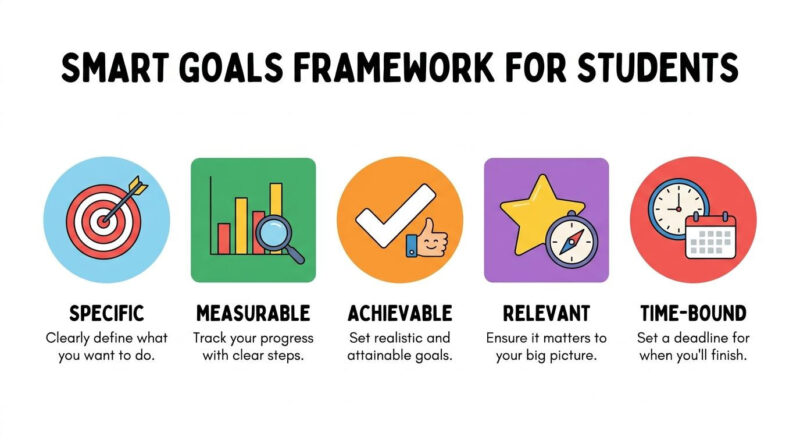
The most common reason goal setting fails is that the goals are vague. “I want to study more” or “I want to score better” are wishes, not goals. The SMART framework converts vague wishes into clear, workable targets. Here is how each element applies to a student’s life:
| SMART Element | What It Means | Student Example (India) |
|---|---|---|
| Specific | Define exactly what you want to achieve | “Score 80% or above in my Class 11 Chemistry mid-term” |
| Measurable | Attach a number or trackable outcome | “Complete 5 NCERT exercises per week” |
| Achievable | Realistic given your current level and schedule | “Improve my score from 60% to 75% — not directly to 100%” |
| Relevant | Connected to a larger academic or career goal | “Strengthen Chemistry for JEE Mains preparation” |
| Time-bound | Has a clear deadline | “Achieve this in the next 6 weeks, by [date]” |
Instead of a vague “study harder” intention, a SMART version would be: “I will study Chemistry for 45 minutes every weekday evening for the next 6 weeks, completing all NCERT exercises for Chapters 1–5, with the goal of scoring 80% or above in the mid-term on [date].”
That single sentence gives you focus, a timeline, a measurable outcome, and a daily action. That is the power of the SMART framework.
How to Set Goals as a Student — Step by Step
Understanding why goal setting matters is the first step. Knowing how to actually do it is what makes the difference. Here is a simple, no-fluff process that any student can follow — whether you are in Class 9 or your final year of college.
- Start with your long-term destination. Ask yourself: where do I want to be one year from now? Two years from now? This could be a board exam score, a college admission target, or a skill you want to master. This is your big goal — your “why”.
- Break it into semester and monthly goals. A year-long goal is too large to act on daily. Divide it. If your long-term goal is cracking NEET, your semester goal might be completing the Biology syllabus, and your monthly goal might be finishing three chapters of Botany with thorough revision.
- Create weekly mini-goals. Every Sunday evening, write down the three to five most important things you want to accomplish that week academically. These should directly feed into your monthly goal. Keep it realistic — overloading a week leads to frustration and giving up.
- Write them down — physically. This matters more than most students realise. The act of writing a goal engages your brain differently than just thinking about it. Use a notebook, a planner, or stick a goal card to your study wall. Our free Study Planner tool on Learnox can help you structure weekly goals easily.
- Review and adjust weekly. Every Sunday, check how you did. Did you meet your targets? If yes, celebrate briefly and raise the bar slightly. If not, ask honestly: was the goal unrealistic, or did you not follow your plan? Adjust accordingly without guilt.
- Find an accountability partner. Share your goals with a classmate, a sibling, or a mentor. You do not need a formal setup. Just telling someone “I am aiming for this score by this date” creates enough social pressure to keep you honest.
Expert Tips for Goal Setting That Actually Works

Instead of just setting a goal, pair it with a specific trigger. Research from ASCD’s Educational Leadership shows that goals with clear “when, where, and how” plans are far more likely to be executed. Instead of “I will study Physics,” say: “When I finish dinner at 8 PM, I will sit at my desk and study Physics for 40 minutes.”
Comparing yourself to toppers in class can be demoralising if you are not at that level yet. Instead, set “personal best” goals — targets that beat your own previous performance. Improved from 55% to 65%? That is a personal best worth celebrating, regardless of where your classmates stand.
Pin your long-term goal (e.g., your target college or exam score) somewhere you see it every single day — your study room wall, your phone lock screen, your notebook cover. Then keep your weekly goals on your desk. The long-term goal provides the “why”; the weekly goal provides the “what to do today.” A well-set study room design can help you keep your goals front and centre.
Finishing a milestone deserves a proper celebration — even if it is just a favourite meal or a guilt-free episode of your favourite show. Celebration is not a reward for laziness; it is a neurological anchor that tells your brain “hard work feels good.” This makes it easier to start the next goal cycle.
Every student has days where motivation collapses. On those days, do not push harder — instead, reconnect with your original reason. Why did you set this goal? What changes when you achieve it? Who benefits? This mental reconnection often reignites enough drive to get through the day.
Common Mistakes Students Make With Goal Setting
Five academic goals, two health goals, one hobby goal, and a social media detox — all starting on Monday. This is the fastest route to abandoning everything by Wednesday. Focus on one to three meaningful goals at a time. Once those are habits, layer in more.
“Study more” or “be more disciplined” are not goals. They are directions. Goals need numbers, dates, and specific actions. The more precisely you define a goal, the easier it is to act on it and measure your progress.
Setting goals and then forgetting to review them is like planning a road trip but never checking the GPS. Life changes, syllabuses change, exam dates shift. Build in a weekly review as a non-negotiable habit — 10 minutes every Sunday is enough.
Missing a weekly target is not a sign that goal setting does not work. It is a data point. Did you overestimate available time? Did an unexpected event disrupt the week? Adjust and continue. Resilience in the face of small failures is itself one of the most valuable skills goal setting teaches you.
A goal set because of parental pressure or peer competition, rather than genuine personal motivation, rarely lasts. Before writing down any goal, ask yourself: “Do I actually want this, or am I chasing someone else’s idea of success?” Authentic goals produce authentic effort.
Real-Life Example: How Goal Setting Changed Riya’s Results
Let me share a story that many Indian students will recognise themselves in.
Riya was a Class 11 student from Pune. Smart girl, no doubt — she understood concepts quickly in class. But her unit test scores were hovering around 55–60%, and she had no idea why. She studied every day, or at least she thought she did.
The problem: Riya studied without any particular target. She would open her textbook to wherever she had left off, spend an hour reading, close it, and consider the day done. No subject priority, no chapter targets, no weekly review. Just motion without direction.
After a particularly bad test result, a teacher suggested she try goal-based studying for one month. Riya wrote down three simple goals: complete and revise two Chemistry chapters per week, attempt 30 Maths problems daily (tracked in a notebook), and score above 75% in the next unit test. She reviewed these every Sunday for 4 weeks.
The result? Her next unit test score was 79%. She did not study more hours — she studied the same number of hours with a clearer plan. The goals did not change her intelligence. They changed her direction. And direction, as it turns out, matters far more than raw effort.
This is exactly how goal setting helps students — not by making them work harder in a vacuum, but by ensuring the work they do is pointed in the right direction.
Frequently Asked Questions
How can setting goals help students academically?
Setting goals helps students improve academic performance by giving them a clear direction to work toward. Research shows that students with specific academic goals demonstrate better time management, stronger focus during study sessions, and higher motivation to complete tasks. When a student knows exactly what they want to achieve — like scoring above 85% in an upcoming board exam — they study with purpose instead of just going through the motions.
What are SMART goals for students?
SMART stands for Specific, Measurable, Achievable, Relevant, and Time-bound. Instead of saying “I want to study more,” a SMART goal would be: “I will study Maths for 45 minutes every day for the next 30 days to improve my chapter test score from 60% to 80%.” This kind of goal is clear, trackable, realistic, connected to your academics, and has a concrete deadline.
How often should students review their goals?
Students should review their goals at least once a week. A short Sunday review of 10–15 minutes is ideal — check what you accomplished, what you missed, and why. Adjust the goal if it is too ambitious or too easy. Monthly reviews help you see the bigger picture and stay aligned with long-term targets like board exams or entrance tests.
Can setting goals reduce exam stress for students?
Yes — significantly. Students who break large exam targets into smaller weekly goals experience far less anxiety because the workload feels manageable. Instead of panicking about the entire syllabus in the last week, a student following a goal-based study plan has already covered most content systematically. This eliminates last-minute cramming and the dread that comes with it.
What is the difference between short-term and long-term goals for students?
Short-term goals are targets you aim to achieve within days or weeks — like finishing two chapters this week or improving attendance this month. Long-term goals take months or years, such as cracking JEE, completing graduation, or landing a placement. Both types work together: short-term goals are the stepping stones that build toward the long-term destination. Without short-term goals, long-term dreams remain just that — dreams.
Conclusion: Start Small, Stay Consistent

So, how can setting goals help students? In every meaningful way possible — focus, motivation, time management, stress reduction, confidence, discipline, and long-term career readiness. Goal setting is not a productivity gimmick. It is one of the most research-supported habits a student can build, and the best part is that anyone can start right now.
You do not need a perfect planner or a beautiful journal. You need a piece of paper, a pen, and five minutes of honest thinking about where you want to go and what you need to do this week to get closer to that destination.
Start with one goal. Keep it SMART. Review it this Sunday. Build from there.
The students who consistently outperform their potential are rarely the most talented ones in the room. They are the ones who decided, at some point, to stop drifting and start directing — one clear, written goal at a time.
Ready to start studying smarter?
Use Learnox’s free Study Planner to create your first weekly goal plan in minutes. No sign-up needed.
Also explore: Pomodoro Technique for Students | Time Management Guide | Reduce Exam Stress