 Soyeb Akhtar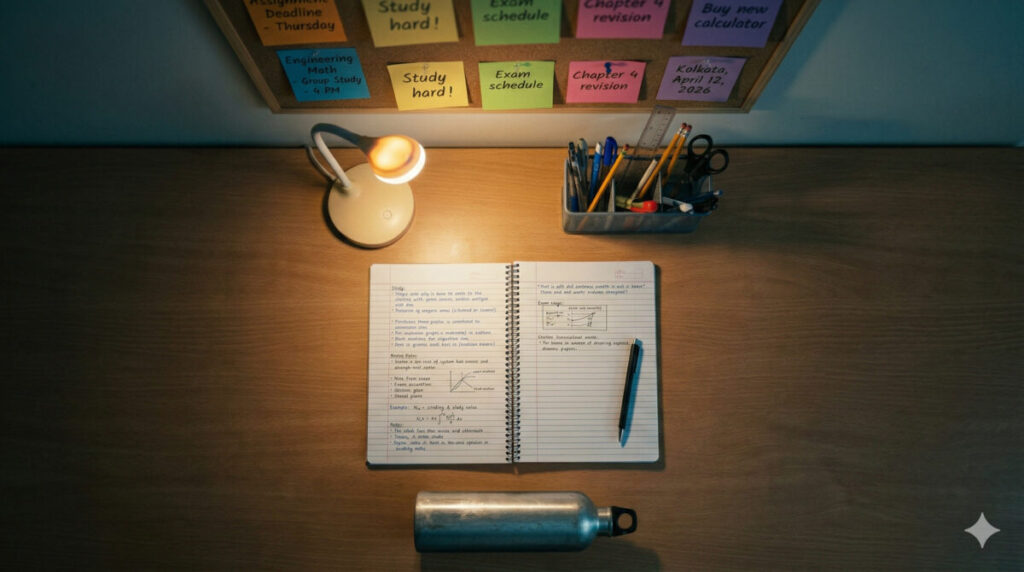
📋 Table of Contents
- Why Your Desk Setup Affects How Well You Study
- 10 Best Budget-Friendly Desk Accessories for Students
- Complete Budget Breakdown (Under ₹2,500)
- Where to Buy and What to Look For
- Expert Tips: Getting the Most from a Budget Desk Setup
- Common Mistakes Students Make When Setting Up Their Desk
- Frequently Asked Questions
- Conclusion
Walk into any well-decorated Instagram study space and it’s easy to feel like you need a ring light, a mechanical keyboard, an acrylic organiser, and a colour-coordinated cable set just to pass your exams. You don’t. That’s an aesthetic, not a productivity system.
But here’s what is true: your physical study environment has a measurable effect on your ability to concentrate. A 2011 study from Princeton University’s Neuroscience Institute found that visual clutter — like a messy desk — actively competes for your attention and reduces your brain’s ability to focus on a single task. The right budget-friendly desk accessories for students solve exactly that problem without requiring a massive spending spree.
Every item in this list was selected based on one criterion: does it make studying easier, more comfortable, or more organised? Not how it looks on a Pinterest board. What it actually does to your daily study experience. Each item includes a DIY alternative and an approximate India price range so you can build the setup that fits both your room and your budget.
1. Why Your Desk Setup Affects How Well You Study
Environmental psychology has a lot to say about the spaces we work in. The short version: your surroundings shape your behaviour in ways you’re not consciously aware of.
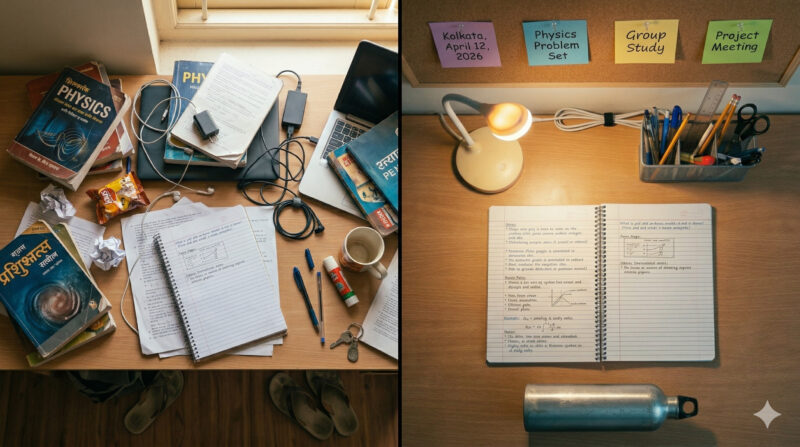
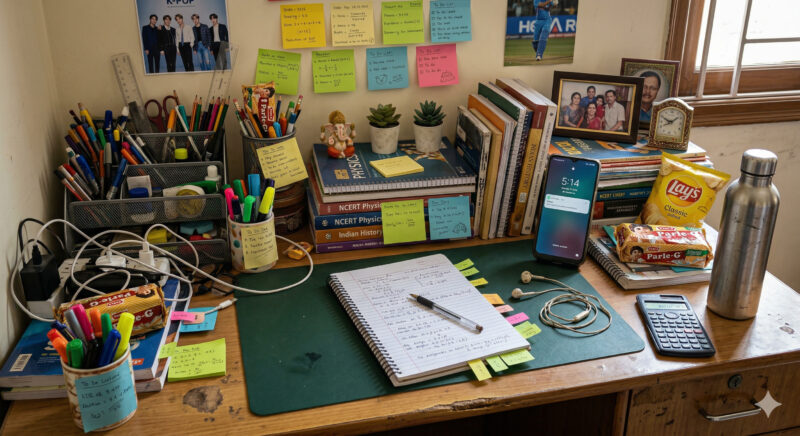
A cluttered desk doesn’t just look disorganised. Every object on your desk that isn’t directly related to your current task is a micro-distraction — your eye catches it, your brain registers it, and a sliver of your working memory gets allocated to it. Over a 3-hour study session, that adds up to significant cognitive overhead that would otherwise go toward understanding your subject.
The reverse is also true. Research published in the Harvard Business Review found that people with organised workspaces made better decisions, showed fewer impulse behaviours, and sustained focus longer than those working in messy environments. A well-organised desk is, in a very literal sense, a cognitive performance tool.
The good news: you don’t need to spend a lot to get these benefits. You just need to choose the right things.
The goal of desk accessories isn’t aesthetics — it’s reducing the number of small decisions and minor frustrations your brain has to process during a study session. Every minute you don’t spend searching for a pen, adjusting your neck to read a textbook, or squinting through bad lighting is a minute your brain can spend on the actual work.
2. The 10 Best Budget-Friendly Desk Accessories for Students
These are ranked loosely by impact — the ones at the top make the biggest immediate difference to your study quality.
₹350 – ₹800
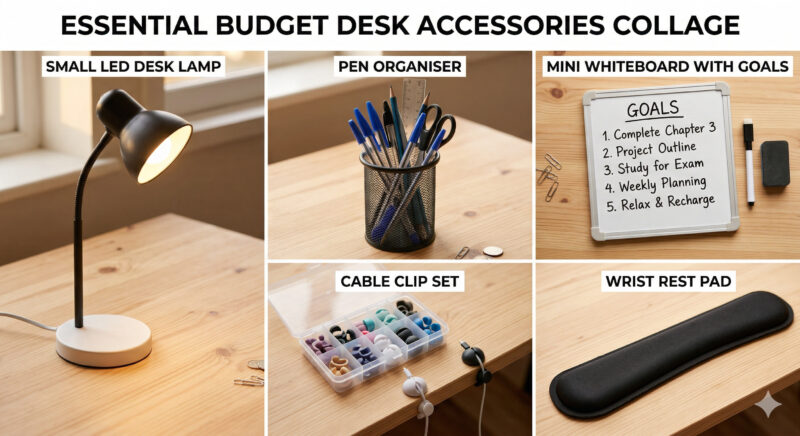
This is the single most impactful item on this list. Most Indian students study under overhead room lighting — a harsh yellow bulb or a tube light positioned behind them, casting shadows directly onto their work. Over a 2–3 hour study session, that kind of poor lighting causes measurable eye strain, headache, and fatigue.
A proper LED desk lamp positioned to the left of your workspace (if you’re right-handed) eliminates shadow, reduces squinting, and makes reading for long periods dramatically more comfortable. Look for one with at least two brightness levels, a flexible neck, and an LED that’s warm-white (not cold blue-white, which strains the eyes more during evening study).
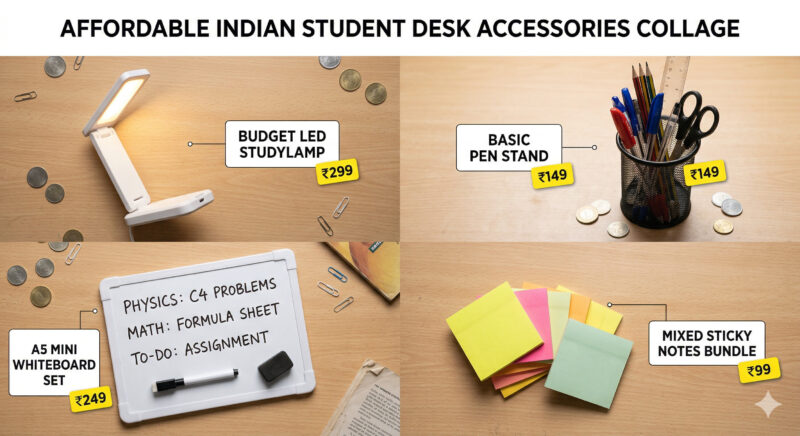
On Amazon India or Flipkart, reliable LED desk lamps start at ₹350–₹500. Brands like Wipro, Havells, and Syska have India-specific models worth checking.
₹200 – ₹550
The number one source of desk clutter for students is loose stationery — pens, pencils, highlighters, erasers, rulers — all competing for surface space with your open textbook and notebook. A desktop organiser consolidates all of this into one compact space and removes the “where is my pen” problem that interrupts study sessions dozens of times per day.
You don’t need anything elaborate. A two-compartment pen stand with a small tray section for clips and sticky notes is all you need. These start at ₹200 on Meesho and Flipkart. Acrylic and bamboo versions are both available under ₹500 on Amazon India.
₹250 – ₹700
Most students in India study with their laptop or textbook flat on the desk and their neck bent 30–45 degrees forward. Do that for 2–3 hours a day and within weeks you’ll notice neck stiffness, upper back pain, and a constant low-level discomfort that makes it hard to sit and study for long periods. A laptop or book stand tilts your screen or reading material to a more ergonomic angle, reducing neck flexion and making long sessions physically sustainable.
For students who primarily read physical textbooks, a simple plastic or metal book holder (available at any stationery shop for ₹120–₹250) props the book upright so you’re reading almost straight ahead rather than down. For laptop users, an adjustable aluminium stand that raises the screen to eye level starts at ₹300–₹400 on Amazon India.
₹200 – ₹500
A small whiteboard or corkboard positioned above or beside your desk is one of the most underrated study accessories. It serves as your daily goal tracker, formula reference board, deadline reminder, and to-do list — all without taking up any desk surface space. Instead of writing goals in a notebook that gets buried under other books, your goals are always in your line of sight.
A 1-foot × 1.5-foot whiteboard is enough for most students and can be found at local stationery shops for ₹150–₹300. Online, slightly larger versions with a marker set cost ₹250–₹500. A corkboard is even cheaper and can be found at arts-and-crafts stores for ₹150–₹400 depending on size.
₹100 – ₹280
Tangled charging cables, dangling earphone wires, a laptop charger snaking across the desk — cable chaos is one of the most common visual distractions on student desks. It’s a low-priority problem that somehow manages to be consistently annoying. Cable clips that stick to the edge of your desk route cables neatly along a fixed path. Velcro ties bundle cables together when not in use.
A set of 10 cable management clips on Amazon India costs ₹100–₹180. A pack of 20 reusable velcro cable ties runs ₹120–₹250. Both are worth having. This is the cheapest item on this list with one of the biggest immediate visual impacts on desk cleanliness.
₹60 – ₹180
Sticky notes are one of the most versatile and underutilised study tools. Beyond reminders, they work as page flags in textbooks, quick formula reference cards stuck to the wall near your desk, colour-coded subject dividers, and disposable flashcard alternatives. A pack of three sizes — small, medium, and large — covers every use case and lasts months.
In India, sticky note pads cost ₹20–₹60 per pad depending on size. A set of four or five pads in different colours — yellow, green, pink, blue — costs ₹120–₹180 at any stationery shop. 3M Post-it pads are available on Amazon India for slightly more but have better adhesive quality for wall use.
₹150 – ₹450
Students who type notes, write assignments, or code for long periods often develop wrist strain without realising what’s causing it. Typing with your wrists bent upward (which most students do when their laptop sits flat on the desk) puts sustained pressure on the carpal tunnel area. A simple foam wrist rest holds your wrists in a neutral position, reducing fatigue during long typing sessions.
Basic foam wrist rests are available on Amazon India for ₹150–₹250. Memory foam versions with better support cost ₹280–₹450. If you’re a laptop user whose wrists float naturally when typing, this may not be necessary — but if you type for more than an hour a day and notice wrist discomfort, it’s worth the ₹200 investment.
₹200 – ₹550
A large desk pad — typically 60cm × 30cm or larger — covers most of your work surface, protects the desk from pen marks and moisture, acts as a large mouse pad, and visually defines your “work zone.” It makes a cluttered desk feel intentional and organised even before you add any accessories. Students who use desk pads consistently report that it helps them mentally “enter” study mode faster, because the defined workspace creates a visual cue that this is where work happens.
On Meesho, basic PU leather or faux-leather desk pads start at ₹200–₹350. On Amazon India, extended mouse mats with fabric surfaces that double as desk pads cost ₹250–₹500 and are excellent quality for the price.
₹300 – ₹700
Students who study with a laptop, phone, tablet, and study lamp all need power — and most Indian study rooms have one or two accessible wall sockets. A short desktop extension board with USB charging ports keeps all your devices charged and cable management clean, without requiring you to crouch to the floor socket every time your phone needs charging. This is a practical, unsexy accessory that eliminates a daily frustration so minor that most students don’t even notice it’s bothering them — until it’s gone.
A 4-socket extension board with 2 USB ports from Syska or Portronics costs ₹350–₹600 on Amazon India and Flipkart. It’s a one-time buy that lasts years.
₹150 – ₹400
This might be the most contrarian item on this list. Why buy a physical timer when you have one on your phone? Because your phone is the single largest source of study interruptions for most students. Every time you glance at your phone to check the timer, you’re one notification away from a 20-minute social media detour. A small desk clock or a basic mechanical timer lets you track your study sessions — whether you’re using the Pomodoro technique or just managing your time blocks — without touching your phone.
Basic desk clocks with alarm functions cost ₹150–₹300 at local electronics stores or online. A traditional wind-up kitchen timer costs ₹80–₹150 and has zero screen. For students who already use focus apps, this item may be less critical — but for students who struggle with phone distraction, it’s transformative.
3. Complete Budget Breakdown — Full Setup Under ₹2,500
Here’s exactly what a complete setup costs, from most to least essential. You can phase this over several weeks if needed — start with the top three and add the rest gradually.
| # | Accessory | Budget Option | Where to Buy |
|---|---|---|---|
| 1 | LED Desk Lamp | ₹350 – ₹700 | Amazon India, Flipkart |
| 2 | Desktop Organiser | ₹200 – ₹550 | Meesho, Flipkart |
| 3 | Laptop / Book Stand | ₹250 – ₹700 | Amazon India |
| 4 | Whiteboard or Corkboard | ₹200 – ₹500 | Local stationery, Amazon |
| 5 | Cable Clips + Velcro Ties | ₹100 – ₹280 | Amazon India |
| 6 | Sticky Notes (Multi-pack) | ₹60 – ₹180 | Any stationery shop |
| 7 | Keyboard Wrist Rest | ₹150 – ₹450 | Amazon India, Flipkart |
| 8 | Large Desk Pad | ₹200 – ₹550 | Meesho, Amazon India |
| 9 | USB Extension Board | ₹300 – ₹700 | Amazon India, local |
| 10 | Physical Timer / Clock | ₹150 – ₹400 | Local electronics store |
| Total (Budget options) | ₹1,960 – ₹5,010 | Start with items 1–4 first | |
Don’t buy all 10 at once. Start with items 1 (lamp), 2 (organiser), and 4 (whiteboard). These three alone address the biggest study pain points — eye strain, stationery clutter, and goal visibility. Spend ₹750–₹1,250 total in the first round and evaluate what else you actually need before spending more.
4. Where to Buy and What to Look For
The biggest mistake students make when buying affordable desk accessories for students online is not comparing prices across platforms. The same item frequently varies by ₹100–₹300 between Amazon India, Flipkart, and Meesho.
Platform-by-Platform Breakdown
- Amazon India: Best for lamps, cable organisers, laptop stands, and extension boards. Widest selection, reliable delivery, easy returns. Check the “Sold by Amazon” filter for genuine products and faster shipping.
- Flipkart: Good for stationery items, organisers, and desk pads. Often runs back-to-school sales in May–June with discounts of 20–40%. Sign up for Flipkart Plus for faster delivery.
- Meesho: Excellent for low-cost organisers, desk pads, and decorative accessories. Prices are sometimes 30–50% lower than Amazon for the same product type. Delivery times are slower, but for non-urgent accessories, it’s the most economical option.
- Local stationery shops: Best for sticky notes, whiteboard markers, small whiteboards, and basic pen holders. No delivery wait, and you can check quality before buying. Worth visiting before ordering online for smaller items.
What to Actually Check Before Buying
- Reviews with photos: Don’t trust star ratings alone — read reviews that include photos of the actual received product, especially on Meesho and Flipkart where product quality can vary significantly from listing photos.
- Dimensions: Always check the physical size of desk accessories before ordering. A whiteboard listed as “small” might actually be too large for your wall space, or an organiser might be narrower than it appears.
- Return policy: For items above ₹300, ensure the seller has a return window. Most items from Amazon India and Flipkart are returnable within 7–10 days if they arrive damaged or don’t match the description.
- Brand for electrical items: For lamps and extension boards, stick to known Indian brands — Syska, Havells, Wipro, and Portronics for extension boards. Avoid no-brand electrical accessories, which can be fire risks.
5. Expert Tips: Getting the Most from a Budget Desk Setup
The best setup in the world does nothing if you haven’t thought about how to use it. Here are six tips that make your best desk accessories for study sessions actually produce results:
📐 Clear Your Desk Completely First
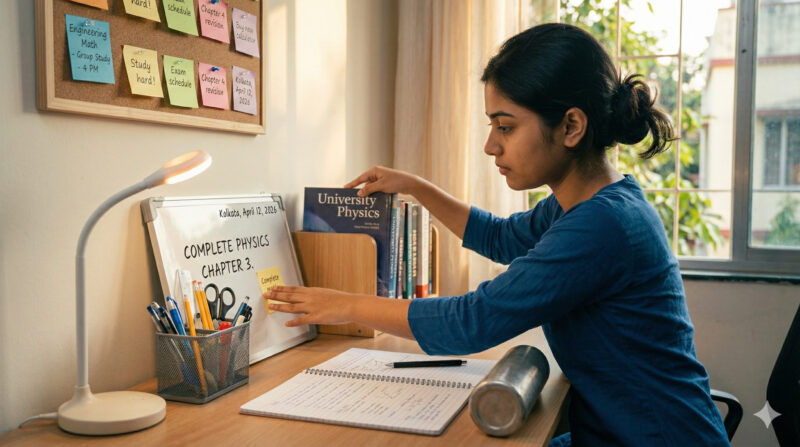
Before adding any new accessory, remove everything from your desk. Place only what you use daily back on the surface. This baseline declutter is more impactful than any accessory you can buy.
💡 Lamp on the Left, Always
If you’re right-handed, position your desk lamp to the upper left. This lights your writing hand without casting a shadow from it. Reverse if left-handed. Correct lamp positioning alone reduces eye strain significantly.
🎯 Use the Whiteboard for Today’s Goals Only
Don’t cover your whiteboard with an entire semester’s worth of notes. Use it exclusively for today’s 3 study goals and tomorrow’s plan. Wipe it clean at the end of each day. This keeps it functional, not decorative.
🧹 5-Minute Desk Reset Each Evening
Before bed, spend 5 minutes returning everything on your desk to its correct place. You’ll start each morning session with a clean environment that requires zero mental energy to begin working in.
🚫 Keep Food Off the Desk
Eating at your study desk trains your brain to associate the space with relaxation, not focus. Eat meals at the dining table. A water bottle is fine — it’s necessary. But a packet of chips signals “rest mode” to your brain.
📦 One “Pending” Box or Tray
Keep a small tray or box beside your desk for items that need to go somewhere but don’t have a home yet. This prevents random objects from landing on your workspace and gives clutter a designated temporary holding zone.
6. Common Mistakes Students Make When Setting Up Their Desk
After helping students build better study environments, these are the patterns that waste money and reduce the effectiveness of even good setups:
The biggest risk in setting up a new study space is spending a full day arranging and decorating it — and calling that “being productive.” This is a classic procrastination pattern. Set up the basics in 30 minutes. Refine over time. Don’t let desk setup become a reason to delay the actual studying.
7. Frequently Asked Questions
8. Conclusion
The best study environment isn’t the most expensive one. It’s the one with the fewest reasons to look up from your textbook, the least visual clutter competing for your attention, and the most physical comfort to sustain long sessions. The right budget-friendly desk accessories for students deliver exactly that — without requiring a ₹10,000 desk overhaul.
Start with a desk lamp and an organiser. These two items alone will make your study space noticeably more functional. Add the whiteboard next. Then, over a few weeks, fill in the remaining items based on what’s actually bothering you about your setup — not based on what looks good on Instagram.
A productive desk is a tool. Build it to work, not to impress.
🎯 Build Your Complete Study Setup with Learnox
Explore more practical, India-specific guides on study setups, routines, and productivity — all free, all made for Indian students.