
 Soyeb Akhtar
📋 Table of Contents
- Why Your Study Environment Directly Affects Your Grades
- The Complete Budget Breakdown: Under ₹2000
- 4 Types of Study Tables Under ₹2000 — Which Is Right for You?
- Step-by-Step: How to Set Up Your Study Table Under 2000 Rupees
- The Ergonomics Section Most Budget Guides Skip
- Why Lighting Is the Most Important Desk Accessory You’ll Buy
- Do You Need a Study Chair in This Budget?
- Expert Tips for a Better Budget Study Setup
- Common Mistakes Students Make (And How to Avoid Them)
- Frequently Asked Questions
- Conclusion
Let’s be honest about the problem. Most Indian students studying at home are either hunched over a shared dining table, working from their bed, or sitting on the floor with a textbook on their lap. These are perfectly understandable situations — but they’re not neutral. They actively work against focus, posture, and study duration.
A dedicated study table setup under 2000 rupees solves all three of these problems at once: it gives you a consistent space that your brain learns to associate with focused work, a surface at the right height to prevent fatigue, and an organised environment that reduces the micro-distractions that interrupt every study session.
The good news is that India is one of the most budget-friendly countries in the world for setting up a student desk. Foldable tables, LED lamps, cable organizers, and basic stationery organisers are all available at prices that simply don’t exist in Western markets. A complete, functional setup is achievable well within ₹2,000 — if you spend in the right order.
This guide takes you through exactly that order: from choosing the right table type for your room and budget, to setting it up properly, to the ergonomic adjustments that determine whether you can study for 2 hours or 5.
1. Why Your Study Environment Directly Affects Your Grades
Before getting into product picks and budget numbers, it’s worth understanding why this matters — because “study environment” sounds abstract until you’ve experienced the difference.
Research from the Harvard Business Review shows that people who work in organised environments make better decisions, stay on task longer, and show lower anxiety levels during complex cognitive work. Your desk isn’t just furniture — it’s an environmental signal to your brain about what kind of mental state to enter.
When you study on a bed, your brain receives a competing signal: this is where I sleep and rest. When you study at a dining table cluttered with family items, every unrelated object competes for your attention. When you study on the floor with bad posture, your body sends pain signals within an hour that make you want to stop.
A dedicated, organised study table setup — even a very budget one — eliminates all three of these problems simultaneously.
A study published in the Journal of Environmental Psychology found that students in organised, well-lit workspaces showed significantly better cognitive performance and reported higher motivation compared to those in cluttered or poorly lit environments. Your ₹2,000 investment isn’t just about furniture — it’s a cognitive performance upgrade.
2. The Complete Budget Breakdown: Under ₹2,000
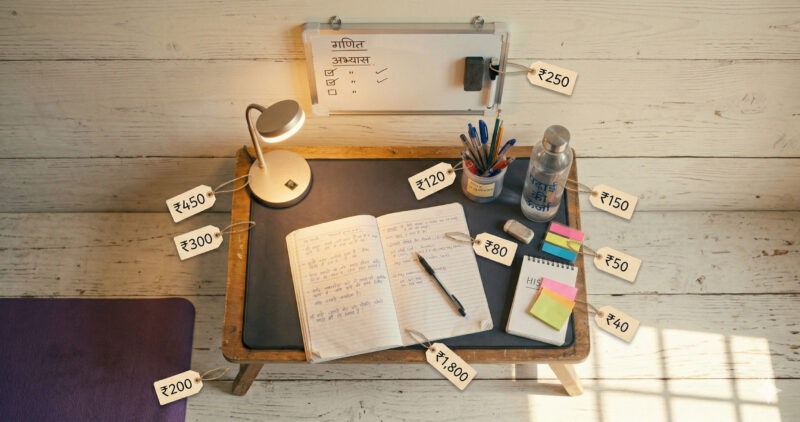
Here is a realistic, tested budget breakdown for a complete study table setup under 2000 rupees in India in 2026. Items are listed in priority order — the first four are essential; items five and six are optional upgrades.
| # | Item | Budget Range | Best Source | Priority |
|---|---|---|---|---|
| 1 | Foldable / Study Table | ₹500 – ₹900 | Amazon India, Flipkart | 🔴 Must-Have |
| 2 | LED Desk Lamp | ₹300 – ₹600 | Amazon India, local | 🔴 Must-Have |
| 3 | Desktop Organiser / Pen Stand | ₹150 – ₹350 | Meesho, Flipkart | 🔴 Must-Have |
| 4 | Desk Pad / Large Mousepad | ₹100 – ₹250 | Meesho, Amazon India | 🟡 High Value |
| 5 | Sticky Notes + Whiteboard Marker Set | ₹80 – ₹200 | Local stationery | 🟡 High Value |
| 6 | Cable Clips / Velcro Ties | ₹100 – ₹200 | Amazon India | 🟢 Optional |
| Total (Budget picks, items 1–5) | ₹1,130 – ₹2,300 | Start with items 1–3 (≈ ₹950–₹1,850) | ||
Buy the table first. Then the lamp. Then the organiser. In that exact order. Students who buy the organiser and desk pad first — because those are cheaper and easier to order online — often delay buying the lamp and end up studying under bad lighting for months. The lamp is the highest-impact accessory at this budget. Buy it second, always.
Amazon India’s Great Indian Festival (October) and Flipkart’s Big Billion Days (September–October) typically slash desk items by 30–50%. If you’re not in a rush, plan your purchase around these windows and you can get a ₹800 foldable table for ₹450–₹500, and the full setup for under ₹1,400. Meesho also runs daily price drops — always compare before buying.
3. Four Types of Study Tables Under ₹2000 — Which Is Right for You?
Not all tables under ₹2,000 serve the same student. Your choice depends on your room size, how you prefer to sit, and whether you need something permanent or portable. Here are the four main options available in India at this budget:
₹500 – ₹900
Lightweight, portable, stores flat under the bed. Can be used on the floor, on the bed, or as a standard sitting desk. Most popular choice for PG rooms and small apartments. Works on both floor-sitting and chair-sitting positions.
✅ Best For: PG rooms, shared spaces, portability
₹700 – ₹1,200
Mounts to the wall, folds flat when not in use. Saves permanent floor space. Excellent for rooms under 100 sq ft. Needs wall drilling — check if renting allows this. Sturdy enough for laptop, books, and a lamp.
✅ Best For: Tiny rooms, permanent study corners
₹900 – ₹1,800
Traditional flat-top table. More surface area than foldables. Includes small shelf or open storage in most models. Requires some assembly. Best value if you have a dedicated study corner and need a permanent setup.
✅ Best For: Permanent desk, more surface area
₹700 – ₹1,200
Adjustable legs allow you to use it as a floor table or a standing/sitting desk. Brands like Nilkamal and Portronics make solid versions in this range. Ideal if you alternate between bed-sitting and chair-sitting while studying.
✅ Best For: Flexibility, floor + chair use
For most Indian students in PG rooms, shared apartments, or homes with limited space, the foldable multipurpose table (₹500–₹900) is the right choice. It’s not a compromise — it genuinely works well, is easy to put away, and can be set up anywhere. The wall-mounted desk is the better permanent solution if you have a dedicated room corner and are allowed to drill.
What to Check Before Buying Any Table Under ₹2000
- Surface dimensions: Your table should be at least 50cm × 40cm to comfortably fit a laptop or an open notebook with space for a glass of water. Anything smaller becomes frustrating quickly.
- Weight capacity: Check the listed load-bearing capacity. Most decent foldable tables support 10–15 kg, which is plenty for a laptop, books, and accessories.
- Material: MDF (medium-density fibreboard) is the most common material at this price range. Avoid tables described only as “particle board” with no additional coating — they absorb moisture and deteriorate quickly in India’s humidity.
- Assembly: Some tables under ₹2,000 require assembly. Check if tools are included and if reviews mention assembly difficulty. Products that arrive with poor or missing hardware are a common complaint in this budget range.
- Return policy: Buy from platforms with clear return options. A table that arrives damaged is not uncommon in this segment — know your options before ordering.
4. Step-by-Step: How to Set Up Your Study Table Under 2000 Rupees
Buying the right items is the easy part. Setting them up in the right way is what actually determines whether your study setup works. Here’s the exact process:
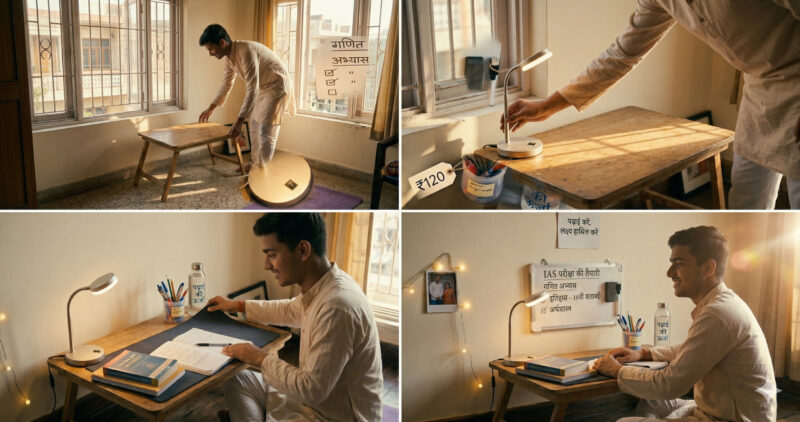
Choose and Commit to One Spot
Before you place the table, choose your study location deliberately. The best study spot has: natural light from a window during the day (reduce dependence on the desk lamp), a wall nearby for a whiteboard, enough space to push back the chair without bumping anything, and is not adjacent to your bed. That last point matters more than it sounds — visual proximity to your bed constantly invites the thought of “I could just lie down for a bit.”
Position Your Lamp and Test It
Once the table is placed, set up the desk lamp before adding any other accessory. For right-handed students, the lamp should sit at the upper-left corner of the desk. This ensures light falls on your writing hand from above and slightly to the left — no shadows on your work, no glare directly in your eyes. For left-handed students, reverse this. Turn the lamp on in the evening and test: if you’re squinting or tilting your head, the angle is wrong. Adjust before you start using it.
Place Only What You Use Daily on the Desk Surface
This step is where most students go wrong. The desk surface should contain only what you use every single study session: your pen organiser, your current textbook, your notebook, your water bottle, and your phone (placed face-down on the far edge — not front and centre). Everything else — extra books, stationery you rarely use, chargers, cables — goes off the desk. If it’s not in your hands in the next 30 minutes, it shouldn’t be on your desk surface.
Mount Your Whiteboard or Sticky-Note Wall at Eye Level
Your whiteboard or sticky-note planning space should be at eye level when you’re seated — meaning you can see it without moving your head down. This is typically 15–20cm above the desk surface if you’re using the wall. Mount it securely (Command strips work for lightweight whiteboards) and use it for today’s 3 study goals only. A whiteboard covered with 30 items is as useless as no whiteboard. Keep it to 3 goals. Clear it at the end of every day.
Route Cables Before They Become a Problem
Cables are the fastest way to make a new, clean desk look messy. Before your first study session, route your lamp cable, laptop charger, and phone cable along the edge of the desk. Use cable clips or even binder clips to hold them in place. If you’re using an extension board (highly recommended — puts all power in one reachable place), position it beside or below the desk, not on the desk surface. Tangled cables on the desk surface are a low-level visual distraction that accumulates over a study session.
End Every Study Session with a 3-Minute Reset
Before you leave the desk — every single time — return every item to its designated spot. Pen back in the stand. Books stacked flat or on shelf. Notebook closed. Cables tucked. This 3-minute habit ensures you start every session with a clean desk that requires zero mental energy to begin working at. The first time you skip this and come back to a messy desk the next morning, you’ll understand why it matters.
5. The Ergonomics Section Most Budget Guides Skip
Here’s something almost every other budget desk guide ignores: the height and positioning of your desk and chair matter more than any accessory you can buy. A ₹900 table positioned at the wrong height will cause more neck and back pain than a ₹5,000 fancy desk positioned correctly.
The correct ergonomic position for desk study has four components:
Most students studying on foldable tables find that the table surface sits too low when used on the floor, causing them to hunch forward. Two simple fixes: use a thick firm cushion on your seat to raise your height, or raise the table by placing it on a small sturdy platform (even a thick book on each leg works as a temporary fix).
For laptop users, a laptop stand — available for ₹300–₹600 on Amazon India — raises the screen to eye level and eliminates the neck-down position almost all laptop users default to. Pair it with a basic USB keyboard (available from ₹400 on Meesho) and you have a proper ergonomic laptop setup for around ₹800 additional investment.
Sit at your desk right now. Look at your laptop or book. Is your neck bent forward? Are your shoulders rounded? Are your elbows hanging in the air rather than resting on the desk? If any of these are true, your setup is causing physical strain that will limit how long you can study — regardless of how good your table is. Fix position first, buy accessories second.
6. Why Lighting Is the Most Important Desk Accessory You’ll Buy
This deserves its own section because it’s both the most underrated and the most frequently skipped element in Indian student desk setups.
Most Indian homes are lit with overhead yellow bulbs or tube lights positioned behind the student, which casts their own shadow directly onto their work area. After 2–3 hours of studying under this kind of lighting, eye strain, headaches, and mental fatigue set in. Students attribute this to the difficulty of the material or their lack of focus. Often, it’s just bad lighting.
A good desk lamp:
- Reduces eye strain by providing direct, adjustable light exactly where you need it.
- Eliminates book/notebook shadows by positioning light correctly relative to your writing hand.
- Extends productive study duration — students consistently report being able to study 60–90 minutes longer with a proper desk lamp than without.
- Creates a focus cue — turning on the desk lamp becomes a ritual signal to your brain that it’s time to study, similar to how some people use music or tea as a focus trigger.
What to Look for in a Desk Lamp Under ₹600
- LED, not CFL or incandescent. LED lamps are cooler, more energy-efficient, and produce more consistent light. They also last 4–5 years under normal student use.
- At least two brightness levels. A very bright setting for reading text-heavy material, a lower setting for typing or light note review at night.
- Warm white or neutral white (3000K–5000K). Cold blue-white light (above 6000K) strains eyes more during evening study. Warm or neutral white is more comfortable for long sessions.
- Flexible or adjustable neck. Lets you redirect light as needed without moving the whole lamp.
- Indian brand for reliability. Syska, Wipro, Havells, and Philips India all have models under ₹600 with good reviews. Avoid no-brand electrical items.
7. Do You Need a Study Chair in This Budget?
This is a question that divides students. The honest answer: it depends on what you already have.
If you have a dining chair or any chair at a reasonable height, it can absolutely work for your study table setup under 2000 rupees — especially for sessions under 2 hours. Add a firm cushion behind your lower back for basic lumbar support, and check that your feet rest flat on the floor.
If you’re studying 3–5 hours a day, sitting on a hard dining chair or wooden stool will start causing back pain within 3–4 weeks, limiting how long and how often you sit at the desk. At that point, a budget study chair becomes worth the investment — but it doesn’t need to come from the same ₹2,000 as the desk setup.
Phase 1 (Week 1): Buy the table, lamp, and organiser — around ₹1,000–₹1,500 total.
Phase 2 (Week 3–4): If you’re using the setup daily for 3+ hours and feel back discomfort, invest in a budget study chair separately. Budget study chairs with lumbar support start at ₹1,200–₹1,700 in India.
8. Expert Tips for a Better Budget Study Setup
These tips come from real patterns observed in student setups — not from generic productivity advice that ignores the Indian context.
🛒 Buy on Meesho First, Amazon for Electronics
Meesho has the lowest prices in India for desk organisers, desk pads, sticky note sets, and cable accessories. Always check Meesho first. For electrical items (lamps, extension boards), buy from Amazon India or Flipkart with name brands only — saving ₹100 on a no-brand lamp is not worth the fire risk.
🪟 Position Your Desk Near Natural Light
Natural daylight during study hours reduces your dependence on the desk lamp, saves electricity, and gives you a better quality of light than any artificial lamp at this budget. If your room has a window, make it the anchor point for your desk location — everything else builds around it.
📵 Phone Has One Place: Face Down, Far Edge
Define exactly where your phone lives on the desk when you study. Far-right edge (or far-left), face down, on silent. Not in your hand. Not in front of you. The physical act of having to reach for the phone — combined with it being face down — adds just enough friction to break the automatic checking reflex.
🧹 The 3-Minute Reset Is Non-Negotiable
Before you leave the desk — every session, every day — spend 3 minutes returning every item to its place. This single habit is the difference between a setup that works for 6 months and one that reverts to chaos within 2 weeks. Make it non-negotiable, not optional.
🪴 One Small Plant Changes the Atmosphere
Research on study environments shows that a small plant on the desk modestly reduces stress and improves mood during long sessions. A small money plant or succulent in a ₹60 clay pot from a local nursery is a surprisingly effective ₹100 addition that most productivity guides never mention.
💡 Buy the Lamp — Not Decorative Items — First
Students consistently make the same mistake: they spend ₹400–₹500 on cute organisers, aesthetic desk pads, and decorative stickers before buying a lamp. Then they study under a ceiling bulb. Lamp first. Everything else second. This sequencing rule applies 100% of the time on a limited budget.
9. Common Mistakes Students Make With Their Desk Setup
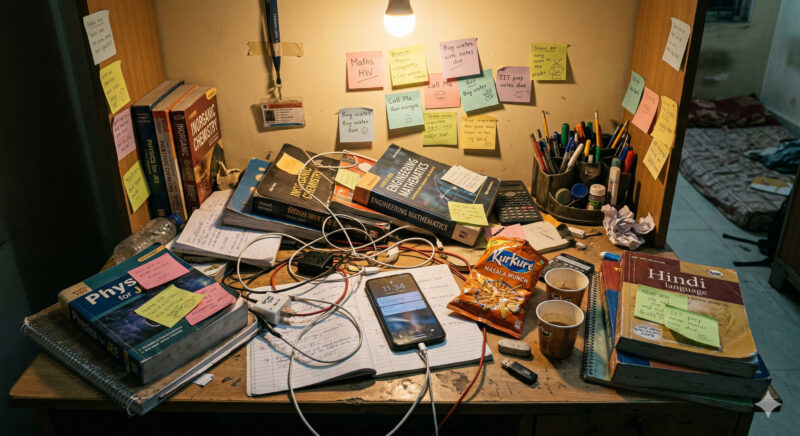
These aren’t hypothetical mistakes. These are the patterns that consistently appear in student setups that look good but don’t actually improve study quality.
10. Frequently Asked Questions
11. Conclusion
Building a solid study table setup under 2000 rupees in India is not a compromise — it’s a smart, strategically sequenced investment. You don’t need a premium desk, a standing desk converter, or a curated aesthetic setup to study effectively. You need a surface at the right height, a lamp that protects your eyes, an organised space that reduces friction, and the discipline to maintain it daily.
Start with the table and the lamp. That’s ₹800–₹1,500 and covers the two highest-impact elements. Add an organiser and desk pad in week two. Mount a small whiteboard in week three. By the end of the month, you’ll have a complete, functional study environment that you built intentionally — and one that actually reflects in your focus and your output.
The best desk setup is the one you actually sit at every day. Build it, maintain it, and then let it do its job.
🎯 Build Your Complete Student Productivity System
Your desk is ready — now complete the system with a daily routine and study strategy that actually sticks.

Flat USDT deductions make things simple, but they’re not always the cheapest
option.