
 Soyeb Akhtar
Let’s be honest. As a fresh commerce graduate, the job hunt can feel overwhelming. You open LinkedIn, type “entry level accounting jobs,” and stare at listings that say “2–3 years experience required.” It’s frustrating — and you’re not alone.
But here’s what most job guides won’t tell you: 2026 is genuinely one of the best years in a decade to enter the accounting profession. AI is automating the dull parts of the job (data entry, basic reconciliation), and companies are actively hiring freshers who can step in, learn fast, and grow with the firm.
According to a recent Fortune report, top universities in the US are seeing 95–97% placement rates for accounting graduates — with median starting salaries crossing $75,000. The picture in India is equally exciting, with demand for finance professionals rising sharply post-GST implementation.
This guide breaks down 12 entry level accounting jobs, what each pays in India, what skills you actually need, and where to apply. No fluff, just actionable career intel.
1. Why Accounting Is a Smart Career Choice in 2026
Accounting is often called the “language of business” — and every business, from a Bengaluru startup to a Mumbai conglomerate, needs someone who speaks it fluently.
Three reasons freshers should take accounting seriously right now:
- Job security is real. According to the U.S. Bureau of Labor Statistics, accounting jobs are projected to grow steadily. In India, GST compliance, MCA filings, and SEBI regulations have created millions of additional accounting positions.
- AI is your friend, not your enemy. Tools like AI-powered reconciliation and automated invoice processing are freeing accountants from tedious data entry. This means fresher roles now involve more analysis, client interaction, and problem-solving from Day 1.
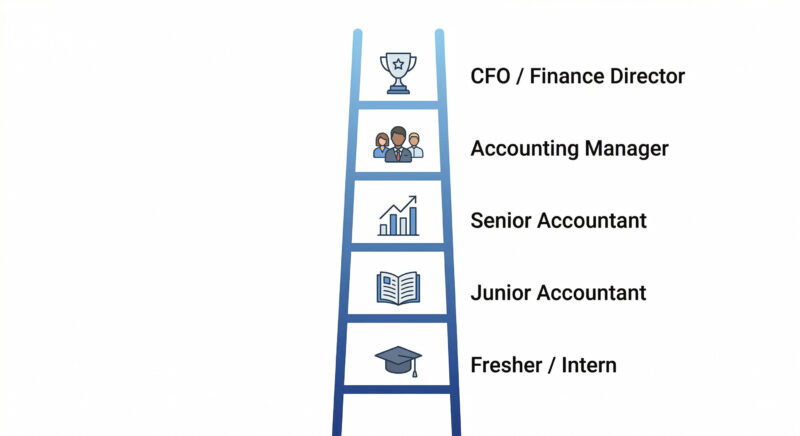
- Career mobility is unmatched. A junior accountant in a mid-sized firm can pivot to audit, taxation, corporate finance, or even entrepreneurship within 5 years.
If you’re still figuring out your career direction, take a look at our guide on 15 Passive Income Ideas for Students in India — some finance skills overlap and can help you build income while you study.
2. What Qualifications Do You Need?
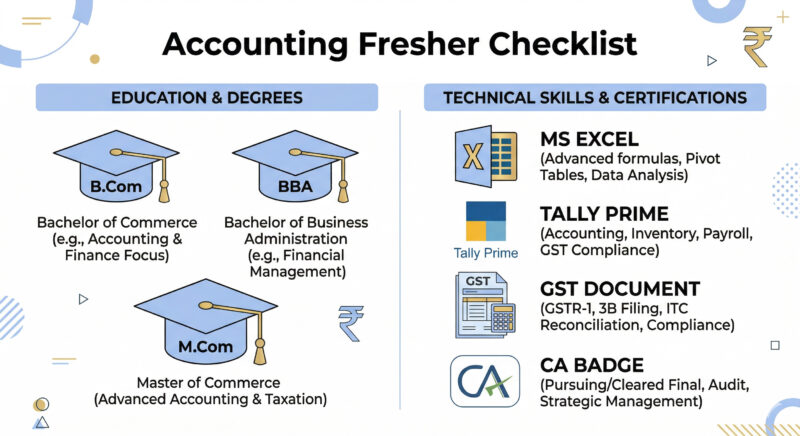
The good news: you don’t need a CA degree to land your first accounting job. Here’s a realistic breakdown of what qualifications get you through the door.
Minimum Qualifications
- B.Com / B.Com (Hons) — the most common entry point
- BBA (Finance) — great for corporate finance and analyst roles
- M.Com / MBA (Finance) — opens doors to analyst and senior clerk roles directly
- Diploma in Accounting / Tally — enough for bookkeeping and AP clerk jobs at SMEs
Certifications That Give You an Edge
- CA Foundation (ICAI) — even if you’re still pursuing CA, partial completion is a strong signal
- CPA (US-based) — ideal if you’re targeting MNCs or global accounting firms
- ACCA (UK-based) — highly valued in Big 4 firms and global companies
- GST Practitioner Certificate — practical, affordable, and in demand at Indian firms
- Tally Prime / QuickBooks Certification — a must-have for most entry level roles in India
As per Accounting.com, even an accounting certificate or associate degree is sufficient to land entry-level roles like bookkeeper or accounting clerk. Certifications matter more than the specific degree name on your resume.
3. Key Skills Every Accounting Fresher Needs
Hiring managers at accounting firms aren’t expecting you to know everything on Day 1. But they do expect you to come with a working toolkit. Here’s what matters most.
| Skill | Why It Matters | Priority |
|---|---|---|
| Microsoft Excel (VLOOKUP, Pivot Tables) | Used daily for financial data, MIS reports, reconciliations | Must Have |
| Tally Prime / Tally ERP 9 | Standard accounting software at 90% of Indian SMEs | Must Have |
| GST & TDS Basics | Required for invoice processing, return filing in India | Must Have |
| QuickBooks / Zoho Books | Used in startups and MNCs; great for remote accounting roles | Good to Have |
| Basic IFRS / GAAP principles | Helps with audit and junior accountant roles at larger firms | Good to Have |
| Attention to Detail | A single misplaced decimal can cost a company crores | Must Have |
| Communication Skills | You’ll coordinate with vendors, clients, and management | Must Have |
| AI Tools (ChatGPT, Copilot) | Increasingly used for drafting reports and summarizing data | Good to Have |
Strong focus and time management are equally important. If you’re still building those habits, our guide on How to Focus on Studies has practical techniques that translate directly into the workplace.
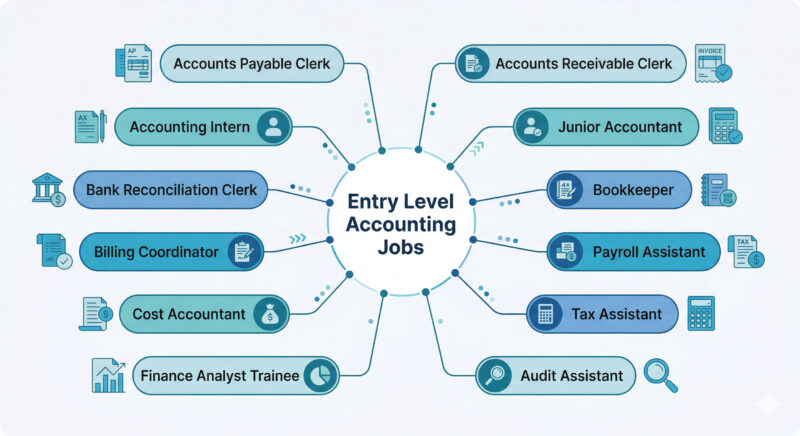
4. 12 Best Entry Level Accounting Jobs for Freshers in 2026
These roles are ranked roughly by how easy they are to break into — from the most accessible for a fresher to those that need a bit more background.
1. Accounts Payable (AP) Clerk
🌍 $38,000–$50,000/yr
An Accounts Payable Clerk is the most common entry point into accounting. You manage the company’s outgoing payments — processing vendor invoices, matching purchase orders, scheduling payments, and resolving discrepancies.
Think of it this way: your company orders 500 laptops from a vendor. Someone needs to receive the invoice, verify it against the purchase order, and ensure payment goes out correctly. That’s you.
- Process and enter supplier invoices into accounting software
- Match invoices with purchase orders and delivery notes
- Schedule and track payment due dates
- Assist with month-end closing entries
- Respond to vendor queries on payment status
Key Skills Needed
- Excel, Tally Prime or SAP (basic), attention to detail
- Understanding of GST / TDS on vendor payments
2. Accounts Receivable (AR) Clerk
🌍 $38,000–$52,000/yr
If Accounts Payable handles money going out, Accounts Receivable handles money coming in. As an AR Clerk, you track customer invoices, follow up on unpaid bills, and maintain records of payments received.
Example: You work at a textile exporter. Your job is to ensure that every client who bought fabric on credit actually pays within the agreed 30-day window — and to follow up politely when they don’t.
- Generate customer invoices and send them on time
- Record all incoming payments in the accounting system
- Follow up on overdue accounts (collections)
- Prepare accounts receivable aging reports
- Reconcile bank deposits with invoice records
3. Junior Accountant
🌍 $43,000–$58,000/yr
The Junior Accountant is the most versatile entry level accounting job. You assist senior accountants with a range of tasks — recording day-to-day transactions, preparing financial statements, and supporting audits.
This is the role where you learn the most in the shortest time. At a mid-sized firm, a junior accountant touches every part of the business’s financial cycle within 12 months.
- Record daily transactions in the general ledger
- Prepare trial balance and basic financial statements
- Reconcile bank accounts monthly
- Assist with GST returns, TDS filing, and payroll
- Support senior accountants on larger projects and audits
4. Bookkeeper
🌍 $40,000–$50,000/yr
Bookkeeping is the backbone of all accounting. A Bookkeeper maintains the day-to-day financial records — recording every transaction, categorising expenses, and keeping the accounts “books” balanced.
Bookkeeping is also one of the easiest entry level accounting jobs to do remotely or freelance, especially with cloud tools like QuickBooks Online and Zoho Books.
- Record sales, purchases, receipts, and payments daily
- Maintain petty cash and expense vouchers
- Reconcile bank statements every week or month
- Prepare basic P&L and Balance Sheet summaries
5. Payroll Assistant
🌍 $42,000–$55,000/yr
Payroll Assistants ensure every employee gets paid accurately and on time. You’ll work with HR to process monthly salaries, calculate PF (Provident Fund), ESI, TDS deductions, and maintain payroll records.
Payroll roles are highly stable — companies can’t delay paying employees, which means your role is always critical regardless of business cycles.
- Process monthly payroll in tools like GreytHR or Keka
- Calculate statutory deductions (PF, ESI, PT, TDS)
- Prepare salary slips and distribute them on time
- Maintain employee records and leave balances
- Assist with Form 16 preparation at year-end
6. Tax Assistant
🌍 $40,000–$55,000/yr
Tax Assistants support CA firms, tax consultancies, and corporate tax departments. You’ll assist in preparing and filing GST returns, income tax returns (ITR), and TDS returns under the supervision of a senior CA or tax manager.
This is an excellent role if you’re pursuing your CA inter or ACCA simultaneously — many CA firms hire freshers specifically in this capacity.
- Prepare GSTR-1, GSTR-3B, and annual returns
- Assist in filing individual and corporate ITR
- Compute and file TDS / TCS returns (Form 26Q, 24Q)
- Maintain tax-related documents and compliance calendar
7. Audit Assistant
🌍 $45,000–$60,000/yr
Audit Assistants work with statutory or internal auditors to verify whether a company’s financial records are accurate and compliant. This is especially common in Big 4 firms — Deloitte, PwC, EY, and KPMG — where freshers are hired as “Article Assistants” or “Associates.”
- Verify financial statements against source documents
- Test internal controls and flag weaknesses
- Prepare audit working papers and documentation
- Assist with stock verification and physical audits
- Draft audit reports with senior guidance
8. Finance Analyst Trainee / Intern
🌍 $40,000–$55,000/yr
Finance Analyst Trainee roles are common at MNCs, banks, and large corporates. You assist senior analysts with financial modelling, budgeting, forecasting, and MIS reporting. This is a great role if you want to move towards investment banking or corporate finance eventually.
- Prepare monthly MIS (Management Information System) reports
- Assist with budget variance analysis
- Maintain Excel-based financial models
- Track KPIs and present findings to senior management
9. Cost Accountant (Junior)
🌍 $44,000–$58,000/yr
Junior Cost Accountants are typically found in manufacturing companies, FMCG firms, and infrastructure companies. They analyse the cost of production, track material usage, and help management make pricing decisions.
- Track direct and indirect production costs
- Maintain cost sheets and BOM (Bill of Materials)
- Assist with standard costing and variance analysis
- Prepare cost reports for management review
10. Billing Coordinator
🌍 $36,000–$48,000/yr
Billing Coordinators are especially common in hospitals, IT service companies, and law firms. You prepare client invoices, track billing milestones, and ensure all billing data aligns with the service or project records.
- Generate and send invoices to clients on schedule
- Ensure billing accuracy against contracts or purchase orders
- Resolve billing disputes with clients
- Maintain billing records in ERP or billing software
11. Bank Reconciliation Clerk
🌍 $37,000–$50,000/yr
This is a focused, detail-intensive role where you match the company’s internal financial records with bank statements — identifying mismatches, pending clearances, and errors. It’s a great role for people who love precise, systematic work.
- Match bank statements with internal ledger entries
- Identify and investigate discrepancies
- Prepare monthly bank reconciliation statements (BRS)
- Report uncleared transactions to seniors
12. Accounting Intern (Remote / Hybrid)
🌍 $15–$22/hr (global)
Don’t underestimate internships. An accounting internship — even a 3-month remote one — can completely transform your resume and open doors that a degree alone never will. Many freshers turn a strong internship into a full-time offer at the same company.
Platforms like Internshala, LinkedIn, and AngelList regularly list accounting internships for students and recent graduates.
- Assist with data entry, invoice processing, and reconciliation
- Shadow senior accountants and learn real-world workflows
- Work with accounting tools like Tally, Zoho, or QuickBooks
- Build a real portfolio of financial work you can show in interviews
Even if an internship is unpaid or low-paid, the certification and reference letter you walk away with is worth 10x more in your first year of job hunting.
5. Salary Comparison at a Glance (India, 2026)
Here’s how the 12 roles stack up salary-wise for freshers in India. These figures are based on actual job listings on Naukri.com, LinkedIn India, and Glassdoor India as of early 2026.
Keep in mind that salaries at Big 4 firms (Deloitte, PwC, EY, KPMG) typically start 30–40% higher than the industry average. The trade-off? Longer hours and steeper learning curves — which most freshers actually appreciate early in their careers.
6. Where to Find Entry Level Accounting Jobs in India
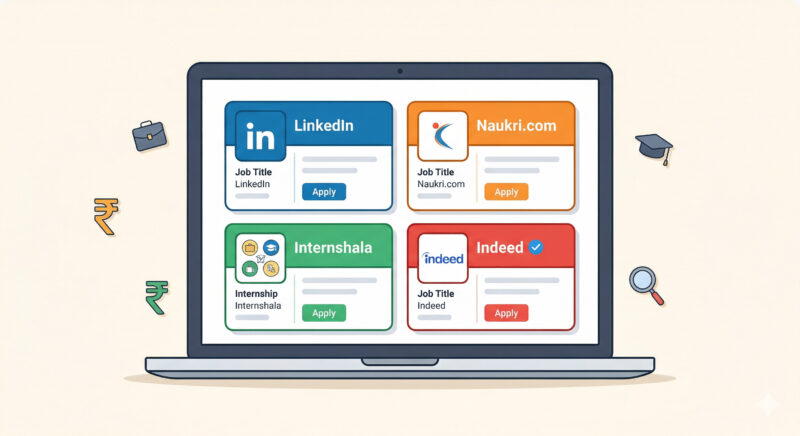
Knowing the roles is only half the battle. You also need to know where to look. Here are the best platforms — both for India and global opportunities.
🔵 LinkedIn India
Best for MNCs & Big 4
🟠 Naukri.com
India’s #1 job board
🟢 Internshala
Internships + fresher roles
🔴 Indeed India
Wide range, SMEs too
🟣 Glassdoor India
Check company reviews + apply
⚫ ICAI Job Portal
CA-specific openings
🔷 AngelList / Wellfound
Startup accounting roles
🟡 Shine.com
Tier 2 city roles
Do not pay any money to “placement agencies” promising accounting jobs. Legitimate employers in accounting never charge candidates a placement fee. Stick to the platforms listed above.
Building consistent work habits also plays a big role in your productivity during the job search. Our Daily Routine for Students guide has a structured schedule you can adapt for your post-graduation job search period.
7. Expert Tips to Land Your First Accounting Job
These tips come from patterns seen in hundreds of fresher hires — what works, what’s a waste of time, and what hiring managers actually look for in entry-level accounting candidates.
1. Get Tally Prime certified before you apply. A Tally certification costs ₹3,000–₹6,000 and takes 1–2 months. It instantly makes you more hireable for 80% of SME accounting roles in India. Don’t skip this.
3. Apply to CA firms, not just corporates. Chartered Accountant firms hire freshers heavily — often for article assistant, tax filing, or audit support work. These roles offer unmatched exposure to real accounting across multiple industries simultaneously.
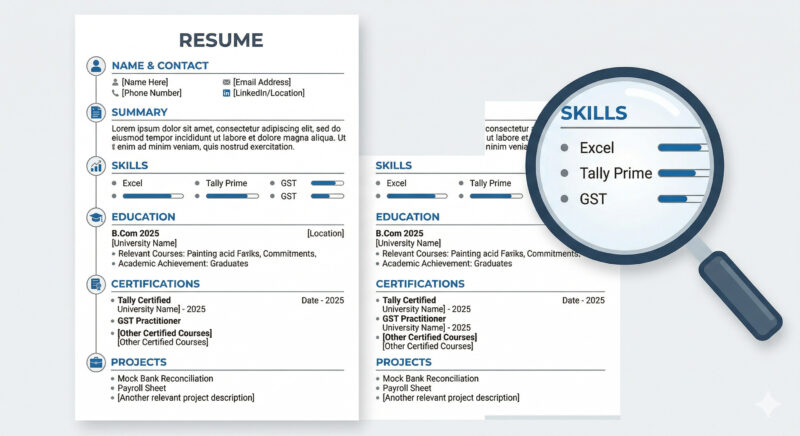
4. Customise your resume for each role. A resume for an AP Clerk role should lead with your invoice processing knowledge. A resume for a tax assistant should highlight your GST/TDS coursework. Generic resumes go to the bin. Read our guide on smart study techniques to build the focused learning habit this requires.
5. Network on LinkedIn before you need a job. Connect with junior and mid-level accountants, comment on their posts, and engage genuinely. When a position opens up, a LinkedIn connection mentioning your name to HR is more powerful than any cold application.
6. Learn one AI tool. ChatGPT, Microsoft Copilot, or Bard can now draft financial summaries, analyse data, and generate reports. A fresher who walks in knowing how to use AI tools alongside Excel is immediately more valuable than one who doesn’t.
8. Common Mistakes Freshers Make (And How to Avoid Them)
Even bright, qualified freshers make avoidable errors in their job search. Here are the most common ones — and how to sidestep them.
Applying only to big companies. Freshers obsess over landing a Deloitte or TCS role. Meanwhile, hundreds of mid-sized firms and CA practices are desperate for reliable, trained freshers. These smaller roles often offer faster promotion tracks and broader exposure.
Ignoring soft skills. Accounting is not just about numbers. You’ll regularly communicate with vendors, clients, and internal teams. Freshers who can’t write a clear professional email or explain a discrepancy confidently lose out — even if their technical skills are solid.
Using the same resume for every application. This is one of the most common and costly mistakes. Tailor your resume to each job description. Mirror the language the employer uses. If their JD says “accounts payable,” use that exact phrase — not “payment processing.”
Not knowing basic GST / TDS when applying in India. In interviews for accounting roles in India, interviewers almost always ask basic GST and TDS questions. Freshers who can’t explain what GSTR-3B is or the current TDS rate on rent make a poor impression. Study these before your first interview.
Waiting until you’re “fully ready.” You will never feel 100% ready. Apply when you have 60–70% of the listed requirements. Companies expect to train entry-level hires. The fresher who applies and learns outpaces the one who waits every time.
9. Frequently Asked Questions
Accounts Payable Clerk and Junior Accountant are the most accessible entry level accounting jobs for freshers. They require basic Excel knowledge, accounting fundamentals, and offer a clear path to senior roles. If you’re pursuing CA simultaneously, an Audit Assistant or Tax Assistant role at a CA firm is ideal.
Entry level accounting salaries in India range from ₹2.5 LPA to ₹5.5 LPA depending on the role, city, and company. Roles in Big 4 firms like Deloitte or PwC typically start at ₹4–6 LPA. In tier 2 and tier 3 cities, starting salaries are often 20–30% lower, but cost of living is also significantly lower.
No. For most entry level accounting jobs, a B.Com, BBA (Finance), or MBA (Finance) is sufficient. CA, CPA, or ACCA certifications are not required to start — but they accelerate your career growth significantly. Even a Tally Prime or QuickBooks certification can get you hired at an SME.
The top skills are: Microsoft Excel (VLOOKUP, Pivot Tables), Tally Prime or QuickBooks, GST and TDS basics, attention to detail, and good communication. AI tools like ChatGPT and Microsoft Copilot are increasingly valued. Learning even the basics of one cloud accounting tool — like Zoho Books — sets you apart from most freshers.
The best platforms are LinkedIn, Naukri.com, Internshala (for internships and fresher roles), Indeed India, and Glassdoor India. For CA-specific roles, the ICAI Job Portal is excellent. For startup accounting roles, check Wellfound (formerly AngelList). Always follow company career pages of firms you’re targeting — many post exclusively there before listing on job boards.
10. Conclusion
The path into accounting is more open than most freshers realise. Entry level accounting jobs are plentiful, pay reasonably well from Day 1, and — crucially — lead somewhere meaningful. Whether you become a CA, a CFO, or a freelance bookkeeper working remotely, it all starts with that first role.
Pick one or two roles from this list that excite you. Get the right certification. Build a small portfolio. Then apply — broadly, specifically, and consistently. The Indian accounting job market is hiring freshers right now. The only question is whether your name is in the right pile.
And while you’re building your accounting career, don’t forget that your student years are also the best time to build additional income. Check out our popular guide on passive income ideas for students in India — some of these work perfectly alongside an accounting internship or entry-level role.
Ready to Launch Your Accounting Career?
Explore more career guides, study tips, and money resources — built specifically for Indian students.