 Soyeb Akhtar
Quick Summary: Most Indian students study for hours but still don’t get the results they deserve — because they’re using the wrong study methods for exams. This in-depth guide reveals 10 science-backed methods used by CBSE toppers, JEE rankers, and NEET qualifiers. You’ll also get a 4-week study plan, subject-specific tips, and a free tool recommendation — everything in one place.
Every year, thousands of Indian students put in long hours of study — and still feel like the results don’t match the effort. If you’ve ever thought “I studied everything but still blanked in the exam,” the problem probably isn’t your intelligence or how hard you worked.
The problem is the method.
Science has known for decades that certain study methods for exams are dramatically more effective than others. Yet most students keep using the same passive techniques — re-reading notes, highlighting, copying text — that have been proven to be among the least effective approaches.
This guide changes that. Whether you’re preparing for CBSE Class 10 or 12 boards, JEE, NEET, or your university semester exams, the 10 methods below will transform how you study — and what you score.
The Science of Effective Studying (Why Method Beats Hours)
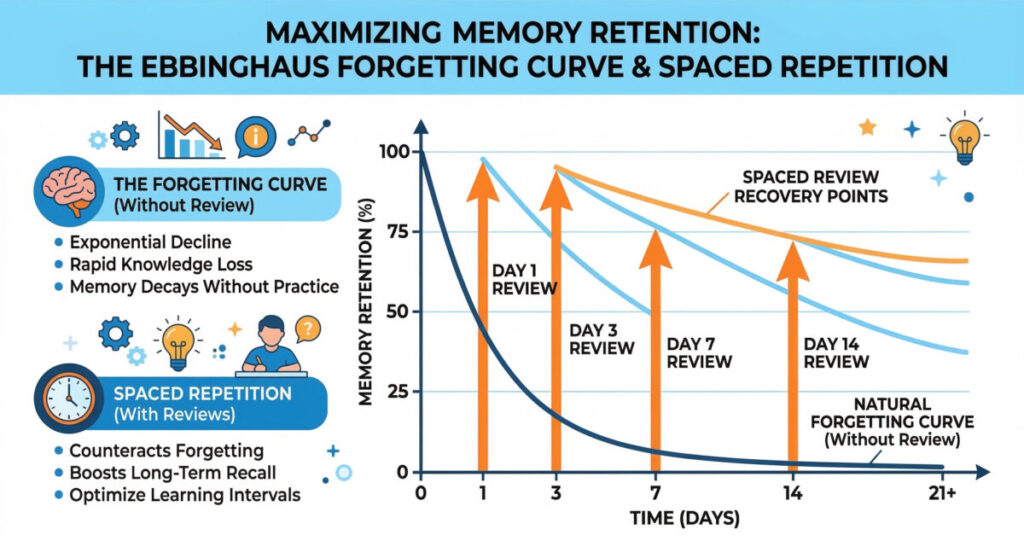
In the 1880s, German psychologist Hermann Ebbinghaus conducted a landmark experiment on memory. He discovered what we now call the Ebbinghaus Forgetting Curve — the finding that without any review, we forget approximately 70% of new information within 24 hours.
That means if you read a chapter today and never revisit it, by tomorrow you’ll remember barely 30% of what you studied. By the end of the week, it’s practically gone.
But here’s the powerful flip side: the right study methods for exams can slow this forgetting dramatically, and even reverse it. Techniques like Active Recall and Spaced Repetition have been shown in research at institutions like UCSD and Princeton to improve long-term retention by 40–60% compared to passive reading.
In short: it’s not how many hours you put in — it’s what you do during those hours. Let’s get into the methods that actually work.
10 Best Study Methods for Exams
01 Active Recall — The Most Powerful Study Method Known to Science Science #1
Active Recall means testing yourself on what you’ve studied instead of re-reading it. When you close your textbook and force your brain to retrieve information from memory, you are actively strengthening the memory pathway — making it easier to recall under exam pressure.
This is fundamentally different from passive revision. Re-reading your notes feels comfortable and familiar — but that feeling of familiarity is not the same as remembering. Active Recall is often uncomfortable, because it forces you to confront what you don’t know. And that discomfort is exactly where the learning happens.
How to practise Active Recall:
- Read a topic or chapter once with full attention.
- Close your book completely. Take a blank sheet of paper.
- Write down everything you can remember — in any order.
- Open your book and check what you missed.
- Repeat only for the gaps — not the whole chapter.
Other Active Recall tools:
- Flashcards: Write a question on one side, answer on the other. Test yourself daily using the Anki app (free).
- Practice questions: Answer past paper questions without looking at notes first.
- Teach it out loud: Explain the topic to yourself or a friend. This is the Feynman Technique (see Method 4).
Real Example: Anjali, a Class 12 PCB student from Nagpur, scored 93% in Biology. Her secret? She stopped reading her NCERT notes and started writing everything she remembered on a blank page after each chapter. “The first time I did it, I realised I actually remembered much less than I thought I did,” she said. “But after a week of daily recall practice, I could write out entire chapters from memory.”
02 Spaced Repetition — Stop Forgetting What You Studied Science #2
Spaced Repetition is the practice of reviewing material at gradually increasing time intervals. Instead of revising a chapter once and moving on, you revisit it after 1 day → 3 days → 7 days → 14 days → 30 days. Each time you review just before your brain is about to forget, the memory becomes significantly stronger.
This is the direct scientific counter to the Ebbinghaus Forgetting Curve — and it works remarkably well for the heavy memorisation demands of Indian board exams (think Biology diagrams, History dates, Chemistry equations, Geography facts).
How to implement Spaced Repetition:
- Option A (App): Use Anki — it automatically schedules your flashcard reviews using a spaced repetition algorithm. You just answer each card and rate how well you remembered it. The app does the rest.
- Option B (Manual): In your study planner, mark every topic with a review schedule: Day 1, Day 4, Day 10, Day 21. Check off each review as you do it.
03 The Pomodoro Technique — Study Focused, Not Longer
Named after the Italian word for tomato 🍅, the Pomodoro Technique is a time-management method developed by Francesco Cirillo. It divides your study session into 25-minute focused blocks (called Pomodoros) separated by short breaks.
Here’s why it works: the human brain can maintain deep focus for roughly 20–40 minutes before attention begins to degrade. Most Indian students ignore this and power through for hours — which leads to diminishing returns, mental fatigue, and poor retention. Pomodoro works with your brain’s natural focus cycle, not against it.
The Pomodoro cycle:
- Choose one specific task (e.g., “Complete Chapter 5 Active Recall”).
- Set a timer for 25 minutes. Study with 100% focus — phone in another room, notifications off.
- When the timer rings, take a 5-minute break. Stand up, stretch, drink water.
- After 4 Pomodoros, take a longer 20–30 minute break.
- Repeat until your session is done.
Try Learnox’s free Pomodoro Timer — it works in your browser, no signup needed, and is built specifically for students.
04 The Feynman Technique — The Topper’s Secret Weapon
Nobel Prize-winning physicist Richard Feynman had a guiding belief: “If you can’t explain something in simple terms, you don’t truly understand it.” His study method turns this into a 4-step process that builds deep understanding — not surface memorisation.
This is one of the best study methods for exams like JEE and NEET, where simply memorising formulas won’t work. You need to understand why and how things work to solve unseen problems.
The 4 steps:
- Pick a concept — for example, “Newton’s Second Law of Motion” or “Photosynthesis.”
- Explain it simply — write it down as if teaching it to a Class 6 student. No jargon.
- Find your gaps — wherever your explanation gets vague or uncertain, that’s your knowledge gap. Go back to your textbook and fill it.
- Simplify further — rewrite your explanation with analogies and everyday examples until it’s crystal clear.
Real Example: Rohan, who got AIR 847 in JEE Advanced, used this technique exclusively for Physics. “I never just read a derivation,” he said. “I would close the book and try to re-derive it from scratch in my own words. If I got stuck, I knew exactly what I didn’t understand. That’s where I focused.”
05 Mind Mapping — Organise Your Thinking Visually
A Mind Map is a visual diagram where you place the central topic in the middle of the page and branch out related subtopics, facts, and connections around it. Because your brain stores information in interconnected networks — not as linear lists — a mind map mirrors how memory actually works, making recall faster and more natural.
How to create an effective Mind Map:
- Start with the central topic in a circle in the middle (e.g., “The Mughal Empire”).
- Draw main branches for key sub-topics (e.g., “Rulers,” “Key Battles,” “Architecture,” “Administration”).
- Add smaller branches for supporting facts under each sub-topic.
- Use a different colour for each main branch — this improves memory recall by activating different parts of your brain.
- Add small sketches, symbols, or icons wherever possible — visual anchors make facts more memorable.
Mind Mapping works best for subjects with lots of interconnected content: History, Geography, Biology, Economics, and Political Science. It’s also a powerful tool for creating one-page chapter summaries before exams.

06 Interleaving — The Method Every Competitor Misses Underrated
Interleaving is one of the most powerful — and least known — study methods for exams. Instead of studying one subject or topic in one long block (called “blocked practice”), you mix up different topics or subjects within the same session.
For example, instead of:
Maths → Maths → Maths → Maths → (2 hours of only Maths)
You do:
Maths → Physics → Chemistry → Maths → Physics → Chemistry
This feels harder — and slightly uncomfortable. But that difficulty is why it works. Your brain has to work harder to retrieve information that it hasn’t just been exposed to — and that extra retrieval effort strengthens the memory. Research shows interleaving improves performance on mixed exams by 43% compared to blocked practice.
When to use Interleaving:
- During revision phase (last 4–6 weeks before exam).
- Ideal for solving mixed problem sets in Maths, Physics, and Chemistry.
- Use the Learnox Study Planner to schedule interleaved sessions across subjects.
07 Cornell Note-Taking Method — Notes That Double as a Revision Tool
The Cornell Method turns your class notes into a ready-made self-testing tool. Developed at Cornell University in the 1950s, it divides each page into three sections that serve different purposes.
Page layout:
- Right column (large, ~70% of width): Main notes — key ideas, explanations, examples. Write during class or while reading.
- Left column (narrow, ~30%): Keywords, questions, and cues. Fill this in after your study session by reviewing your right-column notes.
- Bottom section (~5–6 lines): A brief 2–3 sentence summary of the entire page, written in your own words.
How to use Cornell Notes for revision: Cover the right column with a piece of paper. Use the left-column keywords and questions to test yourself — try to recall the content. This instantly turns your notes into an Active Recall exercise every time you revise.
08 Practice Tests & Past Papers — Simulate the Exam Before the Exam
Solving past year papers and taking timed practice tests is consistently rated as one of the most effective study methods for board exams in India. It does three things simultaneously: it tests your knowledge, familiarises your brain with the exam format, and — crucially — it is itself a form of Active Recall.
Research from Washington University found that students who were tested on material they had studied retained significantly more one week later than students who spent the same time re-studying the material. This phenomenon is called the Testing Effect — and past papers leverage it perfectly.
How to use past papers correctly:
- Start early — begin solving past papers at least 5–6 weeks before your exam, not the week before.
- Simulate real conditions — full paper, timer running, no textbook, no phone.
- Analyse every mistake — don’t just mark it wrong. Write down the concept behind each error.
- Maintain an Error Notebook — one dedicated notebook for all mistakes and their correct explanations.
- Review your Error Notebook every Sunday — without fail.
For CBSE board students, 10+ years of past papers and official sample papers are available free on the CBSE Academic Portal.
09 Colour-Coded Notes — Simple, Fast, and Surprisingly Effective
Using multiple colours while taking notes improves memory recall by helping your brain categorise and organise information visually. It’s one of the quickest upgrades you can make to your existing study habit — you just need a few different pens or highlighters.
A simple colour system that works:
- 🔴 Red: Definitions, key terms, and formulas you must memorise.
- 🔵 Blue: Main concepts and explanations.
- 🟢 Green: Examples, case studies, and real-world applications.
- 🟠 Orange: Dates, statistics, and numbers to remember.
- 🟡 Yellow Highlighter: The single most important line on the page.
Consistency is key. Use the same colour for the same type of information across all your notebooks. After a few weeks, your brain will start associating the colour with the type of information — making retrieval faster.
If you prefer digital notes, check out Learnox’s guide on the best free note-taking apps for students — many of them support colour tagging.
10 The Blurting Method — Active Recall Made Even Simpler
The Blurting Method is a refreshingly simple form of Active Recall that’s been gaining popularity among students worldwide (it was popularised by YouTuber Unjaded Jade). Here’s how it works:
- Read a topic or section of your notes carefully once.
- Close the notes completely.
- On a blank page, “blurt” out everything you remember — write quickly without worrying about organisation, grammar, or structure. Just get it all out.
- Open your notes and check what you forgot. Highlight or mark those gaps in red.
- Re-read only the sections you forgot. Blurt again. Repeat until there are no more red gaps.
The Blurting Method is particularly useful for Biology (huge amount of content to memorise), History (events, dates, causes), and Economics (theories and examples). It’s also a great method for last-day revision since it quickly reveals exactly what your brain has retained and what still needs work.
Which Study Method Is Right for You?
Every student is different. Here’s a quick reference table to help you pick the best study methods for exams based on your learning style, subject, and timeline.
| Method | Best For | Best Subjects | Time Needed |
|---|---|---|---|
| Active Recall | All learner types | All subjects | Medium |
| Spaced Repetition | Students with lots to memorise | Biology, History, Chemistry | Low (15 min/day) |
| Pomodoro Technique | Students with focus issues | All subjects | Ongoing |
| Feynman Technique | Conceptual learners | Physics, Maths, Chemistry | Medium–High |
| Mind Mapping | Visual learners | History, Biology, Geography | Medium |
| Interleaving | Revision phase students | Maths, Physics, Chemistry | Medium |
| Cornell Notes | Students who take a lot of notes | Economics, History, Biology | Low (setup once) |
| Past Papers | Exam-focused students | All subjects | High |
| Colour-Coded Notes | Visual learners | All subjects | Very Low |
| Blurting Method | Last-day/rapid revision | Biology, History, Economics | Low |

Effective Study Methods for Board Exams in India
Indian board exams have unique characteristics that demand specific strategies. Here’s what works best for each type of exam:
CBSE Class 10 & 12 Board Exams
- NCERT first, always. CBSE papers are heavily based on NCERT textbooks. Master every line before moving to reference books.
- Active Recall + Spaced Repetition for Science and Social Science — enormous content, high memory demand.
- Past papers + CBSE Sample Papers (released every year) — essential for understanding the latest question pattern and marking scheme.
- Cornell Notes for Economics, Political Science, and History — great for dense, text-heavy chapters.
- Feynman Technique for Physics and Chemistry concepts that have underlying logic.
JEE Main & Advanced
- Feynman Technique is non-negotiable here. JEE tests deep understanding — you must know the why behind every formula.
- Interleaving during revision phase — solve mixed problem sets from multiple chapters to replicate JEE’s unpredictable format.
- Error Notebook — the single most underrated tool for JEE aspirants. Every wrong answer is a learning opportunity.
- Solve minimum 20 years of JEE past papers — many concepts and question styles repeat across years.
NEET
- Spaced Repetition via Anki is the best friend of every NEET aspirant. The sheer volume of Biology content makes this essential.
- Mind Maps for Biology chapters (especially plant and animal physiology, genetics, ecology) — connect complex processes visually.
- Blurting Method for quick daily Biology revision — especially effective for the last month before NEET.
- Solve NCERT Biology line by line — NEET Biology questions are notorious for testing specific NCERT lines.
Subject-Specific Study Tips for Indian Students
📐 Mathematics
- Math is a doing subject, not a reading subject. You cannot learn Maths by reading solved examples — you must solve problems yourself.
- After understanding a concept, solve 10 problems immediately. Then solve 10 more the next day (Spaced Repetition).
- Use Interleaving during revision — mix problems from different chapters to sharpen problem identification skills.
- Never skip steps while solving — examiners mark each step, and full working shows understanding.
🔬 Biology
- This is the most content-heavy subject in Indian board exams. Spaced Repetition with Anki flashcards is essential.
- Draw every diagram yourself at least 3 times — never just memorise a label list.
- Use Mind Maps for broad chapters (like Biological Classification, Ecology).
- Use the Blurting Method for the last 2 weeks before the exam.
⚗️ Chemistry
- Split Chemistry into three zones: Physical (problem-solving, like Maths), Organic (reaction mechanisms + logic), and Inorganic (memorisation).
- For Organic Chemistry, use the Feynman Technique — understand reaction logic, don’t just memorise reactions.
- For Inorganic, use Spaced Repetition and colour-coded notes.
📖 History & Social Science
- Never try to memorise History as isolated facts. Build a Mind Map of each chapter to understand how events connect.
- Use Cornell Notes while reading — the summary section forces you to process and paraphrase content.
- Practice 3–4 mark and 5-mark answer writing using past papers. History marks are lost more due to poor answer structure than lack of knowledge.
💡 Expert Tips from Indian Toppers
Your brain’s prefrontal cortex — the part responsible for focus, decision-making, and memory consolidation — is most active in the morning. India’s top rankers consistently say morning study hours are their most productive. Even 1–1.5 focused morning hours beats 3 distracted evening hours. Check out Learnox’s guide on building a morning study routine to make this habit stick.
During sleep, your hippocampus transfers what you studied into long-term memory. Students who sleep 7–8 hours retain significantly more than those who pull all-nighters. An all-nighter before an exam is one of the worst strategies possible — you arrive exhausted, anxious, and with weakened recall. Protect your sleep like you protect your study time.
Research from Princeton University found that students who take handwritten notes understand and retain content better than those who type the same material. Writing by hand forces you to paraphrase and process — which is a form of Active Recall. Typing often becomes mindless transcription.
Your environment conditions your focus. If you always study at the same desk, your brain starts associating that space with concentration. Keep your phone out of reach during study blocks. If you’re in a small room, read Learnox’s guide on creating a productive study space — even a small room can be optimised.
Studying for 6 hours means nothing if you can’t recall what you covered. At the end of every session, test yourself on 3–5 key things you learned. If you can’t recall them, those hours weren’t as productive as you thought. Use Learnox’s free Study Planner to track both hours and chapter completion.
❌ Common Study Mistakes Indian Students Must Stop Making
This is the #1 most common — and least effective — study habit. Re-reading creates a false sense of familiarity. You think you know the material because it feels familiar when you read it. But familiar is not the same as retrievable. Replace re-reading with Active Recall and Blurting.
Short-term cramming stores facts in your working memory, which collapses under exam pressure. Information stuffed in at 2 AM may not survive until the exam the next morning — and even if it does, it disappears within days. Spaced Repetition across weeks is always more reliable.
“I’ll study for 3 hours” is not a goal — it’s a time commitment. A real goal is “I’ll complete the Active Recall exercise for Chapter 8 and solve 15 past paper questions.” Vague sessions produce vague results. Use the Study Planner to set specific daily targets.
Many Indian students feel guilty taking breaks, equating rest with laziness. In reality, without regular breaks, your focus degrades sharply after 45–60 minutes and you enter a state of pseudo-studying — eyes on the book, brain elsewhere. Schedule breaks deliberately, like a professional athlete schedules rest days.
Past papers are not just revision tools — they’re diagnostic tools. Solve them 5–6 weeks before the exam to reveal your gaps while you still have time to fill them. The students who start past papers early consistently outperform those who leave them for the last week.
Long hours of studying feel impressive, but they can create an illusion of preparedness. Every 2–3 hours, do a quick 10-minute Blurt test on what you just covered. If you can’t reproduce the key points, you need to revise differently — not longer. Check out Learnox’s guide: how to study for long hours without losing focus.
😰 Dealing with Exam Anxiety — The Part No Competitor Covers
Exam anxiety is a real and serious issue for millions of Indian students — yet almost no study method guide ever addresses it. Here’s the truth: even the best study methods for exams won’t deliver results if anxiety shuts your brain down in the exam hall.
Why Exam Anxiety Happens
Anxiety typically comes from one of three sources: inadequate preparation, fear of disappointing family, or the pressure of high-stakes competitive exams. Knowing the source helps address it directly.
Practical Strategies That Actually Work
- Practise under exam conditions: The more you simulate the actual exam environment during practice (timed, silent, no help), the less threatening the real exam feels. Familiarity reduces fear.
- Focus on process, not outcome: Control what you can — your daily study hours, the chapters you cover, the past papers you solve. The result follows the process. Worrying about the result without controlling the process is entirely counterproductive.
- Box Breathing before the exam: Breathe in for 4 counts, hold for 4, breathe out for 4, hold for 4. Repeat 4 times. This activates the parasympathetic nervous system and measurably reduces anxiety response within 2–3 minutes.
- The night before: Light review only — key formulas, mind maps, a quick blurt test. No new topics. Eat well, sleep by 10:30 PM. Your brain needs rest, not more information.
- During the exam: If you blank on a question, skip it and come back. Never spiral into panic. Mark it, move on, return with a clearer head.
📅 4-Week Exam Preparation Plan Using These Methods
Here’s a practical plan that combines all 10 study methods for exams. Adjust the timeline based on your specific exam date.
Week 1 — Foundation & Understanding
- Use PQ4R / active reading to go through all chapters once with genuine understanding.
- Create Mind Maps for every chapter as you finish it.
- Begin your Anki flashcard deck — add definitions, formulas, and key facts as you go.
- Set your study schedule in the Learnox Study Planner with daily targets.
- Start the Pomodoro Technique from Day 1 — study in 25-minute focused blocks.
Week 2 — Active Recall & Deep Revision
- Switch from reading to Active Recall — test yourself on every chapter.
- Use the Feynman Technique on all concept-heavy topics (Physics laws, Chemical reactions, Economic theories).
- Review Anki flashcards every morning for 15–20 minutes (Spaced Repetition in action).
- Solve 2 past papers per week under timed conditions. Begin your Error Notebook.
- Use Cornell Notes to organise and summarise key chapters for text-heavy subjects.
Week 3 — Practice & Gap Filling
- Increase past paper practice to 4 papers per week. Focus on weak areas revealed by your Error Notebook.
- Switch to Interleaving — mix problems from multiple chapters in each session.
- Use Colour-Coded Notes to revise weak chapters efficiently.
- Review Error Notebook every 2 days. Re-test yourself on previously wrong questions.
- Continue Spaced Repetition reviews — Day 7 and Day 14 intervals.
Week 4 — Final Revision & Confidence
- Solve full-length papers under strict exam conditions every other day.
- Use the Blurting Method each morning for rapid, high-density revision.
- Do final review using Mind Maps and Cornell Notes summaries — no dense reading.
- Review Error Notebook one final time. Focus only on red-flagged items.
- 7–8 hours of sleep every night this week — absolutely non-negotiable.
- Night before exam: Key formulas, Mind Map overview, one Blurt test. In bed by 10:30 PM.
Alt text: “4-week exam preparation study plan timetable for Indian board exam students”
AI Prompt: “Clean and colorful 4-week study timetable calendar for Indian students, showing Week 1–4 with labeled study phases — Foundation, Active Recall, Practice, Final Revision — designed like a printable planner, flat lay on white background with a pen and highlighters”
❓ Frequently Asked Questions
Which is the best study method for board exams in India?
Active Recall combined with Spaced Repetition is the most effective combination for CBSE, ICSE, and State Board exams. Active Recall forces your brain to retrieve information under pressure (which strengthens memory), while Spaced Repetition ensures you review at scientifically-timed intervals so that content sticks in long-term memory — not just for the exam, but for months after.
How many hours should a student study per day for exams?
Research consistently shows that 4–6 hours of focused, distraction-free study per day is more productive than 10+ hours of scattered, phone-interrupted studying. Use the Pomodoro Technique (25 minutes on, 5 minutes off) to maintain quality throughout those hours. If you want to build your capacity to study for longer without losing focus, check out Learnox’s guide on tips to study for long hours.
How can I stop forgetting what I studied the night before?
Use Spaced Repetition. Review your notes after 1 day, then 3 days, then 7 days, then 14 days. This directly fights the Ebbinghaus Forgetting Curve. Pair this with Active Recall — don’t just re-read; test yourself. For automated spaced review, use the free Anki app.
Is the Pomodoro Technique effective for Indian students?
Absolutely. Indian students often push through 3–4 hour study blocks without breaks, which leads to mental fatigue and poor retention. Pomodoro’s 25-minute focused blocks with deliberate breaks work with your brain’s natural attention cycle — not against it. Use Learnox’s free Pomodoro Timer to get started immediately.
What is the Feynman Technique and how do I use it for exams?
The Feynman Technique means picking a concept, writing everything you know about it in plain language, then explaining it as if teaching a Class 6 student. Wherever your explanation becomes vague or falters, that is your knowledge gap — go back to that section and re-study it. This method builds deep conceptual understanding and is especially powerful for Physics, Chemistry, and Mathematics.
Conclusion — Your Exam Success Starts Today
There you have it — 10 science-backed, topper-tested study methods for exams, with step-by-step instructions, real Indian student examples, subject-specific strategies, and a complete 4-week plan.
To recap the most important takeaways:
- Active Recall + Spaced Repetition is the most powerful study combination known to science. Start using it this week.
- Pomodoro Technique protects your focus and energy throughout long study days.
- Past Papers + Error Notebook is your clearest roadmap to exam success.
- Feynman Technique + Interleaving are the secret weapons your competitors aren’t using.
- Sleep, routine, and a clear daily plan are not optional — they are part of the strategy.
You don’t need to implement all 10 methods overnight. Start with Active Recall and the Pomodoro Technique this week. Add Spaced Repetition in Week 2. Build from there. Small, consistent changes compound into massive exam-day advantages.
The students who outscore you are not smarter. They just study smarter. And now, so can you.
🚀 Start Studying Smarter — Right Now
Use Learnox’s free tools built for Indian students. No signup. No cost. Just results.
📅 Free Study Planner
🍅 Free Pomodoro Timer
📝 Best Note-Taking Apps
Evidence-Based Learning Methods — UC San Diego Psychology Dept. |
Official CBSE Sample Papers — CBSE Academic Portal |
Anki — Free Spaced Repetition App |
Coggle — Free Mind Mapping Tool