
 Soyeb Akhtar
A solid morning routine for students study is the single most underrated habit that separates average students from toppers. It’s not about waking up at 4 AM and grinding for 6 hours straight. It’s about spending the first 60–90 minutes of your day in a way that primes your brain, sharpens your focus, and builds the kind of daily discipline that actually moves the needle on your results. In this guide, you’ll get 7 science-backed, practical steps — plus a ready-to-use morning schedule — built specifically for Indian students preparing for boards, entrance exams, college exams, or just trying to stay on top of their studies.
Why Your Morning Routine for Study Determines Your Entire Day
Here’s something most students don’t want to hear: how you spend your first 60 minutes after waking up decides the quality of everything that follows. Your focus level, your mood, your energy, your memory retention — all of it is shaped by what happens in those first few moments of the day.
Most Indian students wake up in a rush. Alarm buzzes, they hit snooze three times, scroll Instagram for 20 minutes, then panic-eat whatever’s available before running to college or coaching. That’s not a morning — that’s a controlled disaster. And it affects their entire study session later.
A proper morning routine for students study flips that completely. When you start the day with intention — water, movement, a nutritious breakfast, a few minutes of mental clarity — your brain enters its first study session already warmed up. It’s like running a race after a proper warm-up versus starting cold. The difference in performance is massive.
Think about Rahul, a JEE aspirant from Kota. He used to study till 2 AM and wake up at 9 AM, groggy and disoriented. His retention was poor, his revision was patchy. One month into following a structured morning routine for students study — 6 AM wake-up, 20-minute walk, light breakfast, 90-minute focused study block — his mock test scores jumped by 18 marks on average. Same content, different system.
of top-ranking students follow a consistent morning routine
better memory retention reported in morning study sessions vs evening
average time to form a solid morning habit, per University College London research

The Science Behind Morning Study – What Research Actually Says
This isn’t motivation-poster advice. There is real, published research that explains why a structured morning routine for students study outperforms random, unplanned study sessions.
🧠 Cortisol and Cognitive Sharpness
Your body naturally releases the highest levels of cortisol — a hormone that boosts alertness and focus — within the first 30–60 minutes of waking up. This natural spike is known as the Cortisol Awakening Response (CAR). Studying during this window means you’re working with your biology, not against it.
🛌 Sleep and Memory Consolidation
While you sleep, your brain consolidates the information you studied the previous day. This means your morning brain has literally just processed and stored your last study session. Starting a new study block in the morning builds directly on top of that — your brain is ready to absorb, not saturated.
📵 Fewer Distractions = Deeper Focus
Between 5:30 AM and 8:00 AM, your phone gets barely any notifications. Nobody is texting. Group chats are quiet. The world hasn’t started demanding your attention yet. That silence is gold for a productive morning routine for students study.
“Willpower is highest in the morning. Every decision you make during the day depletes it slightly. Students who do their most difficult studying in the morning use fresh willpower — not the leftovers.”
— Based on research published in the Journal of Personality and Social Psychology
The data is clear. Building a morning routine for students study isn’t a lifestyle trend. It’s a cognitive strategy — and it works.
7 Steps to Build the Perfect Morning Routine for Students Study
These steps aren’t pulled from some productivity influencer’s fantasy. They’re designed specifically for Indian students — realistic, budget-friendly, and built around a typical student’s daily schedule.
Wake Up at a Fixed Time — Every Single Day
⏰ Duration: Habit, not a task
The foundation of every good morning routine for students study is a consistent wake-up time. Not 6 AM on weekdays and 10 AM on weekends. Consistent means every day — including Sundays.
Why does this matter so much? Your body runs on a circadian rhythm — an internal 24-hour clock. When you wake up at the same time daily, your body starts preparing for wakefulness about an hour before the alarm. You wake up feeling more alert, less groggy. When you sleep in on weekends, you reset this clock — which is literally called “social jet lag” by sleep researchers.
Actionable tip: Set one alarm. Not five. One. Put it across the room so you physically have to get up to turn it off. The moment your feet hit the floor, the battle is 80% won.
- Recommended wake-up time: 5:30 AM – 6:30 AM for most students
- If you sleep at 11 PM, 6 AM gives you a solid 7 hours
- Don’t aim for 4 AM if you’re currently waking at 9 AM — shift gradually by 15 minutes every 3 days
Hydrate Before You Do Anything Else
⏰ Duration: 2 minutes
Your body loses roughly 500ml of water overnight through breathing and sweating. You wake up mildly dehydrated every single morning — even if you don’t feel thirsty. And dehydration, even mild, reduces your ability to concentrate, causes headaches, and makes you feel sluggish.
The fix is embarrassingly simple: drink one full glass of water (250–500ml) within the first 5 minutes of waking up. Keep a water bottle on your nightstand the night before so there’s zero friction. No reaching for your phone first. Water first.
Optional upgrade: Squeeze half a lemon into warm water. It’s a popular Ayurvedic habit, it supports digestion, and the slight tartness genuinely helps you feel more awake. Many students who build a morning routine for students study report this as the single easiest habit that made the biggest immediate difference.
- Drink 1 glass of water — cold or warm, your preference
- Keep phone out of reach until after hydration
- Avoid tea or coffee as your first drink — it’s a diuretic and increases dehydration
Move Your Body — Even for Just 10 Minutes
⏰ Duration: 10–20 minutes
You don’t need to run 5km or hit the gym at 6 AM. Ten minutes of physical movement — stretching, a short walk, yoga, surya namaskars, or even jumping jacks — floods your brain with BDNF (Brain-Derived Neurotrophic Factor), which scientists literally call “Miracle-Gro for the brain.”
This morning movement is one of the most powerful, underused elements of a morning routine for students study. Students who add even 10 minutes of light exercise before studying consistently report sharper focus and better retention in their first study session of the day.
Real example: Anjali, a Class 12 student from Pune preparing for NEET, started doing 15 minutes of yoga every morning. Within two weeks, she said, “I don’t know what happened, but I feel so much more awake during my morning study block. My notes are cleaner and I actually understand what I’m reading.” That’s BDNF doing its job.
- Option 1: 10 surya namaskars (full body warm-up)
- Option 2: 15-minute walk — even inside your building corridor
- Option 3: 10 minutes of stretching (YouTube has free guided sessions)
- Option 4: 20 jumping jacks + 10 push-ups + 10 squats — done in 8 minutes

Eat a Brain-Boosting Breakfast — Never Skip It
⏰ Duration: 15–20 minutes
Skipping breakfast and going straight to studying is one of the most counterproductive things a student can do. Your brain runs on glucose. After 7–8 hours of sleep (fasting), your blood glucose is at its lowest. Trying to study in this state is like trying to run a car with no fuel.
Your breakfast doesn’t need to be elaborate. It needs to be nutritious, quick, and sustainable — not something that spikes your blood sugar and crashes it 45 minutes later (which is what happens when you eat only biscuits or plain white bread).
Best breakfast options for a productive morning routine for students:
- 🥜 Soaked almonds + banana + a glass of milk — classic and incredibly effective
- 🥚 2 boiled eggs + whole wheat toast + a fruit — protein-packed, keeps you full till lunch
- 🌾 Poha or upma — light, easy to digest, and slow-releasing carbs that fuel 90-minute study blocks
- 🥣 Oats with milk and a handful of nuts — minimal prep, maximum nutrition
- 🫘 Sprouts chaat — high protein, Indian, and takes 5 minutes to prepare
What to avoid: Sugary cereals, biscuits alone, chai on an empty stomach, or just a few bites of leftover roti. These give you a quick energy spike followed by a crash — exactly what you don’t want before a study block.
For more on brain-boosting foods, check our guide on healthy snacks that boost brainpower — many of those snacks work brilliantly as breakfast additions too.
Spend 5–10 Minutes on Mental Clarity
⏰ Duration: 5–10 minutes
This is the step most students skip — and it’s the one that makes the biggest difference to study quality. Before you open your books, spend 5–10 minutes preparing your mind. Think of it as warming up before a gym session, but for your brain.
You have three options here — pick whatever feels natural:
Option A: Journal for 5 Minutes
Write down three things you’re grateful for, one study goal for the day, and one thing you’re looking forward to. This takes 5 minutes and dramatically reduces the anxiety that often blocks concentration. It’s not “soft” — journaling is used by athletes, CEOs, and toppers worldwide.
Option B: Deep Breathing or Meditation
Apps like Headspace or YouTube free guided meditations offer 5-minute sessions. Even simple box breathing (inhale 4 seconds, hold 4 seconds, exhale 4 seconds, hold 4 seconds — repeat 4 times) activates your parasympathetic nervous system and reduces cortisol spikes from stress.
Option C: Review Your Study Plan for the Day
Open your planner or note-taking app and review what you’re going to study today. Not to panic about it — just to orient your brain. When your mind knows what’s coming, it starts preparing in the background. You’ll find it easier to sit down and start studying without the usual “where do I even begin?” paralysis.
Start Studying with Your Hardest Subject First
⏰ Duration: 60–90 minutes
This is where the morning routine for students study pays off in full. You’ve hydrated, moved, eaten, and mentally prepared. Now your brain is at its sharpest — highest willpower, freshest working memory, lowest distraction. This is the window to attack your hardest subject.
Not the easy stuff. Not revision of concepts you already know. The hardest, most uncomfortable topic on your syllabus — the one you’ve been avoiding. Put that first.
This idea comes from Brian Tracy’s “Eat the Frog” principle — tackle your biggest, most difficult task when your energy is highest. For students, the frog is always the subject they fear the most: Organic Chemistry for NEET students, Mathematics for JEE aspirants, Essay writing for UPSC students.
How to structure your morning study block:
- Use the Pomodoro method: 25 minutes study + 5 minutes break
- Complete 3 Pomodoros = 90 minutes of deep work
- Keep your phone in a different room or on DND
- Have a glass of water on your desk — not tea yet (caffeine is better used in the mid-morning dip, around 9:30 AM)
- Work on active recall — not passive reading — to maximize retention
Set up your study space properly before this block begins. A clean desk makes an enormous difference. Check our guide on DIY study table organization hacks for practical, free ideas.
End Your Morning Block with a Quick Revision Recap
⏰ Duration: 10–15 minutes
Before you close your books and move on with your day, spend the last 10–15 minutes doing a quick recap of what you studied this morning. Don’t re-read it — instead, close the book and try to recall the main points from memory. Write them down in your note-taking app or on a piece of paper.
This technique — called active recall — is the most powerful revision tool known to learning science. It forces your brain to retrieve information rather than just passively recognize it. Retrieval practice creates stronger, longer-lasting memories than re-reading ever can.
This quick 10-minute recap at the end of your morning routine for students study effectively doubles the retention from the session. Your brain has just encoded the material twice — once during study, once during recall. That’s two full encoding cycles before 8 AM.
- Close your book and write down everything you remember
- Use flashcards (physical or apps like Anki) for key formulas or dates
- Say it out loud — verbal recall is even more powerful than written
- Tick off what you covered in your planner — the visual confirmation boosts motivation
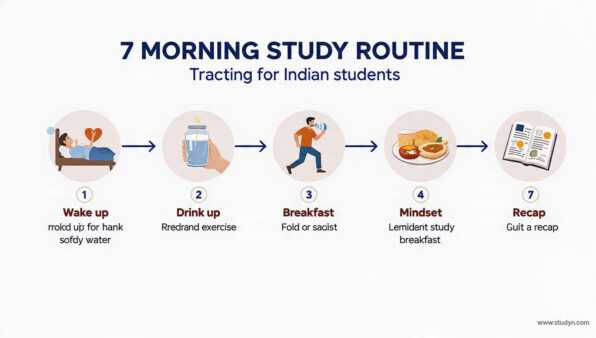
Complete Sample Morning Schedule for Students – With Timings
Here’s a full, ready-to-use schedule based on the 7 steps above. This is a productive morning routine for students that you can copy, adjust to your timings, and start tomorrow:
| Time | Activity | Duration | Notes |
|---|---|---|---|
| 6:00 AM | Wake up — alarm across the room | – | No snooze. Feet on floor immediately. |
| 6:00–6:05 AM | Drink 1 full glass of water | 5 min | Keep bottle on nightstand the night before. |
| 6:05–6:20 AM | Freshen up — brush, wash face | 15 min | Cold water splash on face works better than coffee. |
| 6:20–6:40 AM | Light exercise — yoga / walk / stretching | 20 min | No gym required. 10 surya namaskars are enough. |
| 6:40–7:00 AM | Nutritious breakfast | 20 min | No scrolling during breakfast. Eat mindfully. |
| 7:00–7:10 AM | Journaling / review daily study plan | 10 min | Write today’s 3 study goals. Review yesterday’s progress. |
| 7:10–8:40 AM | Deep study block — hardest subject first | 90 min | 3 × Pomodoros. Phone on DND. Door closed if possible. |
| 8:40–8:55 AM | Active recall recap | 15 min | Close book. Write / say what you remember. Check gaps. |
| 8:55 AM | Morning routine complete ✅ | – | College, coaching, or next study block starts fresh. |
You’ve done 90 minutes of your best studying by 9 AM — before most people have even had their first chai. That’s the power of a structured morning routine for students study.
Morning Routine Variants by Exam Type
Not all students have the same study needs. Here’s how to adjust the core morning routine for students study based on what you’re preparing for:
🔬 For JEE / NEET Students
- Wake up by 5:30 AM — competition demands earlier starts
- Morning block: 90 minutes on your weakest subject chapter
- Focus on problem-solving and practice questions — not theory re-reading
- End with 10 minutes of formula revision on flashcards
📜 For UPSC / State PSC Aspirants
- Start morning with 15 minutes reading one newspaper (The Hindu or Indian Express) — note only exam-relevant facts
- 90-minute block on one GS paper topic (deep reading + note-making in Notion or OneNote)
- Recap with a 10-minute mental map — who, what, why, implications
🎓 For Board Exam Students (Class 10 / 12)
- Morning block: revision of previous day’s chapter + one new chapter introduction
- Write answers by hand — not just reading — because board exams test writing speed
- Use past paper questions to guide your active recall session
🏫 For Regular College Students (Semester Exams)
- Even a 60-minute morning block is enough to stay ahead of syllabus
- Alternate subjects daily so no topic gets ignored
- Keep notes in a digital app (check our guide on best study apps for students) for easy revision before internals

Expert Tips to Make Your Morning Routine Actually Stick
Building a morning routine for students study is easy for the first three days. Making it last for three months is where most students fail. Here’s how you make it permanent:
💡 Tip #1: Prepare Your Environment the Night BeforeLay out your clothes, keep your water bottle filled, open the book or notebook you’re starting with tomorrow. When your environment is ready, decision-making in the morning is reduced to zero — you just follow the path you’ve already set up. This “environment design” approach is recommended by behaviour change expert James Clear in Atomic Habits.
💡 Tip #2: Use a Habit TrackerA simple calendar or habit tracking app (like Habitica or even Google Keep) where you tick off each day you completed your morning routine creates a “don’t break the chain” motivation. Once you have 10 consecutive days ticked, skipping feels psychologically painful — and that’s exactly the feeling that builds lifelong habits.
💡 Tip #3: Don’t Touch Your Phone for the First 30 MinutesPhone-first mornings are study-routine killers. The moment you open Instagram, YouTube, or WhatsApp, your brain gets a dopamine hit — and then every study task feels boring by comparison. Keep your phone in another room or use app timers to block social media until after your morning block ends.
💡 Tip #4: Link Your Routine to an Existing HabitThis is called “habit stacking.” If you already brush your teeth every morning without fail, add your water-drinking habit immediately after. “After I brush my teeth, I drink one glass of water.” Then: “After I drink water, I change into exercise clothes.” Each habit triggers the next automatically within a few weeks.
💡 Tip #5: Allow One Flexible Day Per WeekRigidity kills routines. Give yourself one day — typically Sunday — where the morning routine is lighter. Maybe you wake up an hour later. Maybe the study block is 30 minutes instead of 90. Having a built-in flexible day prevents the “I broke my streak, forget it” spiral that kills most students’ routines after 2–3 weeks.
For a complete system that pairs with your morning routine, read our guide on best time management tips for students — it covers how to structure your full day around the productive morning you’re building.
Common Mistakes Students Make with Their Morning Routine
These mistakes are so common that I see them every week in student communities. Avoid them and your morning routine for students study will outlast the average student’s 5-day attempt:
❌ Mistake #1: Making the Routine Too Complicated on Day 1Students see a 7-step routine and immediately plan to wake at 4:30 AM, run 5km, meditate for 30 minutes, cook a full breakfast, and study 3 subjects — all from day one. This burns out within a week. Start with just Step 1 and Step 2. Add one step every 5 days. Slow build = lasting habit.
❌ Mistake #2: Checking the Phone Before StudyingThis single habit destroys more morning study sessions than anything else. Seeing a stressful message, getting into a WhatsApp argument, or falling down a YouTube rabbit hole — each of these hijacks your mental state for the next hour. Phone goes on DND and stays in another room until after your morning block. Non-negotiable.
❌ Mistake #3: Starting with Easy, Comfortable TopicsMany students use their best morning brain hours to revise topics they already know well — because it feels productive and comfortable. It’s not. That’s busy work. Use your sharpest morning focus for the topics that genuinely challenge you. Save revision of familiar material for evenings when your energy is lower.
❌ Mistake #4: Skipping the Routine When It Goes ImperfectYou woke up 45 minutes late. Now what? Most students think “I’ve already ruined it, forget today.” That’s the wrong response. A half routine is infinitely better than no routine. Compress the schedule — skip the exercise, have a quick snack, still do 60 minutes of study. Show up, even imperfectly. That’s the discipline that actually builds character.
❌ Mistake #5: Not Creating a Proper Study SpaceA bad study environment kills even the best morning routine for students. A cluttered desk, poor lighting, a chair that hurts your back, no ventilation — these kill focus silently. Your study space needs to be ready the night before and optimized for work. Read our guide on how to create a study space in a small room for practical, free solutions.

Build Your Complete Study System – More from Learnox
A great morning routine for students study is your foundation. These guides help you build the rest of the system around it:
For research-backed study strategies beyond morning routines, the American Psychological Association’s guide on effective learning is one of the most useful free resources you’ll find — highly recommended alongside any routine you build.
Frequently Asked Questions – Morning Routine for Students Study
What is the best morning routine for students study?
The best morning routine for students study follows seven key steps: wake up at a fixed time, drink water immediately, do 10–20 minutes of light exercise, eat a nutritious breakfast, spend 5–10 minutes on mental clarity (journaling or meditation), study your hardest subject for 90 minutes using the Pomodoro method, and close with a 10–15 minute active recall session. This complete routine fits within 3 hours and maximizes both energy and retention.
What time should students wake up for a productive morning routine?
Between 5:30 AM and 6:30 AM is the optimal wake-up window for most students. This creates a 2–3 hour golden window of focused, distraction-free study time before school, college, or coaching begins. If you currently wake up at 9 AM, shift gradually by 15 minutes every 3 days rather than making a sudden drastic change.
How long should a morning study session be for students?
A 60 to 90-minute morning study block is ideal for most students. Use the Pomodoro method — 25 minutes of focused work followed by a 5-minute break — to stay sharp throughout. Three Pomodoros equal 90 minutes and cover a complete study session without mental fatigue.
Is studying in the morning better than studying at night?
Yes, for most students. Morning study leverages the Cortisol Awakening Response for natural alertness, freshly consolidated memories from sleep, and fewer digital distractions. Night study is fine for revision but generally less effective for learning new complex material. A productive morning routine for students that includes a morning study block consistently outperforms random night-only studying.
Can a morning routine help students score better in exams?
Absolutely. A structured morning routine for students study builds daily consistency, which is the single biggest predictor of exam performance. Students who study 90 minutes every morning for 3 months cover and revise more material than students who cram for 8 hours in the week before exams. Consistent beats intense, always.
Conclusion – Start Your Morning Routine for Study Tomorrow, Not “Someday”
Let me be completely honest with you. Building a morning routine for students study is not complicated. It doesn’t require a ₹5,000 planner, a YouTube productivity guru, or a dramatic lifestyle overhaul. It requires one thing: starting.
Start tomorrow. Not next Monday. Not after your current exam. Tomorrow.
Set one alarm. Drink one glass of water. Open one book. Study for 60 minutes. That’s it. That’s your day one. Build from there.
The students who top their class, crack JEE and NEET, clear UPSC, or simply feel on top of their syllabus all year — they’re not necessarily more intelligent. They’re more consistent. And consistency starts with how you begin your morning.
This complete guide to the morning routine for students study has given you every tool you need — the science, the steps, the schedule, the expert tips, and the mistakes to avoid. The only thing left is the decision to act on it.
Share this with one classmate who needs to fix their mornings. And if you want to go even deeper into building a system that keeps you productive all day — not just in the morning — read our guide on how to study for long hours without getting tired. It pairs perfectly with everything you’ve built here.
Ready to Make Every Morning Count? ☀️
Explore all our free guides on study habits, productivity, and smart student life — built specifically for Indian students who want real results.