
 Soyeb Akhtar
The Pomodoro Technique for studying is a time management method where you study in focused 25-minute sessions followed by short 5-minute breaks. Developed by Francesco Cirillo in the 1980s, it helps students beat procrastination, improve concentration, and avoid burnout — especially during long exam preparation sessions. This guide covers everything: how it works, why it’s effective for Indian students, the best free timer apps, expert tips, and common mistakes to avoid.

You sit down to study at 6 PM. By 6:15, you’re on Instagram. By 6:30, you’re watching one “quick” YouTube video. At 9 PM, you panic and try to cram everything — and none of it sticks.
Sound familiar? You are not alone. Every student struggles with focus at some point. The good news is that the Pomodoro Technique for studying is one of the simplest, most effective tools you can use right now to fix this problem — without downloading expensive apps or completely overhauling your schedule.
In this guide, you will learn exactly how to use the Pomodoro Technique for studying, why it works (backed by science), and seven practical tips tailored specifically for Indian students juggling school, coaching classes, and competitive exam prep.
What Is the Pomodoro Technique?
The Pomodoro Technique is a time management method developed by Francesco Cirillo in the late 1980s when he was a university student struggling to focus during exam prep. Frustrated with constant distractions, he picked up a tomato-shaped kitchen timer — pomodoro is Italian for tomato — set it for 25 minutes, and made a simple promise to himself: stay completely focused until it rings.
It worked. And it has been working for students and professionals worldwide ever since.
The core idea is straightforward: break your study time into short, intense intervals separated by planned breaks. Each 25-minute work session is called a “Pomodoro.” After four Pomodoros, you take a longer break of 15–30 minutes.
→
☕ 5 min Break
→
🍅 25 min Study
→
☕ 5 min Break
→
🍅 25 min Study
→
☕ 5 min Break
→
🍅 25 min Study
→
🛌 15–30 min Long Break
One full Pomodoro cycle = 4 sessions + breaks ≈ 2 hours
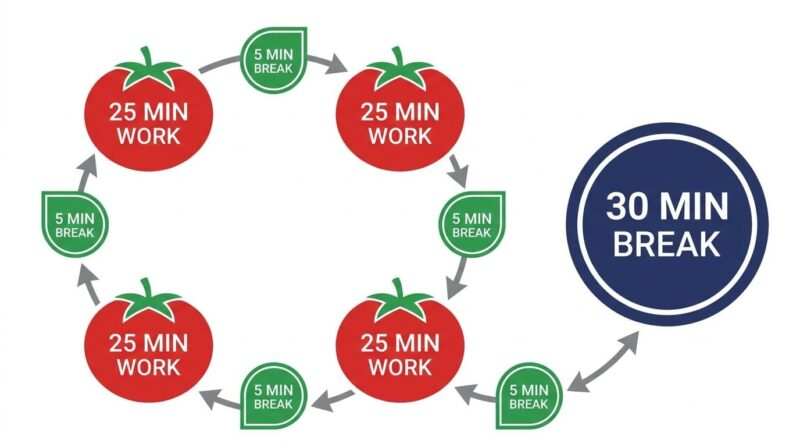
How to Use the Pomodoro Technique for Studying
Learning how to use the Pomodoro Technique for studying takes about five minutes. The magic is in consistently applying it. Here’s the step-by-step process:
1. Choose one task to work on
Before you start the timer, decide exactly what you’re going to study. “Study for physics exam” is too vague. Better: “Complete Chapter 7 — Newton’s Laws of Motion.” Specific tasks give your brain a clear target.
2. Set your timer for 25 minutes
Use a physical timer, your phone, or a free app like Pomofocus. Once the timer starts, treat it as sacred — you do not stop for anything except a genuine emergency.
3. Study with zero distractions
Phone on Do Not Disturb. Notifications off. Close all social media tabs. If a distracting thought pops up — “I need to reply to that WhatsApp message” — write it down on a notepad and return to it after the session. Do not act on it right now.
4. When the timer rings, mark your Pomodoro
Put a checkmark on paper or tap the app. This gives you a measurable sense of progress — which is genuinely motivating. Even if the chapter isn’t finished, you showed up and focused. That counts.
5. Take a 5-minute break — properly
Get up. Stretch. Drink water. Look away from your screen. Five minutes of real rest is not laziness — it’s active recovery. Do not stay at your desk and “rest” by scrolling Reels. That defeats the purpose entirely.
6. After 4 Pomodoros, take a longer break (15–30 min)
This is your reward for two solid hours of focused work. Eat something, take a short walk, or rest your eyes. Let your brain fully decompress before the next round.
Pomodoro Technique Benefits for Students
Many students ask: “Why not just study for as long as I can?” The answer is simple — longer is not always better. Here’s a breakdown of the key Pomodoro Technique benefits for students:

| Benefit | What It Means for You |
|---|---|
| 🎯 Kills Procrastination | Starting a 25-minute session feels far less scary than “studying all evening.” The lower barrier gets you to begin — and beginning is the hardest part. |
| 🧠 Sharpens Focus | Knowing the timer will ring in 25 minutes creates a mild, healthy sense of urgency. Your brain naturally minimizes wandering. |
| 😌 Prevents Burnout | Regular breaks prevent the mental exhaustion that hits during long sessions. You stay fresh for 4–6 hours instead of burning out after 90 minutes. |
| 📊 Shows Real Progress | Checking off completed Pomodoros gives you concrete evidence that you studied — even on days that didn’t feel productive. |
| 🗓️ Improves Time Estimation | Over time, you learn how many Pomodoros a chapter or assignment actually takes — so your study planning becomes far more accurate. |
| 📵 Reduces Phone Addiction | Committing to 25 minutes without your phone teaches you that you can survive without constant notifications. It rewires the habit loop. |
Research cited by Coursera’s learning experts confirms that students who use structured, timed study methods with built-in breaks report higher concentration levels and lower fatigue compared to those who study in unbroken blocks.
Best Free Pomodoro Timer Apps for Students
You do not need to spend any money to use the Pomodoro Technique for studying. Here are the best free options for Indian students:
🌲 Forest App
Grow a virtual tree while you focus. If you quit early, the tree dies. Gamified and fun.
✅ Focus To-Do
Combines a task list with a Pomodoro timer — great for students with many subjects.
⏱️ Learnox Timer
Our built-in free Pomodoro timer — no app, no ads, works directly in your browser.
Pro tip: If you study from your phone, use the Forest app — it physically blocks other apps while your timer runs. Ideal for students who know they’ll be tempted by Instagram or YouTube during study sessions.
7 Expert Pomodoro Study Tips for Indian Students
Most articles tell you the basics of how to use the Pomodoro Technique for studying and stop there. Here are seven advanced Pomodoro study tips that will actually help you get more out of every session:

📝Tip 1: Plan Your Pomodoros the Night Before
Before you sleep, write down exactly which chapters or topics you’ll cover the next day — and estimate how many Pomodoros each will take. You’ll wake up with a clear plan instead of a vague intention to “study.”
📵Tip 2: Use Physical Do Not Disturb Signals
If you study at home with family around, a simple handwritten “Studying — Back in 25 Min” sign on your door works wonders. Remove the social cost of interruptions before they happen.
📓Tip 3: Keep an Interruption Log
Every time a distraction pops into your head — a text, a craving, a random thought — note it on a slip of paper. Don’t act on it. Knowing you’ve written it down is enough for your brain to let it go.
🔊Tip 4: Pair With Lo-Fi or White Noise
Background noise at a low, consistent level (lo-fi music, brown noise, or rainfall sounds) can mask distracting household sounds. Many students report sharper concentration with this trick.
📊Tip 5: Track Your Weekly Pomodoros
Keep a simple weekly Pomodoro log — even on paper. Watching the number grow across a week is quietly motivating and shows you patterns: which days are productive, which subjects take more sessions.
🏃Tip 6: Use Long Breaks for Light Movement
A 10-minute walk during your long break — even just around your house or terrace — measurably improves subsequent cognitive performance. It’s not a luxury; it’s neurologically sound strategy.
🔄Tip 7: Adjust Session Length for the Subject
Math and problem-solving benefit from strict 25-minute sessions. Heavy reading subjects like History or Polity may suit 40-minute sessions better. The Pomodoro framework is a starting point — customize it to fit how your brain actually works.
Adapting the Pomodoro Technique for Different Study Needs
One size does not fit all when it comes to studying. Here’s how to adapt the Pomodoro Technique for studying to different situations Indian students commonly face:
Board Exams
Class 10 / 12 Board Prep
Use strict 25-min sessions. Assign one chapter section per Pomodoro. After each long break, do a quick 5-minute self-quiz of what you just covered — this is active recall, and it dramatically increases retention.
JEE / NEET
Competitive Exam Prep
For solving practice problems, stick to 25-min rounds. For heavy theory reading (NCERT chapters), extend to 40 minutes. Aim for 10–12 Pomodoros on intense prep days — that’s 5–6 hours of real, focused work.
Assignments
College Assignments / Essays
Break assignments into phases: 1 Pomodoro for research, 1–2 for writing, 1 for editing. This prevents the overwhelming feeling of staring at a blank page and makes large projects feel manageable.
Quick Revision
Last-Day Exam Revision
Use 20-minute Pomodoros (slightly shorter than usual) with 5-minute review breaks where you test yourself on what you just revised. Don’t try to learn new material the night before — use short sessions to reinforce what you already know.

Common Mistakes Students Make With the Pomodoro Technique
The Pomodoro Technique looks simple — and it is — but there are some common traps students fall into. Avoid these to get the most out of every session:
❌ Mistake 1: Multitasking During a Pomodoro
One session = one task. Period. Switching between subjects mid-session defeats the entire purpose. Your brain needs uninterrupted focus to achieve real depth. If you finish early, review what you just covered rather than jumping to something new.
❌ Mistake 2: Scrolling Social Media During Breaks
A break means rest for your brain — not swapping one screen for another. Opening Instagram during a 5-minute break is the single fastest way to ruin your next Pomodoro. Your brain gets pulled into social content and takes 5–10 minutes to refocus afterward.
❌ Mistake 3: Treating It as a Timer, Not a System
Many students set a 25-minute timer but continue to glance at their phone, chat with family, or check notifications. The timer is just one part of the system. The real value is in the commitment to total focus during those 25 minutes.
❌ Mistake 4: Skipping the Long Break
“I’m in a flow, I’ll skip the long break and keep going.” This is tempting but counterproductive. Your brain consolidates short-term information into long-term memory during rest. Skipping breaks means studying more but retaining less.
❌ Mistake 5: Starting With the Hardest Subject First (Sometimes)
While it’s generally good to tackle difficult subjects when your energy is highest, if you’re having trouble starting at all, begin with a topic you enjoy. One momentum Pomodoro in a subject you like can prime your brain for the harder subjects that follow.
❌ Mistake 6: Not Adapting the Technique to Yourself
If 25 minutes feels too short for heavy reading, try 40 or 45. If it feels too long because you’re a beginner, start with 15 minutes. The Pomodoro Technique is a framework — it is not a rigid rule. The goal is focused, sustainable study, whatever duration achieves that for you.

Frequently Asked Questions
Conclusion: Start Your First Pomodoro Today
The Pomodoro Technique for studying is not a magic pill. It will not replace hard work or make difficult subjects suddenly easy. But it will do something incredibly valuable: it will help you actually show up, actually focus, and actually retain what you study.
For Indian students juggling school, coaching classes, competitive prep, and everything else life throws at you — this technique gives you a structured, sustainable way to build consistent study habits without burning out.
Here’s what to do right now:
- Pick one subject you’ve been putting off.
- Open the free Learnox Pomodoro Timer.
- Set it for 25 minutes. Put your phone face-down.
- Begin. Just one Pomodoro. That’s it.
See how different it feels. Then do one more. That’s how every productive study session starts — with a single tomato.
🍅 Ready to Study Smarter?
Try our free Pomodoro Timer tool — no sign-up, no ads. Or explore more productivity guides to build your ultimate study system.