 Soyeb Akhtar
Exam season in India is brutal — board exams, competitive tests, semester finals. The pressure is real. But knowing how to reduce stress during exams can be the difference between freezing up and performing at your best. This guide gives you 12 science-backed, student-tested strategies — from fixing your sleep to managing exam day anxiety — written specifically for the Indian student experience.
Why Do Students Feel So Stressed During Exams?
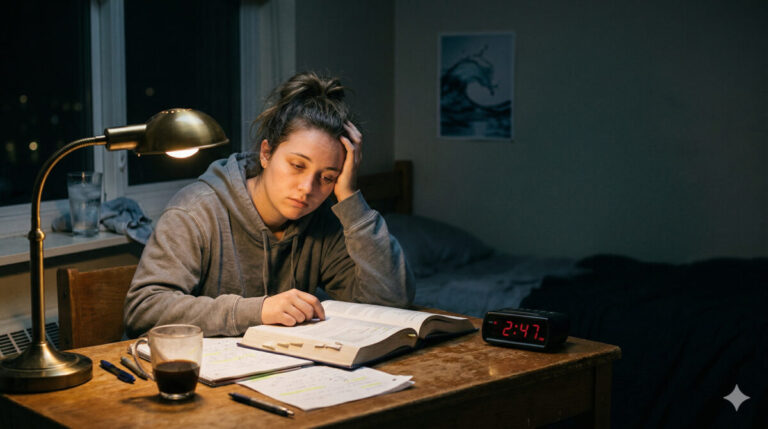
Let’s be honest — exams in India carry a lot more weight than just marks on a paper. For many students, board results, JEE ranks, or NEET scores feel tied to their entire future. Add family expectations, social comparison, and the sheer volume of syllabus to cover, and it is no surprise that anxiety takes over.
According to the National Institute of Mental Health, stress becomes a problem when it interferes with your ability to concentrate, sleep, or function normally. For students, this line is crossed far too often — especially in the weeks leading up to exams.
Common Causes of Exam Pressure in India
- Family expectations — “Beta, 90% se kam mat aana” is a sentence most Indian students know well.
- Fear of failure — Worrying that one exam will define your entire career or worth.
- Poor time management — Starting late, then trying to cover months of syllabus in days.
- Social comparison — Seeing classmates on Instagram “studying 14 hours a day” and feeling behind.
- Too much syllabus, too little time — Especially true for CBSE, ICSE, JEE, NEET, and state board students.
- Sleep deprivation — Burning the midnight oil and waking up foggy and anxious.
Signs You Are Experiencing Exam Anxiety
Stress during exams is not always obvious. Sometimes it creeps in quietly. Here is what to watch for — because naming it is the first step to managing it.
| Physical Signs | Emotional Signs | Behavioural Signs |
|---|---|---|
| Headaches or stomach aches before exams | Feeling hopeless or overwhelmed | Avoiding study altogether |
| Racing heart while reading questions | Irritability with family | Excessive scrolling on phone |
| Difficulty sleeping even when tired | Crying without clear reason | Skipping meals |
| Sweating or shaking in the exam hall | Feeling like you’ll forget everything | Comparing study hours constantly |
If you recognize three or more of these signs, your stress has moved from “motivating” to “harmful.” The good news? Every one of these responses is manageable. Here is how.
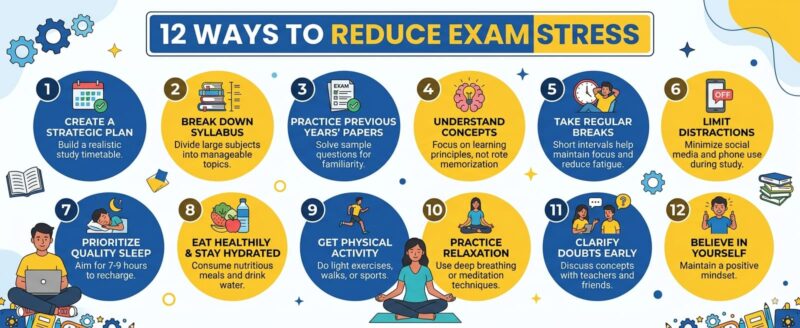
How to Reduce Stress During Exams — 12 Proven Strategies
These are not generic tips copied from a wellness magazine. These are strategies that work specifically for the Indian student context — with limited time, heavy syllabi, and real pressure from all sides.
1. Build a Realistic Study Timetable — Before Panic Sets In
Most exam stress is not about the exam itself. It is about feeling unprepared. The single most effective way to fix that is a proper study schedule — not a colour-coded fantasy, but a realistic plan you can actually follow.
Break your syllabus into chapters. Assign 1–2 chapters per day based on how many days you have left. Tackle difficult subjects when your brain is freshest (usually mornings) and use evenings for revision. Our guide on time table for study at home will walk you through this step-by-step.
Pro tip: Add buffer days. Students who plan with no buffer hit the wall the moment one topic takes longer than expected.
2. Use the Pomodoro Technique to Study Without Burning Out
Sitting at your desk for four straight hours without a break does not make you more productive. It makes you exhausted and anxious. The Pomodoro Technique — 25 minutes of focused study, 5-minute break, repeat — is scientifically proven to improve retention and reduce mental fatigue.
You can use Learnox’s free Pomodoro Timer — no app download needed, works right in your browser. Set it, study, and give your brain the breaks it needs to absorb what you are reading.

3. Stop Pulling All-Nighters — Sleep Is Your Secret Weapon
This one is hard to hear during exam season, but it is non-negotiable. All-nighters feel productive but they actually damage memory consolidation — the process by which your brain moves information from short-term to long-term storage. That happens during deep sleep.
Research from Harvard Medical School confirms that sleeping after studying dramatically improves recall the next day. Aim for 7–8 hours. If you must stay up, sleep by midnight and wake at 5–6 AM — your brain is sharpest in the early morning. A tired brain under exam conditions is a recipe for blanking out on answers you actually know.
4. Eat Smart — What Goes Into Your Body Affects Your Brain
During exams, most students survive on Maggi, biscuits, and endless cups of chai. The problem? High sugar and excess caffeine cause energy spikes followed by crashes — exactly what you do not want in the middle of a revision session.
Instead, eat foods that support focus and calm anxiety: bananas (natural serotonin booster), walnuts and flaxseeds (omega-3s for brain function), dark chocolate in small amounts, curd and yoghurt, and green tea over regular chai. Drink at least 2.5 litres of water daily — dehydration is a hidden cause of brain fog and irritability.

5. Move Your Body — Even 20 Minutes Changes Your Brain Chemistry
Exercise is one of the most underrated exam stress tips for students. When you move your body, your brain releases endorphins — natural chemicals that reduce pain and boost mood. You do not need a gym. A 20-minute walk outside, 10 minutes of yoga, or even dancing to 3–4 songs in your room works.
The World Health Organization recommends at least 60 minutes of moderate physical activity daily for young people. Even half of that is better than nothing. Build it into your schedule — treat it like a study session, not an optional extra.
6. Learn Deep Breathing — It Works in Under 60 Seconds
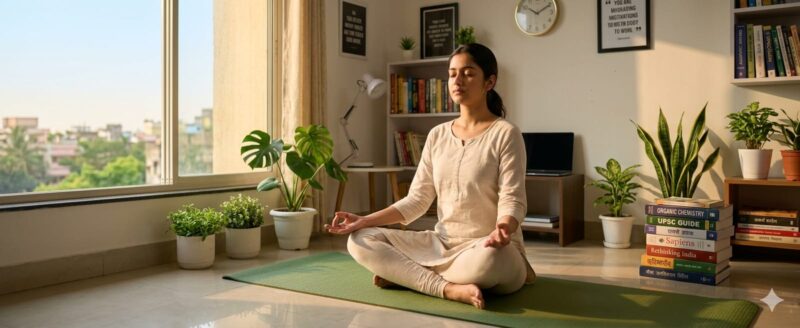
Here is something you can do right now, in the middle of a panic spiral: Inhale for 4 counts. Hold for 4 counts. Exhale for 6 counts. Repeat 5 times.
This is called box breathing (or 4-4-6 breathing), and it activates your parasympathetic nervous system — the biological “calm down” switch. It lowers cortisol levels and slows your heart rate almost immediately. Mindfulness research published by the American Psychological Association confirms that regular breathing exercises significantly reduce anxiety before high-stakes events. Practice it every morning, not just when panic hits.
7. Stop Comparing Yourself to Other Students
This one is quietly responsible for enormous exam anxiety. When you hear that your classmate has already finished two revisions and is on mock tests while you are still on Chapter 6 — the spiral begins.
Here is the truth: you do not know their actual preparation level. You do not know their strengths, their prior knowledge, or how much of it will actually stick. Your only useful benchmark is yesterday’s version of yourself. Focus on your progress, your understanding, your growth.
Unfollow or mute social media accounts that trigger comparison anxiety during exam season. This is not weakness — it is strategy.
8. Talk to Someone — Silence Makes Stress Worse
Indian students are often expected to “handle it silently.” But bottling up exam pressure does not make it go away — it makes it explode at the worst possible moment.
Talk to a friend who gets it. Call a parent without feeling like you’re failing them. If your college has a counsellor, use that resource — it exists precisely for this. Venting for even 10 minutes lowers cortisol levels measurably. You do not need to have a solution to the problem — sometimes just saying “I’m overwhelmed” to someone who listens is enough to bring the pressure down.
9. Take Smart Study Breaks (Not Doom-Scrolling Breaks)
There is a big difference between a productive break and a break that leaves you more scattered than before. Picking up your phone and going on Instagram or YouTube for “5 minutes” is almost never 5 minutes. Your dopamine system gets hijacked and suddenly 45 minutes are gone.
Smart breaks look like: a short walk, some stretching, washing your face, making a cup of tea without a screen, or doing 10 minutes of something creative with your hands. These actually restore focus. Screen breaks just replace one kind of exhaustion with another.
10. Use Active Recall Instead of Passive Re-reading
One of the biggest hidden causes of exam stress is feeling like you studied a lot but still do not feel prepared. The culprit is usually passive studying — reading and highlighting without truly testing yourself.
Switch to active recall: close your notes and try to write down everything you remember from a topic. Then check what you missed. This is harder and more uncomfortable than re-reading — which is exactly why it works so much better. Pair it with spaced repetition (review material at growing intervals) and your retention will jump significantly.
Check out our list of the best self-study apps for students in India — many of them have built-in flashcard and active recall features.
11. Prepare Your Exam Kit the Night Before
This sounds small, but it genuinely reduces anxiety on exam morning. The morning of a big exam is not the time to be hunting for your admit card, extra pens, or identity proof.
Night before: pack your bag. Keep hall ticket, ID, pens, pencils, eraser, water bottle, and a light snack ready. Set your alarm. Plan to arrive 10–15 minutes early. When you walk into the exam hall feeling prepared and not rushed, your baseline anxiety is already lower. It is logistics, but it matters.
12. Use a Study Planner to Track Your Progress
A huge source of anxiety during exam season is not knowing how much you have covered and how much is left. When everything is floating in your head as one undifferentiated cloud of “stuff to study,” it feels massive. When you write it down and cross things off as you go, it becomes manageable.
Use Learnox’s free Study Planner to map your topics, set daily targets, and track what you have completed. Progress visibility is one of the most underrated anxiety reducers — seeing a tick next to five chapters feels genuinely calming.

Expert Tips to Stay Calm During Exams
We looked at what educational psychologists and student counsellors consistently recommend — here is what makes it onto the short list.
- Reframe the exam as a conversation, not a judgement. You are showing the examiner what you know, not defending yourself in court. A mental shift from threat to challenge measurably reduces anxiety response.
- Practice “if-then” planning. “If I forget an answer, I will skip it, move on, and come back.” Pre-decided responses to exam-day situations reduce real-time panic.
- Use positive self-talk — but make it realistic. Not “I’m going to ace this” but “I have prepared, I know this material, I can do this.” Grounded optimism outperforms both pessimism and forced positivity.
- Write your anxiety down the morning of the exam. Research from the University of Chicago found that students who spent 10 minutes journaling their worries before an exam performed significantly better. It clears mental bandwidth.
- Zoom out after it is over. One exam — or even one bad result — almost never defines a career. The Indian education system has multiple entry points. Failed JEE? Dropped a semester? There is always another path.
Also worth reading: How to Focus on Studies: 15 Proven Tips That Actually Work — a Learnox deep-dive on building the kind of concentrated study sessions that leave you feeling prepared, not panicked.
Common Mistakes Students Make During Exam Season
Understanding what not to do is just as important as knowing the right strategies. These are the patterns that consistently make exam stress worse.
- Cramming the night before. It does not work. What it does is exhaust you, disrupt sleep, and create the illusion of coverage without actual understanding.
- Skipping meals “to save time.” Your brain runs on glucose. Skipping meals leads to poor concentration, irritability, and ironically — more time wasted because you cannot focus.
- Studying in a messy, distracted space. A cluttered desk contributes to a cluttered mind. 10 minutes cleaning your study area before sitting down pays dividends.
- Re-reading notes passively for hours. Feeling like you studied without actually retaining anything is one of the most demoralising experiences during exam prep. Switch to active recall.
- Discussing questions outside the exam hall. That moment when everyone outside is arguing about question answers — step away. It is almost always anxiety-inducing and rarely accurate.
- Ignoring signs of genuine burnout. If you cannot study at all despite trying, are sleeping too much or too little, and feel completely flat — that is burnout, and it requires rest and recovery, not more pressure.
Frequently Asked Questions About Exam Stress
Take 5 slow deep breaths before entering the exam hall (inhale 4 counts, exhale 6 counts). Avoid discussing the syllabus with classmates outside the door — it increases panic and confusion. Eat a light meal beforehand, drink water, and arrive 10–15 minutes early. When you are not rushing, your baseline anxiety is already lower before you pick up the pen.
Absolutely. Studies show that over 70% of students in India report some level of anxiety before board or competitive exams. A small amount of stress is actually helpful — it keeps you alert and motivated. The problem is when it becomes overwhelming and starts hurting your preparation and performance. That is the tipping point where you need active strategies.
7 to 8 hours is the recommended minimum for students during exam season. All-nighters feel productive but actually reduce memory consolidation — the process where your brain stores what you studied into long-term memory. That consolidation happens during deep sleep. Consistently sleeping 5 hours or less leads to declining recall and rising anxiety over the following days.
Bananas (boost serotonin naturally), dark chocolate in small amounts, walnuts and flaxseeds (rich in omega-3 fatty acids that support brain health), yoghurt and curd, and green tea all help. Avoid excessive chai, coffee, and sugary snacks — they cause energy spikes and crashes that worsen anxiety. Stay well hydrated throughout the day.
Yes, and the science is clear on this. Even 20 minutes of brisk walking, yoga, or light stretching releases endorphins — your brain’s natural stress-fighting chemicals. The WHO recommends at least 60 minutes of moderate physical activity daily for young people, but even a 20-minute walk in the morning makes a measurable difference in your mood, focus, and anxiety levels for the rest of the day.
Conclusion: Manage the Pressure, Do Not Let It Manage You
Knowing how to reduce stress during exams is not about eliminating pressure entirely — that is not realistic, and honestly, a little pressure helps you perform. It is about keeping that pressure in the zone where it sharpens you, not the zone where it shuts you down.
Start with the basics: a realistic study schedule, consistent sleep, proper food, and short daily movement. Layer on the mental tools — breathing exercises, journaling, and honest self-talk. And use the right resources: free tools like Learnox’s Study Planner and Pomodoro Timer exist precisely to make this easier.
You have worked hard to get to this point. One exam, one season — it does not define who you are or where you end up. What matters is that you show up prepared and calm enough to show what you actually know. That is entirely within your control.
Ready to Take Control of Your Exam Prep?
Use our free Study Planner to map your syllabus, set daily goals, and track your progress — built for Indian students, completely free.