 Soyeb Akhtar
If you are struggling to focus on studies, you are not alone. Most Indian students lose 2–3 hours every day to phone distractions, noise, and poor study habits. This guide gives you 15 practical, science-backed tips to sharpen your concentration, beat phone addiction, and turn every study session into a productive one — no matter your subject or exam pressure.
15 Proven Tips for Indian Students
Let’s be honest. You opened this article because you sat down to study, looked at your syllabus, and within 15 minutes ended up scrolling Instagram or watching YouTube Shorts. Don’t worry — that does not make you lazy. It just means no one ever taught you how to focus on studies the right way.
Whether you’re preparing for JEE, NEET, board exams, or college semester exams, concentration is the one skill that separates toppers from average scorers. It’s not about studying 12 hours a day. It’s about studying well for 4–6 focused hours.
In this guide, you’ll find 15 actionable study focus techniques backed by psychology and real student experience — written specifically for the Indian student’s reality.
Why Can’t You Focus on Studies?
Before we jump to solutions, it’s important to understand why your brain drifts away the moment you open a textbook. This is not a personal failing. Your brain is literally wired to chase novelty.
Every time a WhatsApp notification pops up or you switch a tab on YouTube, your brain gets a tiny hit of dopamine — the “feel good” chemical. Studying, on the other hand, requires effort and delayed rewards. So your brain prefers the easy dopamine hit over the hard work of understanding Physics derivations.
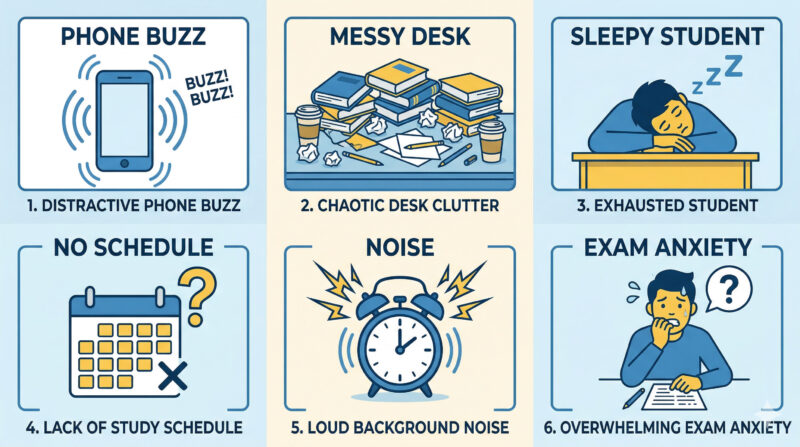
Common reasons students can’t concentrate on studies:
- Phone notifications — even the sound of a buzz breaks your train of thought
- Uncomfortable study space — studying in bed, noisy rooms, or cluttered desks
- No clear goal — sitting down to “study” without knowing what exactly you’ll cover
- Fatigue and poor sleep — a tired brain simply cannot retain information
- Wrong time of day — studying during your lowest-energy hours
- Anxiety about exams — stress literally shuts down the brain’s learning center
- No study routine — the brain needs consistency to switch into “study mode”
The good news? Every single one of these problems is fixable. Let’s get into how.
Set Up the Perfect Study Environment First
Your environment shapes your behaviour more than your willpower does. The same student who cannot concentrate for 10 minutes at home might study for 2 hours straight at the school library. That’s not magic — that’s environment design.
Choose a Dedicated Study Space
Pick one spot — a corner of your room, a table near the window, or a library desk — and use it only for studying. Over time, your brain builds a powerful association between that spot and deep focus. Just sitting down there will signal your brain: “It’s time to study.”
Avoid studying on your bed or couch. Your brain links those places to relaxation and sleep — not learning. A proper study setup matters more than most students realize.
Reduce Visual Clutter
A messy desk creates a messy mind. Keep only the books, notes, and stationery you need for the current session on your desk. Put everything else away. This small habit dramatically reduces mental friction before you even begin.
15 Proven Tips to Focus on Studies
These are not generic self-help tips. These are techniques that real students — from competitive exam aspirants to college goers — have used to transform their concentration and scores.
Tip 01 Use the Pomodoro Technique
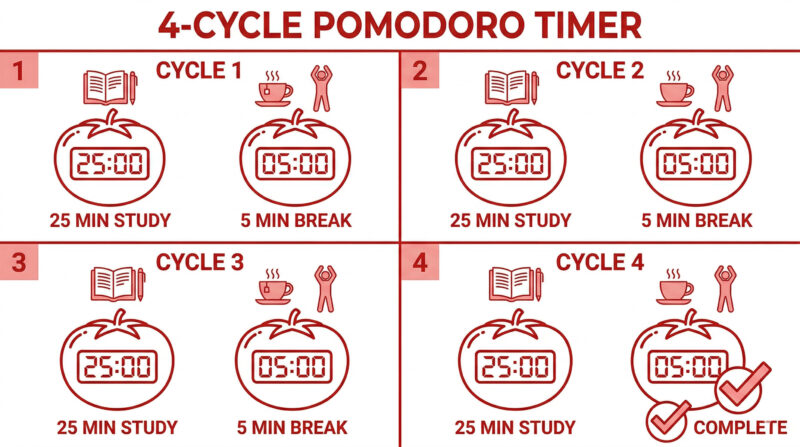
Study for 25 minutes. Take a 5-minute break. Repeat 4 times, then take a long 20–30 minute break. This is called the Pomodoro Technique, and it works because it creates urgency (“I only need to focus for 25 minutes”) and prevents mental burnout. Use our free Pomodoro Timer to get started right now.
Tip 02 Set a Clear Goal Before Every Study Session
Never sit down to “just study.” Always write a specific goal: “Complete Chapter 5 of Organic Chemistry — reactions and mechanisms.” A clear target focuses your brain and gives you a sense of accomplishment when you finish. Vague intentions produce vague results.
Tip 03 Break Your Syllabus Into Small, Daily Chunks
Looking at a full syllabus before exams is overwhelming and kills motivation instantly. Instead, use our Study Planner to divide your syllabus into daily micro-targets. Completing small chunks daily builds momentum and keeps anxiety low. This pairs perfectly with understanding study techniques for students that match your learning style.
Tip 04 Tackle Your Hardest Subject First
Your brain is sharpest within the first 1–2 hours of your study session. Use that prime time for your most difficult or least-liked subject. Leave the easier revision or light reading for later. Most students do the opposite and wonder why they never make progress on tough topics.
Tip 05 Use Active Recall Instead of Re-reading
Re-reading the same chapter 5 times feels productive but barely works. Active recall — closing the book and forcing yourself to write or say everything you remember — is one of the most powerful study focus techniques known to learning science. It keeps your brain engaged and builds long-term memory far more effectively.
Tip 06 Build a Consistent Daily Study Routine
Your brain thrives on routine. When you study at the same time every day, your body and mind begin to anticipate it — just like how you feel hungry at lunchtime even without checking the clock. A strong daily routine for students is the foundation of consistent academic performance. Consistency beats intensity every single time.
Tip 07 Prioritize 7–8 Hours of Sleep
Sleep is not a waste of time — it is literally when your brain consolidates and stores everything you studied. Sleep deprivation severely impairs memory, decision-making, and concentration the next day. Pulling all-nighters before exams is one of the worst study strategies possible. Protect your sleep like it’s your most important study tool — because it is.
Tip 08 Eat Brain-Boosting Foods
What you eat directly affects your focus. Students who skip breakfast or eat heavy, oily meals before studying often feel sluggish and unfocused. Foods that help you concentrate include: walnuts, almonds, eggs, bananas, oats, dark chocolate, and plenty of water. Your brain is roughly 75% water — even mild dehydration makes it harder to think clearly. Keep a water bottle on your study desk at all times.
Tip 09 Move Your Body for 20 Minutes Every Day
A 20-minute morning walk or a quick set of stretches before studying increases blood flow to your brain, boosts your mood, and sharpens focus for hours afterward. You don’t need a gym. Even jumping jacks, yoga, or a walk around the block works brilliantly. This is one of the most underrated tips to concentrate on studies that costs you nothing.
Tip 10 Try 5–10 Minutes of Meditation or Deep Breathing
Before you sit down to study, take 5–10 deep breaths or do a short guided meditation. Apps like Headspace or Calm have free sessions specifically for students. This clears mental noise, reduces exam anxiety, and prepares your prefrontal cortex (the brain’s focus center) for deep work. Think of it as a warm-up before a workout — but for your mind.
How to Study Without Phone Distraction
Let’s talk about the elephant in the room — or rather, the smartphone in your pocket. A 2023 study found that just having your phone on the desk (even face down, even on silent) reduces your cognitive capacity by a measurable amount. The solution isn’t willpower. It’s distance.

Tip 11 Put Your Phone in Another Room (Seriously)
This one tip alone can add 2 hours of productive study time to your day. Put your phone in another room, give it to a family member, or lock it in your bag. If you need it for studying, use only specific apps and nothing else. “Out of sight, out of mind” is not just a saying — it’s neuroscience.
Tip 12 Use App Blockers During Study Hours
If your phone must stay with you, use app-blocking tools. Apps like Forest (plant a virtual tree that dies if you use your phone), Stay Focused (browser extension), or Android’s built-in Digital Wellbeing feature can block Instagram, YouTube, and WhatsApp during your study blocks. This removes the temptation entirely without requiring constant willpower. You can also explore the best study apps that boost focus rather than break it.
Tip 13 Enable Do Not Disturb or Focus Mode
Both Android and iPhone have built-in Focus/DND modes. Schedule “Study Mode” for your regular study hours so notifications are silenced automatically. You can allow calls from specific contacts (parents, in case of emergency) while blocking everything else. Set it up once, and let it run on autopilot every day.
How to Avoid Distractions While Studying
Phones are not your only enemy. Noise, family interruptions, and even your own wandering thoughts are just as disruptive. Here’s how to handle them.
Tip 14 Use Lo-Fi Music or White Noise to Block Sound
If you live in a noisy home (which is very common in Indian households), background music can actually help by masking irregular sounds. The key is to choose music without lyrics — lo-fi beats, classical music, rain sounds, or white noise are ideal. Lyrics activate your language processing brain, which directly competes with reading and thinking. YouTube’s “lo-fi hip hop study” streams are free and perfect for this.
Tip 15 Communicate Your Study Hours to Your Family
One of the biggest distractions for Indian students is family interruptions — someone calling your name, TV noise from the next room, or relatives visiting. Have a simple, respectful conversation with your family: “From 7–10 PM, I’ll be studying. Please don’t disturb me unless it’s urgent.” Most families will respect this when they understand what’s at stake. Also, knowing that you’ll be free after 10 PM makes those 3 hours feel manageable, not overwhelming.
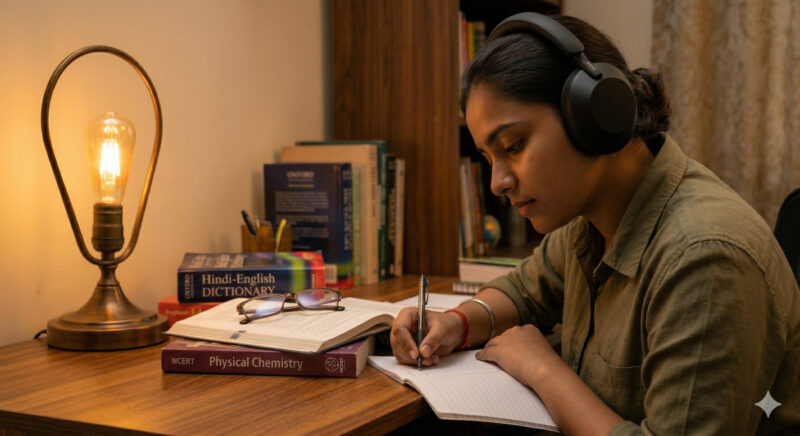
Expert Tips for Deep Focus While Studying
✅ Advanced Study Focus Techniques (Try These)
- Batch similar tasks: Do all reading in one block, all practice problems in another. Multitasking is a proven myth — every task switch drains mental energy.
- Use spaced repetition: Review material after 1 day, 3 days, 1 week, and 1 month. Apps like Anki are built for this.
- Write it, don’t type it: Handwritten notes force you to process and reword information, which deepens understanding and memory far more than typing.
- Create a “parking lot” list: When unrelated thoughts pop up (like “I need to reply to that message”), write them on a small notepad beside you. This lets your brain release them without acting on them, so you can stay focused.
- Study in natural light when possible: Exposure to natural sunlight during study hours keeps your circadian rhythm in sync, reduces eye strain, and improves alertness.
- End each session with a “next action”: Before you close your books, write down exactly what you’ll do in tomorrow’s session. This removes the mental friction of starting and helps you dive in immediately.
Also, if you’re worried about how to avoid sleep while studying, these expert techniques will keep your energy levels stable throughout your sessions.
Study Techniques: Quick Comparison Table
| Technique | Best For | Effort Level | Effectiveness |
|---|---|---|---|
| Pomodoro Technique | Long study sessions | Low | ⭐⭐⭐⭐⭐ |
| Active Recall | Memorization & exams | Medium | ⭐⭐⭐⭐⭐ |
| App Blockers | Phone distraction | Very Low | ⭐⭐⭐⭐ |
| Spaced Repetition | Long-term retention | Medium | ⭐⭐⭐⭐⭐ |
| Study Routine | Daily consistency | Medium | ⭐⭐⭐⭐⭐ |
| Lo-fi Music | Noisy environments | Very Low | ⭐⭐⭐ |
Common Mistakes Students Make When Trying to Focus
❌ Stop Doing These Right Now
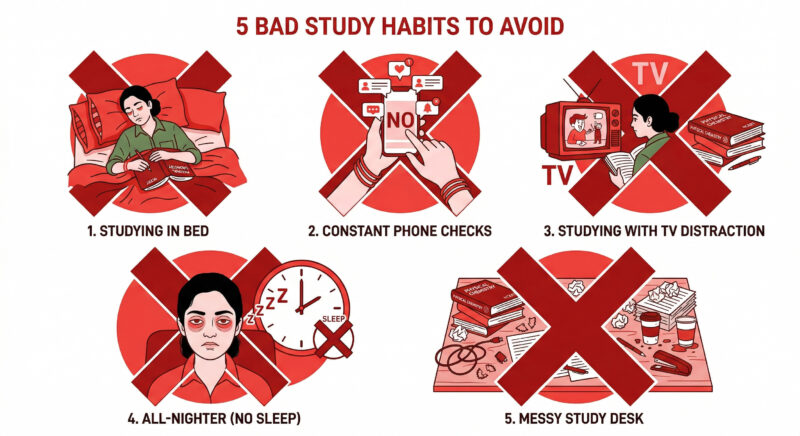
- Studying on the bed: Your brain associates the bed with sleep. Within 20 minutes, you’ll feel drowsy. Always use a chair and desk.
- Multitasking (TV + studies): Studying with a TV in the background is not studying. It is a complete waste of time disguised as productivity.
- Long study sessions without breaks: Sitting for 3–4 hours straight without a break burns out your brain. Focus degrades sharply after 45–60 minutes without rest.
- Checking the phone “for just 2 minutes”: Those 2 minutes become 45 minutes every single time. There is no such thing as a quick social media check.
- Skipping sleep to study more: A tired brain stores almost nothing in long-term memory. 7 hours of sleep + 5 focused study hours beats 10 hours of sleepy cramming every time.
- Starting with easy content always: Saving the hardest topics for “when you feel ready” means you never get to them. Attack your most challenging material first when your brain is freshest.
- No clear study goal: Sitting down to “study Physics” is too vague. Sit down to “solve 20 numerical problems from Chapter 3.” Clarity drives focus.
Frequently Asked Questions (FAQs)
Conclusion: Focus is a Skill You Can Build
Learning how to focus on studies is not about becoming a different person overnight. It’s about making small, smart changes to your environment, habits, and mindset — one step at a time.
Start with just two or three tips from this list today. Maybe put your phone in another room and try one 25-minute Pomodoro session. That’s it. Build from there. Within a week, you’ll notice a real difference in how much you get done and how much less exhausted you feel at the end of each day.
The students who score well in JEE, NEET, boards, or college exams are not smarter than you. They’ve simply learned to protect and direct their focus — and now, so can you.
Ready to Study Smarter?
Use our free tools and guides to build better study habits starting today.
⏱ Free Pomodoro Timer
📅 Study Planner
📚 Study Techniques Guide →