
 Soyeb Akhtar
Most students spend hours studying but still score average marks — because they’re using the wrong methods. This guide covers the 12 most powerful study techniques for students, backed by cognitive science and proven in real exam contexts across India. You’ll learn exactly how each technique works, when to use it, and how to combine them for maximum results — whether you’re preparing for boards, JEE, NEET, or college semester exams.
Why Your Study Technique Matters More Than Study Hours
Priya and Anjali were in the same Class 12 batch in Hyderabad. Both studied Chemistry for 3 hours every evening. By March, Anjali had revised the entire syllabus four times. Priya had barely finished it once.
The difference? Anjali used active recall and spaced repetition. Priya re-read the same textbook pages over and over, highlighted everything yellow, and called it “studying.” She remembered almost nothing under exam pressure.
This is the most important thing students need to understand about study techniques for students: the method decides the outcome, not the number of hours. Passive reading, re-copying notes, and highlighting text are comfortable habits that feel like studying — but they produce almost no long-term retention.
According to research reviewed by the UNC Learning Center, active, evidence-based study methods consistently produce superior academic results compared to traditional passive approaches. The 12 techniques in this guide are all in that category.
Before diving in, pair these techniques with a solid daily routine for students — because even the best technique fails without consistent practice time built into your day.
Quick Comparison: All 12 Study Techniques at a Glance
| # | Technique | Best For | Effort | Effectiveness |
|---|---|---|---|---|
| 1 | Active Recall | All subjects | Medium | Very High |
| 2 | Spaced Repetition | Memorisation | Low-Med | Very High |
| 3 | Feynman Technique | Concept mastery | High | Very High |
| 4 | Pomodoro Technique | Focus / Time mgmt | Low | High |
| 5 | Cornell Note-Taking | Lecture notes | Medium | High |
| 6 | Mind Mapping | Visual learners | Medium | Medium-High |
| 7 | SQ3R Method | Reading comprehension | Medium | High |
| 8 | Interleaved Practice | Maths / Science | High | Very High |
| 9 | Elaborative Interrogation | Conceptual subjects | Medium | High |
| 10 | Practice Testing | Exam prep | Medium | Very High |
| 11 | Teaching Others | Deep understanding | High | Very High |
| 12 | Chunking | Complex topics | Low | Medium-High |
The 12 Best Study Techniques for Students (Explained)
Active Recall — The Single Most Powerful Study Method
✅ Best For: All subjects, all exam types
What it is: Instead of re-reading your notes, you close the book and try to recall the information from memory. That’s it. Simple concept, enormous impact.
Why it works: Every time you retrieve information from memory, you strengthen the neural pathway that holds that information. Re-reading only engages recognition (easy). Active recall forces retrieval (hard) — and “hard” is exactly what your brain needs to retain information long-term.
How to use it — step by step:
- Read a chapter or section of your textbook once, carefully
- Close the book completely
- On a blank page, write everything you can remember — concepts, definitions, formulas, diagrams
- Open the book and check what you missed
- Focus your next reading only on the gaps — not the entire chapter again
- Repeat the recall attempt 24 hours later without re-reading
Real example: Rahul is studying the chapter on Electrochemistry for Class 12 boards. After reading it once, he closes the book and writes down on a blank page: EMF, electrode potential, Nernst equation, Kohlrausch’s Law, and everything else he can recall. He checks — he missed Faraday’s laws. Next day, he recalls again without reading. Within 3 days, he knows the entire chapter cold.
Use flashcards (physical or apps like Anki) to make active recall even more systematic. Write the question on the front, the answer on the back. Test yourself daily.
Spaced Repetition — The Memory Multiplier
✅ Best For: Long-term memorisation, vocabulary, dates, formulas
What it is: Review material at increasing intervals over time — rather than cramming everything in one session. For example: study today → review tomorrow → review in 3 days → in 1 week → in 2 weeks.
Why it works: This method exploits the “forgetting curve” — the brain’s natural tendency to forget information that isn’t revisited. By reviewing just before forgetting occurs, you reset the forgetting curve at a higher level each time. The result: information moves from short-term to long-term memory efficiently.
The Spaced Repetition Schedule for Indian Students:
| Review # | When to Review | Session Length |
|---|---|---|
| 1st Review | Same day (after studying) | 10–15 min |
| 2nd Review | Next day | 10 min |
| 3rd Review | 3 days later | 8 min |
| 4th Review | 1 week later | 5 min |
| 5th Review | 2 weeks later | 5 min |
| 6th Review | 1 month later | 3 min |
Tools: Use Anki (free flashcard app) which automatically schedules your spaced repetition reviews based on how well you recalled each card. It’s used by medical students worldwide and works brilliantly for NEET biology, UPSC facts, and English vocabulary.

The Feynman Technique — If You Can’t Explain It Simply, You Don’t Know It
✅ Best For: Physics, Chemistry, Maths, Economics — concept-heavy subjects
What it is: Explain a concept out loud or in writing as if you’re teaching it to a 10-year-old. Any point where you get stuck or use jargon you can’t define — that’s where your actual understanding breaks down.
The 4 steps of the Feynman Technique:
- Choose a concept — e.g., “Newton’s Third Law of Motion”
- Explain it simply — write it in plain language, no textbook phrases
- Identify gaps — wherever you get stuck or start using complex terms you can’t explain, mark those as gaps
- Go back and study the gaps — then explain again until it flows perfectly
Real example: Amit is struggling with “osmotic pressure” for NEET. He tries to explain it without looking at his textbook: “Osmotic pressure is… the pressure… water… moves through a membrane?” He gets stuck immediately. He goes back to his textbook, reads only about osmosis, then tries again. This time: “Osmotic pressure is the minimum pressure needed to stop water from moving through a semi-permeable membrane into a more concentrated solution.” Clear. Usable. He’ll never forget it now.
Use your younger sibling or a friend as your “student.” Actually teaching out loud triggers different parts of your brain than silent reading. If no one’s available, use a mirror or record a voice note on your phone.
The Pomodoro Technique — Study Smarter With Timed Focus Blocks
✅ Best For: Students who struggle with focus, procrastination, or long study sessions
What it is: Work in 25-minute focused study bursts followed by a 5-minute break. After four rounds (called “Pomodoros”), take a longer 15–20 minute break.
Why it works: The human brain’s prefrontal cortex — the focus and decision-making centre — fatigues with continuous use. Short, timed study sessions exploit the brain’s natural attention cycles. The ticking timer also creates mild urgency that kills procrastination at the source.
Pomodoro cycle for a 2-hour study block:
- 🍅 0:00–0:25 — Deep study (phone in another room)
- ☕ 0:25–0:30 — Break (walk, water, stretch — no scrolling)
- 🍅 0:30–0:55 — Deep study continues
- ☕ 0:55–1:00 — Break
- 🍅 1:00–1:25 — Deep study
- ☕ 1:25–1:30 — Break
- 🍅 1:30–1:55 — Deep study
- 🛌 1:55–2:15 — Long break (20 min)
Try the free Learnox Pomodoro Timer and other top study tools to run these sessions without needing to watch the clock yourself.
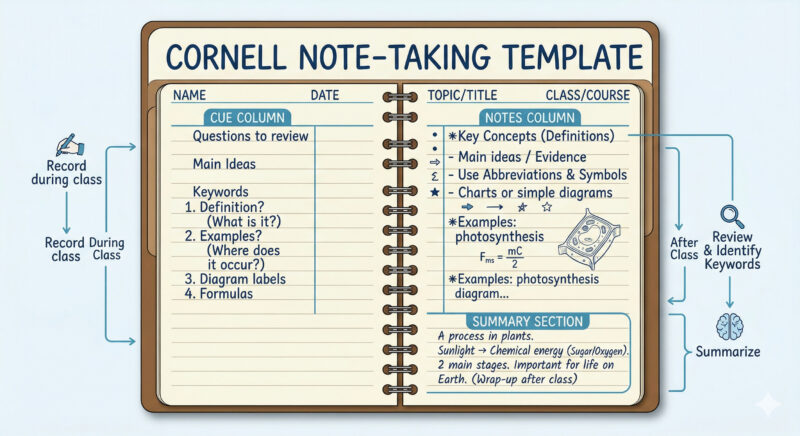
Cornell Note-Taking — The Note System That Doubles as a Study Tool
✅ Best For: School lectures, college classes, self-study chapters
What it is: Divide your notebook page into three sections: a wide right column for notes, a narrow left column for keywords/questions, and a short bottom section for your summary. Fill these during and after each study session.
How to set it up:
- Right column (6 inches wide): Take notes during class or reading — points, diagrams, formulas
- Left column (2.5 inches): After class, write keywords, cue questions (“What is Ohm’s Law?”), or key terms that relate to the notes on the right
- Bottom section (2 inches): Write a 3–5 line summary of the entire page — in your own words
Why it’s brilliant for revision: Cover the right column. Use the left-column questions to quiz yourself. This builds active recall directly into your note-taking system. Your notes don’t just record information — they become a self-testing tool.
Mind Mapping — Visualise Connections Between Concepts
✅ Best For: Biology, History, Geography, Economics — subjects with interconnected concepts
What it is: Draw a central concept in the middle of a blank page. Branch out to related sub-topics. From each sub-topic, branch further to details, examples, and connections. The result is a visual “map” of how everything in a chapter connects.
When to use it: Mind maps are most effective for revision and for seeing the “big picture” of a chapter before drilling into details. They’re especially powerful for UPSC aspirants dealing with vast interconnected topics, and for Biology students mapping organ systems or ecological relationships.
Tool options: Physical pen and paper works best (the act of drawing improves retention). For digital: use free tools like MindMeister or Canva’s mind map templates.
The SQ3R Method — How to Actually Read a Textbook
✅ Best For: History, Political Science, Geography, Economics — reading-heavy subjects
What it is: SQ3R stands for Survey, Question, Read, Recite, Review. It’s a structured approach to reading that transforms passive reading into active engagement.
- Survey: Skim the chapter first — read only headings, subheadings, bold terms, and the conclusion. Get a mental map before reading in full.
- Question: Before reading each section, turn the heading into a question. “The French Revolution” becomes “What caused the French Revolution? What were its effects?”
- Read: Read to answer your questions — not to “finish the chapter.” Stop when you find answers.
- Recite: After each section, close the book and answer your question aloud or in writing from memory.
- Review: After the full chapter, review all your questions and recall all answers without looking.
This is one of the most effective study techniques for exams because it makes you an active reader from the first minute — rather than someone who reaches page 20 and realises they remember nothing.
Interleaved Practice — The Counterintuitive Technique Toppers Use
✅ Best For: Maths, Physics, Chemistry problem-solving
What it is: Instead of practising 20 questions of the same type back-to-back (“blocked practice”), you mix different problem types in the same session.
Example for Maths students:
- Blocked (ineffective): 20 quadratic equations → 20 linear equations → 20 trigonometry problems
- Interleaved (effective): 3 quadratic → 3 linear → 3 trigonometry → 3 quadratic → repeat
Interleaving forces your brain to identify which technique or formula to apply — the actual skill tested in exams. Blocked practice feels easier and more productive, but produces much weaker results. Research in mathematics education has shown up to 76% improvement in problem-solving accuracy with interleaved practice compared to blocked practice.
Interleaving will feel harder and slower at first. That’s the point. The difficulty is what creates learning. If studying feels too comfortable, you’re probably not growing.

Elaborative Interrogation — Ask “Why?” Until It Makes Sense
✅ Best For: Science subjects, Economics, any topic requiring cause-effect understanding
What it is: As you study, constantly ask “Why is this true?” and “How does this connect to what I already know?” Instead of accepting facts passively, you force your brain to build logical connections.
Example: Instead of just memorising “Photosynthesis occurs in the chloroplast,” ask: “Why does photosynthesis occur specifically in the chloroplast? What property of the chloroplast makes it suitable?” This forces you to understand that chloroplasts contain chlorophyll and a membrane system for the light-dependent reactions — meaning you understand the process, not just a fact. You’ll recall it under exam pressure even if your exact memorised wording fails.
This is especially powerful for NEET Biology and Class 12 Chemistry where exam questions test application of concepts, not just definitions.
Practice Testing — Attempt Past Papers Before You Feel “Ready”
✅ Best For: Board exams, JEE, NEET, UPSC — any high-stakes exam preparation
What it is: Regularly test yourself with practice questions, past papers, and mock tests — even before you feel fully prepared. The act of testing itself is a study method, not just an assessment tool.
Why students avoid it (and why that’s a mistake): Most students wait to feel “ready” before attempting practice tests. They want to finish the syllabus first. This is exactly backwards. Practice testing reveals gaps you didn’t know you had — gaps that re-reading never reveals because recognition feels like knowledge, but recall under test conditions does not.
How to use practice testing effectively:
- After every chapter, attempt 10–15 chapter-wise questions before moving on
- Every weekend, do one full-length timed practice test
- Review wrong answers in detail — not just the correct answer, but why you went wrong
- Track your performance subject-wise to identify weak areas
- For competitive exams: treat every practice test as a real exam — same conditions, same timing
Teaching Others (Protégé Effect) — Explain to Learn
✅ Best For: Any subject where you want deep mastery, not just surface recall
What it is: Teach what you’ve learned to someone else — a classmate, a friend, a younger sibling, or even an imaginary “student.” The Protégé Effect is a documented psychological phenomenon: people learn more thoroughly when they expect to teach the material than when they only study it for themselves.
Why it works: When you know you have to teach something, your brain automatically organises the information more carefully. You anticipate questions. You look for gaps. You try to find the clearest explanation. All of this deepens understanding far beyond passive studying.
Practical formats for Indian students:
- Form a small study group (3–4 people) and take turns “teaching” one chapter each session
- Record a 5-minute voice explanation of a topic on your phone — play it back
- Write a one-page “teaching note” for a difficult chapter as if you’re making study notes for a classmate
Chunking — Break Big Topics Into Manageable Pieces
✅ Best For: Long chapters, complex topics, memory-heavy subjects like Biology or History
What it is: Break large, overwhelming topics into smaller, logically connected “chunks” and master each chunk before connecting them. Your working memory can only hold 5–7 pieces of information at once. Chunking respects this biological limit.
Example for Class 12 Biology — “Human Reproduction” chapter:
- Chunk 1: Male reproductive system (anatomy only)
- Chunk 2: Female reproductive system (anatomy only)
- Chunk 3: Gametogenesis — spermatogenesis and oogenesis
- Chunk 4: Fertilisation and implantation
- Chunk 5: Pregnancy and parturition
- Connect all chunks with a mind map
Trying to study the entire chapter at once = confusion, overwhelm, and poor retention. Breaking it into chunks and mastering each one before connecting = efficient, confident learning.
How to Combine These Study Techniques for Maximum Results
The real power comes from combining these methods. Here’s a proven daily study stack for Indian students that layers multiple techniques together:
| Study Phase | Primary Technique | Supporting Technique | Duration |
|---|---|---|---|
| Learn new material | SQ3R + Cornell Notes | Elaborative Interrogation | 45–60 min |
| Same-day review | Active Recall | Feynman Technique | 15–20 min |
| Problem-solving session | Interleaved Practice | Pomodoro Technique | 60 min |
| Weekly revision | Spaced Repetition | Practice Testing | 30–45 min |
| Group study | Teaching Others | Chunking for presentation | 60 min |
To manage this system well, you need solid time management. Read our complete guide on time management skills for students to build the scheduling framework that makes these techniques work week after week.

🏆 Expert Tips: Making These Techniques Work in the Real World
- Start with one technique, not all twelve. Pick Active Recall and use it exclusively for one week. Once it’s automatic, add Spaced Repetition. Stack techniques gradually. Trying to implement all 12 at once leads to overwhelm and abandoning everything.
- Match the technique to the subject type. Active Recall and Spaced Repetition work universally. Interleaved Practice is for Maths and Sciences. SQ3R is for text-heavy subjects. Don’t force the wrong technique onto the wrong subject.
- Struggle is the point. Active recall will feel harder than re-reading. Interleaving will feel slower than blocked practice. The difficulty is not a sign that the technique isn’t working — it’s a sign that genuine learning is happening.
- Use the best tips for time management to protect your study blocks. Read the best time management tips for students — because the best study technique is useless without a protected time slot to practise it in.
- Track your progress, not your hours. After each study session, note what you covered and test yourself on it. A 30-minute active recall session where you score 9/10 is worth more than 3 hours of passive reading where you retain nothing.
- Build your study system around your daily routine. The students who consistently use these techniques have them built into a fixed daily schedule. Check our complete daily routine for students guide for a ready-to-use framework.
❌ Common Mistakes Students Make When Applying Study Techniques
- Mistaking familiarity for mastery. Re-reading your notes until they “feel familiar” is not studying. Familiarity is recognition. Exams test recall. If you can’t produce the information from a blank page, you don’t know it — regardless of how many times you’ve read it.
- Using highlighting as a study technique. Highlighting is a pre-study organisation tool, not a study technique. It has almost zero impact on long-term retention on its own. Highlight → then use active recall on what you highlighted. The recall is the work.
- Doing blocked practice and calling it “solving problems.” Finishing 30 quadratic equations from the same exercise is comfortable, but it doesn’t build the ability to identify which technique to apply in an exam — which is exactly what JEE and board papers test.
- Waiting until the syllabus is “done” to attempt practice tests. Start practice testing from Week 1. You don’t need to know everything to start testing — in fact, testing reveals what you need to learn next more accurately than any study plan.
- Studying with your phone nearby. Every phone notification — even one you don’t act on — breaks your focus and takes 15–20 minutes to fully recover according to cognitive science research. Phone in another room during study sessions. Always.
- Skipping sleep to study more. Sleep is when the brain consolidates memories formed during the day. Skipping sleep doesn’t give you more study time — it erases what you already studied. 7–8 hours is non-negotiable.
Frequently Asked Questions

Conclusion: Study Smarter Starting Today
Here’s the truth most students don’t want to hear: hours don’t matter as much as method. You can study 10 hours a day using passive re-reading and score average. Or you can study 4 focused hours using the study techniques for students in this guide and outperform your batch.
The best part? You don’t need to implement all 12 techniques immediately. Start with Active Recall tonight — after your next study session, close your notes and write everything you remember from memory. That one habit alone will change your retention in ways re-reading never could.
Add Spaced Repetition next week. Bring in the Feynman Technique the week after. Stack one technique per week until your study system runs on autopilot.
Combined with a solid daily routine for students and the right time management tools, these techniques will produce results that make your study hours feel genuinely worth it.
Ready to Build a Complete Study System?
Explore Learnox’s full library of study guides, schedules, and productivity tools — all built for Indian students.