 Soyeb Akhtar
📋 Table of Contents
- Why Most Students Struggle Without a Timetable
- What Makes a Time Table for Study at Home Actually Work?
- How to Make Study Time Table at Home (Step-by-Step)
- Best Time Table for Study at Home – Sample Schedules
- How to Divide Study Time Between Subjects
- Expert Tips to Actually Stick to Your Timetable
- Common Mistakes Students Make (And How to Fix Them)
- Best Tools and Apps to Build Your Time Table
- Frequently Asked Questions
- Conclusion
You already know you should study more. The problem isn’t motivation — it’s structure.
Every student who struggles at exam time will tell you the same thing: “I had the whole year, I just didn’t plan properly.”
A solid time table for study at home is the most practical thing you can build this week. Not a dream schedule — a real one that fits your life, respects your energy, and actually gets followed.
This guide doesn’t recycle the same generic advice you’ll find everywhere. It gives you a field-tested, step-by-step method — written specifically for Indian school and college students — along with two complete sample schedules, a subject-split formula, and the honest mistakes most students make within the first two weeks of a new routine.
1. Why Most Students Struggle Without a Study Timetable
Here’s something most students don’t realise: the real reason you procrastinate isn’t laziness. It’s because every day, you’re forced to make a fresh decision — what to study, when to start, for how long. That decision-making drains mental energy before you even open a book.
When there’s no fixed daily time table for study, a few predictable things happen:
- You default to studying your favourite subjects and avoid the weak ones.
- You confuse “being busy” with “being productive.”
- Revision never happens until the night before the exam.
- You feel guilty during free time because you haven’t studied enough.
- Stress compounds every week until it becomes exam panic.
A timetable removes that daily friction. Once a slot is fixed for a subject, you don’t debate it — you just sit down and do it. Over 21 days, that becomes automatic. That’s exactly how toppers operate.
According to research published by the UNC Learning Center, students who use scheduled study blocks retain information significantly better than those who study in random, unplanned sessions. Structure isn’t a cage — it’s a launch pad.
2. What Makes a Time Table for Study at Home Actually Work?
Most students build a perfect-looking timetable on Sunday night and abandon it by Tuesday afternoon. Why? Because they designed an ideal schedule, not a realistic one.
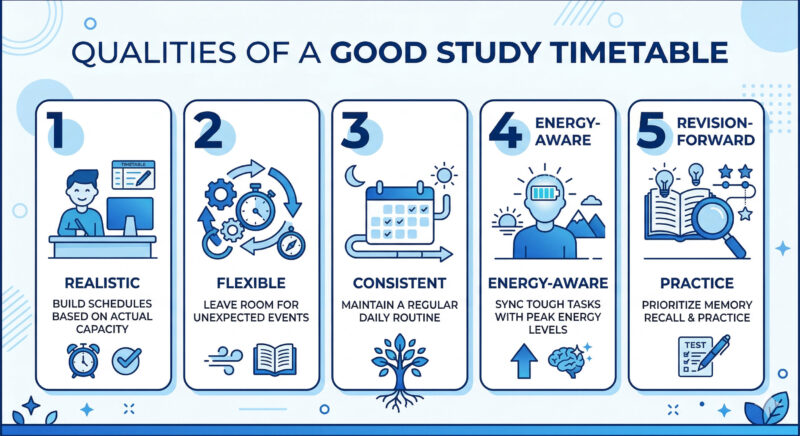
The best time table for study at home has five qualities:
- Realistic: Based on your actual free hours, not an aspirational version of yourself.
- Flexible: Has buffer time built in so one bad day doesn’t collapse the whole week.
- Consistent: Same start time every day builds a habit trigger in your brain.
- Energy-aware: Hard subjects go in your sharpest hours; lighter work goes when energy dips.
- Revision-forward: Every week includes time to revise what’s already been studied — not just push through new content.
3. How to Make Study Time Table at Home (Step-by-Step)
Here’s the exact process. Go through each step in order — don’t skip to the timetable before you’ve completed Steps 1–3 or it won’t hold.
Take a blank weekly grid and block out non-negotiable commitments first: school/college hours, travel, meals, sleep, and any fixed family responsibilities. What’s left is your actual study window — and it’s usually smaller than students think.
This is critical. Are you sharp in the morning before 9 AM, or does your brain only kick in after 7 PM? Pay attention for three days. Your peak window is when your hardest subject should sit. Don’t waste your best hours on YouTube — or on easy subjects you already know well.
List every subject you’re studying. Rate each one: Hard / Medium / Easy. Subjects you rate Hard get the most slots and the best time. Subjects you already feel comfortable with get fewer slots. This single step is what separates smart students from hard-working-but-stuck ones.
The most effective study sessions run 45–50 minutes, followed by a 10-minute break. This is loosely based on the Pomodoro Technique, but extended slightly for deeper study. Never schedule more than 90 minutes on a single subject without a significant break. Your brain needs time to consolidate information.
Add 20–30 minutes of buffer between major blocks. Life always interrupts. Also, reserve the last 15 minutes of each study day for a quick revision of the day’s work — just re-reading your notes. This doubles retention without extra effort.
Ask yourself: What slipped? What’s working? Which subject needs more time next week? Small weekly adjustments prevent a timetable from becoming stale. The best timetable is a living document, not a rigid law.
4. Best Time Table for Study at Home – Sample Schedules
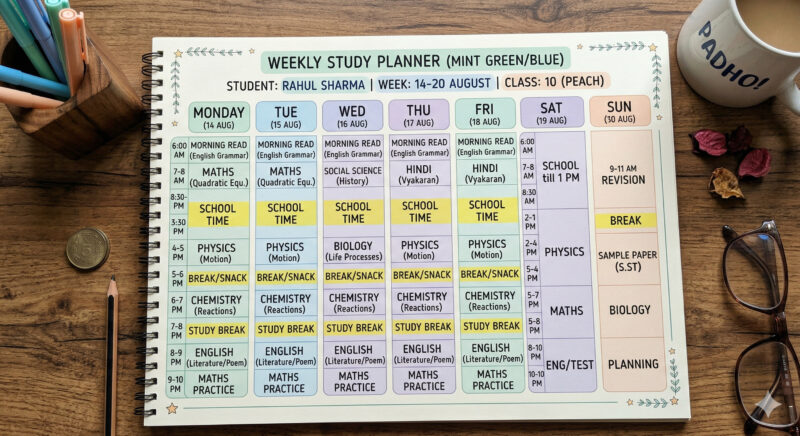
These are practical templates — not fantasy schedules. Adjust the subject names to your own syllabus.
Sample A: Daily Time Table for Study (Class 9–12 School Students)
This schedule assumes school from 8 AM–2 PM and 4–5 hours of home study.
| Time | Activity | Notes |
|---|---|---|
| 5:30 AM | Wake up, freshen up, light exercise | 10–15 min walk or stretching |
| 6:00 AM – 7:30 AM | 📚 Morning Study Block #1 | Hardest subject (Maths / Physics / Chemistry) |
| 7:30 AM – 8:00 AM | Breakfast + get ready for school | No screen time here |
| 8:00 AM – 2:00 PM | School / College | — |
| 2:00 PM – 3:30 PM | Lunch + rest / nap | 20–30 min nap is fine |
| 3:30 PM – 5:00 PM | 📚 Afternoon Study Block #2 | Medium difficulty subject (Biology / History) |
| 5:00 PM – 5:30 PM | Break — outdoor activity | Walk, play, stretch — move your body |
| 5:30 PM – 7:00 PM | 📚 Evening Study Block #3 | English / Language / Easy subjects |
| 7:00 PM – 8:00 PM | Dinner + family time | Stay away from textbooks |
| 8:00 PM – 9:00 PM | 📚 Revision Block | Review today’s notes; solve 5 practice questions |
| 9:00 PM – 9:30 PM | Wind down | No screens; light reading or music |
| 9:30 PM – 10:00 PM | Sleep prep | Aim for 7.5–8 hrs sleep |
Sample B: Daily Time Table for Study (College Students / Competitive Exam Prep)
This schedule suits students preparing for JEE, NEET, UPSC, or semester exams with more self-directed time.
| Time | Activity | Notes |
|---|---|---|
| 5:00 AM – 5:30 AM | Wake up, exercise, meditate | Consistency here sets the whole day |
| 5:30 AM – 8:00 AM | 📚 Deep Work Block #1 | Most complex subject — full concentration mode |
| 8:00 AM – 8:30 AM | Breakfast | High-protein: eggs, nuts, fruits recommended |
| 8:30 AM – 11:00 AM | 📚 Deep Work Block #2 | Second hardest subject or problem-solving |
| 11:00 AM – 11:30 AM | Break + light snack | Go outside briefly if possible |
| 11:30 AM – 1:30 PM | 📚 Study Block #3 | Theory / reading-based subjects |
| 1:30 PM – 3:00 PM | Lunch + rest | Power nap 20–30 min allowed |
| 3:00 PM – 5:00 PM | 📚 Practice Block | Mock tests, previous year papers, MCQs |
| 5:00 PM – 6:00 PM | Free time / exercise | Mandatory mental reset |
| 6:00 PM – 8:00 PM | 📚 Revision + Weak Area Focus | Revisit what you struggled with this week |
| 8:00 PM – 9:00 PM | Dinner + family/personal time | — |
| 9:00 PM – 10:00 PM | 📚 Light Reading / Planning | Review tomorrow’s plan; read theory lightly |
| 10:00 PM – 5:00 AM | Sleep (7 hours) | Non-negotiable — sleep is when memory consolidates |
According to the Sleep Foundation, memory consolidation happens primarily during sleep — especially for information studied in the 2 hours before bedtime. That evening revision block isn’t optional. It’s where most of the actual learning gets locked in.
5. How to Divide Study Time Between Subjects
One of the most common questions: “How many hours should I spend on each subject?” Here’s a simple formula that works for most students:
| Subject Category | % of Total Study Time | Example (5 hrs/day) |
|---|---|---|
| ⚠️ Hardest / Weakest Subject | 35–40% | ~2 hours |
| 📘 Medium Difficulty Subject | 25–30% | ~1.5 hours |
| ✅ Easiest / Strongest Subject | 15–20% | ~45 minutes |
| 🔄 Daily Revision | 10–15% | ~30–45 minutes |
Rotate subjects every week based on exam proximity. If Maths is your exam in 10 days, temporarily shift it to 50% of your time and compress others.
6. Expert Tips to Actually Stick to Your Timetable
Building the timetable is the easy part. Following it for 30+ consecutive days is where most students fail. Here’s what actually works:
⏰ Use a “Trigger Habit” to Start
Pair your study start with a fixed action — making a cup of chai, putting on headphones, sitting at your desk. This cue signals your brain: “study time is now.” Over days, this becomes automatic.
📵 Phone in Another Room
Not on silent. Not face-down. In another room. Studies show even a phone visible on the desk reduces cognitive capacity — even when it’s off. Physical distance is the only reliable solution.
✅ Use a Daily Checklist
At the start of each day, write 3–5 specific study tasks (not vague goals like “study Maths” — instead: “Solve Ch. 5 trigonometry exercises 1–20”). Crossing tasks off is a real dopamine hit that builds momentum.
🏆 Reward Completed Blocks
After finishing a study block, reward yourself deliberately — 15 minutes of your favourite show, a snack, a short call with a friend. Associating completion with reward reinforces the habit loop.
👥 Tell One Person Your Schedule
Social accountability is underrated. Tell a parent, sibling, or study friend your daily plan. The mild pressure of “they’ll ask me if I did it” is surprisingly effective — especially in the first 2 weeks.
📆 Never Miss Two Days in a Row
You will miss a day — that’s fine. The rule is: never miss two consecutive days. Missing once is a break. Missing twice is the beginning of quitting. One skip is allowed; the second one is a choice you make consciously.
7. Common Mistakes Students Make with Study Timetables
After reviewing dozens of student schedules, these are the patterns that keep coming up — and exactly how to fix each one.
Feeling guilty about not following a timetable perfectly is one of the top reasons students abandon it entirely. Progress over perfection. A timetable followed 70% of the time is infinitely more valuable than a perfect one that lasts 4 days.
8. Best Tools and Apps to Build Your Time Table
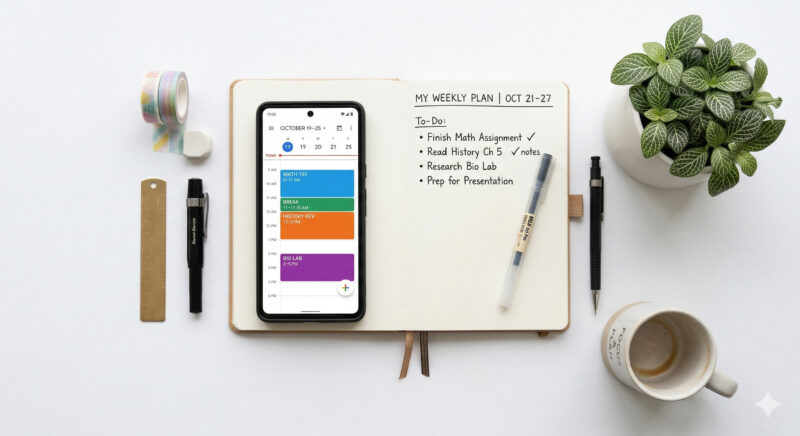
You don’t need an app to build a great timetable — a plain notebook works perfectly. But if you prefer digital tools, here are the most useful options:
- Google Calendar (Free): Create recurring study blocks with colour-coding per subject. Set reminders. Works on every device. Best for students who already live in the Google ecosystem.
- Notion (Free for students): Build a full weekly planner with subject trackers, to-do lists, and progress columns. Steep initial learning curve but incredibly powerful once set up.
- Forest App (Free / Paid): Gamified focus timer. You grow a virtual tree during study blocks and it dies if you open your phone. Remarkably effective for students who struggle with phone distraction.
- Todoist (Free): Daily task manager — great for the “specific task per block” method described in the expert tips section.
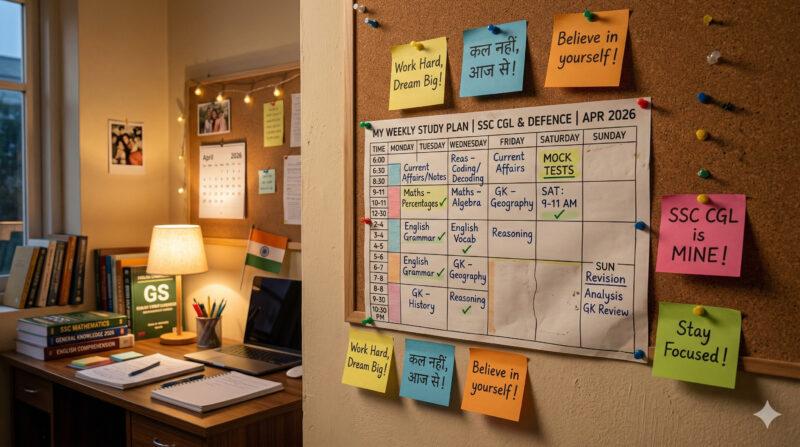
- Printable paper planner: For students who retain better when they write by hand, a printed weekly grid on your wall is often the most effective system of all.
9. Frequently Asked Questions
10. Conclusion
A time table for study at home is the simplest, highest-leverage habit a student can build. It doesn’t require any special talent, expensive coaching, or perfect willpower. It just requires you to sit down, be honest about your hours and energy, and design something that fits your actual life — not your imagined ideal self.
Start small. Block three focused hours today. Assign one hard subject, one medium subject, and a 20-minute revision session. Do that for seven days in a row. That’s your foundation.
Every topper you’ve ever envied wasn’t smarter than you. They just had a system — and they followed it long enough for it to work.
Now you have the same system. Use it.
🎯 Ready to Build Your Perfect Study Routine?
Explore more free guides on Learnox — made specifically for Indian students who want to study smarter, not harder.